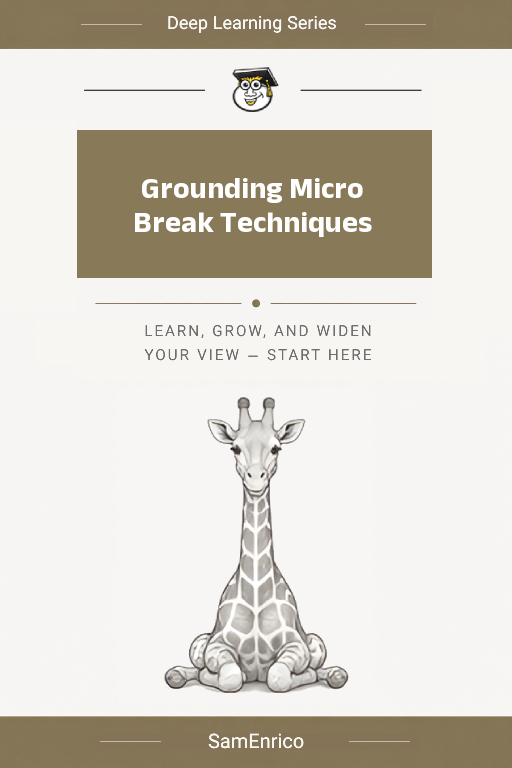
Grounding Micro Break Techniques eBook
Uses 5-4-3-2-1 sensory grounding, feet on floor, a
Uses 5-4-3-2-1 sensory grounding, feet on floor, and tactile awareness as micro-breaks that regulate the nervous system during anxiety spikes.
Formats
Free sample
Chapter 1: The 90-Second Lie--–- You have been told a lie about your own anxiety. It is a well-intentioned lie, repeated by well-meaning people, but a lie nonetheless. The lie sounds something like this: “When you feel anxious, just take a break. Step away. Give yourself time to calm down.”On the surface, this advice seems harmless.
Of course you should step away from a stressful situation. Of course you should give yourself space to breathe. But here is what the research actually shows, and what this entire book will prove to you through science, technique, and daily practice: unstructured long breaks do not resolve anxiety. They often make it worse.This chapter dismantles the myth that managing anxiety requires lengthy meditation sessions, hour-long walks, or fifteen-minute escapes to the breakroom. It opens with the neurobiology of an anxiety spike—what actually happens inside your brain and body during those terrifying seconds when calm evaporates and panic rushes in.
You will learn why the traditional “take a break” advice backfires so spectacularly, why your well-meaning friends and even some therapists have been giving you the wrong instructions, and most importantly, what actually works.By the end of this chapter, you will understand the single most important concept in this entire book: that the most effective anxiety interventions occur in under sixty seconds, use your body’s own sensory systems, and work with your biology instead of against it. This is not meditation. This is not positive thinking. This is neuroscience applied to the specific problem of nervous system dysregulation, and it will change how you understand every anxious moment you have ever experienced.The Anatomy of a Panic Spiral Let us begin with what happens inside your brain during the first few seconds of an anxiety spike. You are sitting in a meeting, or driving on a highway, or lying in bed at three in the morning.
Suddenly, without warning, your heart rate accelerates. Your palms become slick. Your breathing becomes shallow. Your mind, which moments ago was calmly processing information, now fixates on a single catastrophic thought: Something is wrong.What you are experiencing is not a character flaw. It is not weakness.
It is not a failure of willpower or a sign that you are broken. It is a neurological event, as specific and predictable as a sneeze or a hiccup, and it follows a consistent biological pathway.The amygdala—two small, almond-shaped clusters of neurons deep within your brain—serves as your body’s threat detection system. Evolution designed it to identify danger and activate your survival response before your conscious mind even registers what is happening. When you encounter a genuine threat, like a car swerving toward you or a snake on a hiking trail, the amygdala performs its job beautifully. It triggers a cascade of stress hormones, preparing your body to fight, flee, or freeze, all within milliseconds.But here is the problem.
The amygdala cannot distinguish between a real threat and a perceived threat. It cannot tell the difference between a car about to hit you and a critical email from your boss. It cannot tell the difference between a physical predator and the memory of an embarrassing mistake you made five years ago. All it knows is that it has detected something dangerous, and it must act immediately.In as little as eight to ten seconds, the amygdala can hijack your prefrontal cortex—the rational, planning, decision-making part of your brain located directly behind your forehead. This hijacking is not metaphorical.
Under anxiety, the prefrontal cortex shows reduced activity on brain scans. Your ability to reason, to plan, to think through consequences, to tell yourself “I am safe” and actually believe it—all of these functions become compromised.This is why, during a panic attack, you cannot simply “think your way out of it.” This is why being told to calm down feels insulting and impossible. The part of your brain that would normally help you calm down is currently offline, overpowered by a threat detection system that is screaming louder than any rational voice.The 90-Second Wave Here is where the science offers us extraordinary hope. Dr. Jill Bolte Taylor, a Harvard-trained neuroanatomist who survived a severe stroke and documented her recovery in the bestselling book My Stroke of Insight, identified a critical window in the brain’s stress response.
She observed that the biochemical surge triggered by the amygdala—the flood of cortisol, adrenaline, and other stress hormones—lasts approximately ninety seconds from the moment it is triggered.Ninety seconds.That is it. The chemicals themselves, the raw biological substrate of panic, dissipate in a minute and a half. If you could simply ride out that wave without adding anything to it, your body would naturally return to a state of biochemical equilibrium.But here is the catch. Most people do not simply ride the wave. They fuel it.
They add catastrophic thoughts to the biochemical surge. They think: “Something is really wrong. I can’t handle this. This is never going to end. Everyone can see how anxious I am.
I’m going to lose my job. I’m going to have a heart attack. I’m going crazy.”Each catastrophic thought tells the amygdala: “Thank you for your service. There is indeed a threat. Please release more stress hormones.” And the amygdala obliges.
It releases another surge, which triggers more catastrophic thoughts, which triggers another surge. What could have been a ninety-second biochemical event becomes a ninety-minute spiral of escalating panic.The ninety-second wave, therefore, is not a guarantee that your anxiety will end in ninety seconds. It is an opportunity. If you can stop fueling the fire with your thoughts, the fire will naturally burn itself out. The techniques in this book are designed to do exactly that: to interrupt the thought-fuel cycle and allow your nervous system to complete its natural recovery arc.Why Long Breaks Fail Now we arrive at the central contradiction of traditional anxiety advice.
When you feel anxious, well-meaning people tell you to take a break. Step away from your desk. Go for a walk. Take fifteen minutes for yourself. On paper, this sounds reasonable.
In practice, it often makes things worse, and the research explains exactly why.An unstructured long break gives your mind time to wander. When your mind wanders, where does it go? For someone prone to anxiety, it does not wander to pleasant memories or future hopes. It wanders to the threat. It replays the meeting that went badly.
It rehearses the conversation you are dreading. It imagines worst-case scenarios. Without a structured anchor for your attention, a long break becomes an extended rumination session.Workplace productivity research makes this point powerfully. Studies on micro-breaks—intentional, structured pauses of sixty seconds or less—have shown that these ultra-short resets restore cognitive function more effectively than fifteen-minute unstructured breaks. Why?
Because they interrupt the stress cycle without giving your mind enough time to wander into threat-based thinking. A sixty-second reset forces your attention onto a specific anchor: your breath, your senses, the feeling of your feet on the floor. It does not leave room for rumination.There is another problem with…
This is the end of the free sample. Get the eBook to keep going. Buy now
About this book
Details
- Author
- Snell Felicitas
- Publisher
- SamEnrico
- Language
- English
- Genre
- Non-Fiction, Mental Wealth, Grounding
- Released
- 2026-05-30
- Pages (approx.)
- 149
- Available as
- eBook, Audiobook

Read better in the ZLOADR app
Your eBooks on your phone or tablet. Sign in with your SamEnrico account and start reading.
More by Snell Felicitas
 The Fairness Fallacy GuideSnell Felicitas$11.99
 U Boat Propaganda WarSnell Felicitas$11.99
 Letting Go Of Lost OpportunitySnell Felicitas$11.99
 Doctor Workaholism RecoverySnell Felicitas$11.99
 The Moving House Dream GuideSnell Felicitas$11.99
 Whispers in the Dark: The Silent Uprising of the MaroonsSnell Felicitas$11.99
 Understanding Spondyla–spondyliSnell Felicitas$17.99
 Dairy Cooperative East AfricaSnell Felicitas$12.99
 How to Become a Drum-drier OperatorSnell Felicitas$11.99
 African Ebony HarvestingSnell Felicitas$11.99