
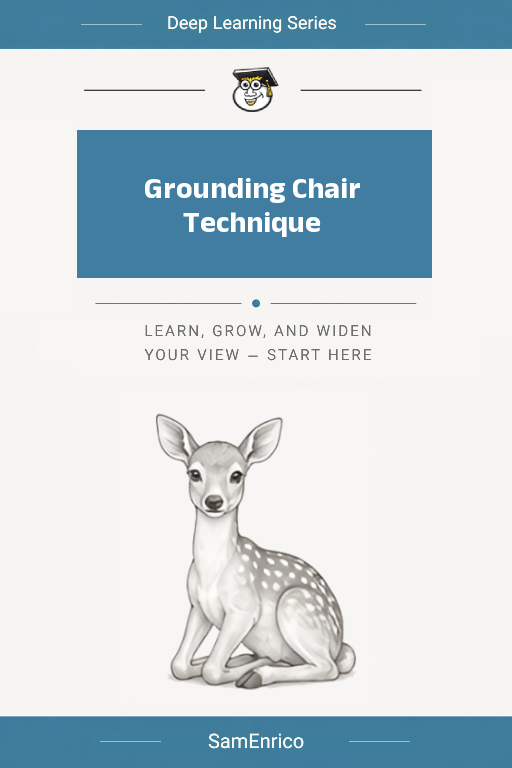
Non-FictionMental WealthGrounding
Grounding Chair Technique eBook
Feel your sit-bones to anchor presence during seat
Feel your sit-bones to anchor presence during seated presentations.
Formats
Free sample
Chapter 1: The Quarter Test--–- You are about to perform an experiment that will take exactly twelve seconds. It requires no equipment except a single United States quarter—or any coin roughly the size of a nickel—and a chair. Any chair will do. An executive high-back, a plastic waiting-room special, a dining chair, a folding metal relic from 1987, even the driver’s seat of your car. The experiment has no risk, no discomfort, and no downside.
But I need you to do it right now, before you read another sentence.Go find a quarter. Place it on the seat of your chair. Then sit down directly on top of it, positioning the coin under the fleshiest part of your right buttock. Sit normally. Do not adjust your posture.
Do not sit up straighter than usual. Do not “try” to feel anything. Just sit the way you always sit.Now answer this question: can you feel the quarter?If you can feel it—if there is a distinct, localized pressure, a small hard spot beneath you that you would like to move because it is slightly uncomfortable—then you are currently sitting on your sit-bones. The quarter is pressing directly against your ischial tuberosities, the two bony knobs at the base of your pelvis that are designed to bear your weight.If you cannot feel the quarter—if the coin has disappeared into a cushion of flesh, if you have to shift your weight or dig around to locate it, if you are unsure whether you are sitting on it at all—then you are not sitting on your sit-bones. You are sitting on your gluteal muscles, your hamstring attachments, or the soft tissue of your upper thigh.
You are hovering. And hovering, as you are about to learn, is the single greatest saboteur of confident speaking that you have never heard of.This chapter is called The Quarter Test not because it is a test you pass or fail, but because it is a test that tells you the truth. And the truth, for the vast majority of professionals who spend their days in seated meetings, Zoom calls, and boardroom presentations, is this: you have forgotten how to sit.The Posture Lie You Were Taught in Third Grade Let us rewind to something your grandmother, your first-grade teacher, or your military school drill instructor probably told you. “Sit up straight.” “Shoulders back.” “Chest out.” “Stomach in.” These commands are delivered with such frequency and authority that most of us have never questioned them. They are treated as self-evident rules of good posture, as fundamental as “look both ways before crossing the street.”They are wrong.
Not slightly imprecise. Not in need of a minor update. Completely, biomechanically, neurologically wrong for the specific task of seated public speaking.Here is what happens when you “sit up straight” in the way most people interpret that command. You lift your ribcage away from your pelvis. You retract your shoulder blades toward your spine.
You arch your lower back slightly, or you tuck your pelvis under depending on your habit. You brace your core. And then—this is the crucial part—you hover. You lift your weight off your sit-bones and transfer it forward onto your thighs or backward onto your sacrum. Your body interprets this lifted posture as a state of readiness.
Readiness for what? For action. For movement. For fight or flight.The problem is that you are not about to fight or flee. You are about to speak.
You are about to sit in a chair and communicate complex ideas to other human beings. But your ancient nervous system does not know the difference between a boardroom and a savanna. When your posture signals instability—when your sit-bones are not firmly planted—your brain activates a low-grade stress response. Your heart rate increases. Your breathing becomes shallow and high in your chest.
Your muscles tense in preparation for movement that never comes.This is the Seated Stress Response, and it is the biological explanation for why you can prepare for a presentation for three days, know your material cold, and still feel your voice tighten and your mind race the moment you open your mouth.The Anatomy of a Chair-Based Nervous System To understand why your sit-bones matter more than your shoulders, your eye contact, or your hand gestures, you need a quick tour of a part of your body that most presentation coaches ignore entirely: your pelvis.The ischial tuberosities—sit-bones, for the rest of this book—are two roundish knobs of bone at the bottom of your pelvis. They are the points where your body is designed to transfer weight to a sitting surface. When you were an infant learning to sit up, you naturally found them. When you are sleeping, your body finds them when you roll onto your side. When you are sitting on a hard surface like a park bench or a wooden dining chair, you cannot avoid feeling them.
They are your body’s built-in grounding mechanism.But modern office chairs have done something strange to the human relationship with sit-bones. They are padded. Deeply, luxuriously padded. A typical high-end office chair has between two and four inches of memory foam, gel inserts, or high-density cushioning. This padding feels wonderful.
It feels like luxury. It also feels like nothing.When you sit on a soft surface, your sit-bones sink into the cushion, and the cushion distributes your weight across a broad area of your glutes and thighs. You lose the specific, localized pressure that tells your brain where your body is in space. This is called reduced proprioceptive feedback, and it is disastrous for nervous system regulation. Your brain cannot feel where your pelvis is, so it assumes you are unstable.
Instability triggers vigilance. Vigilance triggers anxiety.Here is the paradox that will define everything else in this book: the most comfortable chair is often the worst chair for confident speaking. And the most uncomfortable chair—the hard, unpadded, slightly unforgiving chair—is often the best.The Hidden Language of Bone Meeting Surface Let us go deeper into the neurology, because understanding why this works will make you a believer long before the physical sensations become automatic.Your skin and deep fascia are filled with mechanoreceptors—specialized nerve endings that detect pressure, stretch, and vibration. The highest concentration of these mechanoreceptors in your seated body is not in your hands or your face. It is in your gluteal region and the backs of your thighs.
From an evolutionary perspective, this makes perfect sense. Your ancestors needed to know immediately when they were sitting on something unstable, sharp, or dangerous. The faster that signal reached the brain, the faster they could stand up and run.When you press your sit-bones firmly into a chair—not painfully, but consciously—you activate thousands of these mechanoreceptors. They send signals up through your spinal cord to your brainstem, specifically to a region called the nucleus tractus solitarius. This region is a major hub of your vagus nerve, the tenth cranial nerve, which is often called the “wandering nerve” because it travels from your brainstem down through your neck, chest, and abdomen…
This is the end of the free sample. Get the eBook to keep going. Buy now
About this book
Details
- Author
- Sherrill Marci
- Publisher
- SamEnrico
- Language
- English
- Genre
- Non-Fiction, Mental Wealth, Grounding
- Released
- 2026-06-05
- Pages (approx.)
- 135
- Available as
- eBook, Audiobook

Read better in the ZLOADR app
Your eBooks on your phone or tablet. Sign in with your SamEnrico account and start reading.
More by Sherrill Marci
 Plant Based Transition GuideSherrill Marci$11.99
 SAD Relapse PreventionSherrill Marci$11.99
 4 7 8 Breath PracticeSherrill Marci$11.99
 Anger De escalation with ADHDSherrill Marci$11.99
 Workplace Energy ManagementSherrill Marci$11.99
 The Test Drive GenerationSherrill Marci$11.99
 Networking for ConstructionSherrill Marci$11.99
 Collaborative PrioritizationSherrill Marci$11.99
 The Conquerors of the Clouds: The Golden Age of Alpinism (1950-1980)Sherrill Marci$11.99
 The Alpine Culinary Crown: How Swiss Innovation Transformed Global DiningSherrill Marci$11.99
 Service Providers Guide to GardenersSherrill Marci$11.99
 How to Produce Waffle Iron AccessoriesSherrill Marci$11.99
You may also like
 Hong Kong Handover 1997Dunn Johnnie$11.99
 Zumba For Postnatal Recovery CourseNeal Christian$11.99
 Zumba for BeginnersLadner Nikia$11.99
 YouTube Comment Mining GuideHumes Pandora$12.99
 Worry Box MeditationCarlin Rudy$11.99
 Workplace Stress MeditationNguyen Lynn$11.99
 Workplace Stress and Sleep RepairHawley Ivory$11.99
 Workplace Perfectionism CureDelaney Jeffry$11.99
 Workplace Injustice Anger GuideWallen Isabelle$11.99
 Work Addiction and Burnout LinkGreenwood Ester$11.99
 Women in Yoga and WellnessBeattie Galina$11.99
 Women in Stand Up ComedyChun Evangeline$11.99