
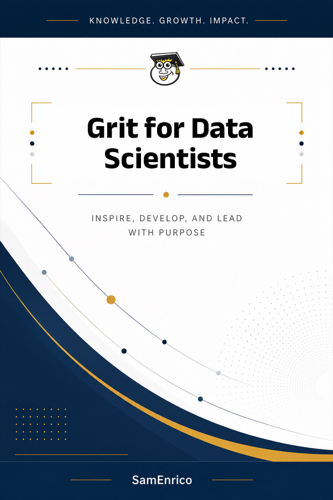
Grit for Data Scientists eBook
Perseveres through inaccurate models.
Perseveres through inaccurate models.
Formats
Free sample
Chapter 1: The Broken Model...--–- The email arrived at 4:47 PM on a Friday, which was already a bad sign. Maya stared at her screen, watching the validation loss climb like a fever chart. Three weeks of work. Fourteen feature engineering sessions. Seven late nights.
And now, as the model processed the final batch of production data, the accuracy was dropping below random chance. Not just bad. Worse than guessing.Her boss had already left for the weekend. The client was expecting results Monday morning. And somewhere in the tangled layers of her gradient-boosted trees, a silent error was turning customer data into digital noise.
Maya rested her forehead on her desk and asked herself the question that would define her career: Do I grind this out all weekend, or do I admit that something fundamental is wrong?This book is for every data scientist who has asked that question. It is for the junior analyst whose A/B test failed for the fifth time. It is for the team lead who watched a perfectly tuned model collapse in production. It is for anyone who has ever stared at a validation loss curve that refused to bend and felt the quiet, creeping certainty that they were not smart enough for this job.You are smart enough. You are just using the wrong definition of grit.The Grit Trap Angela Duckworth’s bestselling book Grit made a powerful argument: the secret to outstanding achievement is not talent but sustained passion and perseverance over long periods.
Consistency of interests, she called it. Sticking with the same goal for years. Never giving up.This is terrible advice for data scientists.Not because Duckworth is wrong about psychology. Her research, published in top journals including PNAS, shows that grit predicts retention in rigorous settings like the National Spelling Bee and West Point. Perseverance of effort matters.
But data science operates under different rules than spelling bees. In a spelling bee, the word is fixed. The rules are stable. Your job is to recall a known answer. In data science, the ground shifts beneath your feet.This chapter introduces a central tension that runs through every page of this book: the world tells you to never give up, but data science demands that you fail fast.
The same persistence that makes a champion speller will make a data scientist pour months into a model that should have been abandoned after two weeks. The same consistency of interests that leads to mastery in chess leads to catastrophic overfitting in machine learning.Let me tell you why.Concept Drift and the Moving Target In data science, we work with a phenomenon called concept drift. The statistical relationship between your input features and your target variable changes over time. Customer behavior shifts. Sensor calibration drifts.
The language people use in reviews evolves. The model you built on last year’s data is systematically wrong about this year’s data, not because your code has bugs but because reality has changed.Consider a fraud detection model trained on 2022 transaction data. In 2023, fraudsters learn new patterns. The “normal” behavior your model learned is no longer normal. If you persist with the same algorithm, the same features, the same thresholds, you are not being gritty.
You are being rigid.Traditional grit assumes a stable goal. Data science assumes a moving target.This is the grit paradox: the very quality that helps you succeed in stable environments—stubborn persistence with a single approach—will destroy you in probabilistic, high-iteration fields. What you need instead is something this book calls Strategic Stamina: the ability to persist through the process of elimination while maintaining the intellectual flexibility to abandon specific approaches instantly.You do not persist with a failing model. You persist with the search for a working one.The Three Scales of Strategic Stamina Throughout this book, we will return to a framework that resolves the apparent contradiction between “never give up” and “fail fast.” Strategic Stamina operates across three distinct time scales, each requiring different skills and emotional responses.Micro-scale failures happen in minutes to hours. A line of code throws an unexpected error.
Your pipeline crashes because of a version mismatch. A data type conversion fails silently, turning integers into strings and strings into nulls. These failures are rapid, frequent, and relatively cheap. The skill required is not deep reflection but rapid recovery. You need to diagnose, fix, and move on without emotional investment.
Chapter 5 introduces Chaos Engineering for the Mind—deliberate practice at exactly this scale.Meso-scale failures unfold over days to weeks. Your model fails to generalize to the validation set. A carefully engineered feature set proves useless. Your A/B test shows no significant difference between treatment and control. These failures are expensive enough to hurt but cheap enough to survive.
The skill required is documented learning. Each meso-scale failure should produce a one-sentence lesson that you log and review. Chapter 2 distinguishes heroic failures (which teach you which path not to take) from stupid failures (which merely waste time). Chapter 8 introduces the Failure Portfolio, where you track these lessons over your career.Macro-scale failures span months to years. A project direction was wrong from the start.
A strategic bet on a particular modeling approach failed despite months of iteration. A problem you thought was solvable turns out to be fundamentally ill-posed. These failures are devastating. The skill required is the courage to quit with pride. Chapter 6 introduces the Kill Switch—a formal protocol for abandoning macro-scale projects before they consume your career.The critical insight is that “fail fast” applies to micro and meso scales.
“Never give up” applies only to the macro-scale commitment to the problem domain itself. You should fail fast on algorithms, features, and hyperparameters. You should never give up on the search for truth.Maya’s Story: A Cautionary Tale Let us return to Maya, the data scientist with her forehead on her desk.Maya had been hired fresh out of a prestigious data science bootcamp. She was brilliant, hungry, and deeply insecure—a combination that made her vulnerable to the grit trap. When her first model failed to converge, she told herself that successful data scientists never quit.
She stayed late. She came in on weekends. She ran 47 different hyperparameter combinations, each one taking four hours to complete.By week six, she had achieved 99.2% training accuracy. She presented her results to the team with pride. The senior data scientist, a woman named Priya who had been in the field for fifteen years, asked a single question: “What’s your validation accuracy on the time-split data?”Maya had not time-split her validation.
She had randomly sampled, which meant future data was leaking into her training set. Her 99.2% accuracy was a mirage. When she reran the model with proper temporal validation, accuracy dropped to 51%—barely above random.Maya had spent six weeks on a stupid failure. Not heroic. Not educational.
Just stupid.What went wrong? Maya had confused persistence with progress. She had mistaken the micro-scale skill of hyperparameter tuning for the macro-scale commitment to solving the problem. She had fallen in love with her model rather than falling in love with the truth.The Emotional Architecture…
This is the end of the free sample. Get the eBook to keep going. Buy now
About this book
Details
- Author
- Black Colleen
- Publisher
- SamEnrico
- Language
- English
- Genre
- Non-Fiction, Self-Help, Data
- Released
- 2026-06-05
- Pages (approx.)
- 141
- Available as
- eBook, Audiobook

Read better in the ZLOADR app
Your eBooks on your phone or tablet. Sign in with your SamEnrico account and start reading.
More by Black Colleen
 London Pop Up CostsBlack Colleen$11.99
 Open Monitoring for AnxietyBlack Colleen$11.99
 Morning Journaling GuideBlack Colleen$11.99
 Deadline Pressure ManagementBlack Colleen$11.99
 Reverse Mortgage for CareBlack Colleen$11.99
 Design Thinking for Personal ProblemsBlack Colleen$11.99
 Facilitating BreakthroughsBlack Colleen$11.99
 Windigo's Hollow: The Hunger of the FrostBlack Colleen$11.99
 Eagles Over Austerlitz: Napoleon's Perfect BattleBlack Colleen$11.99
 Service Providers Guide to Executive SearchBlack Colleen$11.99
 How to Start a Ethyl Alcohol Manufacturing BusinessBlack Colleen$11.99
 How to Produce Lawn Mower BladesBlack Colleen$11.99
You may also like
 Hong Kong Handover 1997Dunn Johnnie$11.99
 Zumba For Postnatal Recovery CourseNeal Christian$11.99
 Zumba for BeginnersLadner Nikia$11.99
 YouTube Comment Mining GuideHumes Pandora$12.99
 Worry Box MeditationCarlin Rudy$11.99
 Workplace Stress MeditationNguyen Lynn$11.99
 Workplace Stress and Sleep RepairHawley Ivory$11.99
 Workplace Perfectionism CureDelaney Jeffry$11.99
 Workplace Injustice Anger GuideWallen Isabelle$11.99
 Work Addiction and Burnout LinkGreenwood Ester$11.99
 Women in Yoga and WellnessBeattie Galina$11.99
 Women in Stand Up ComedyChun Evangeline$11.99