
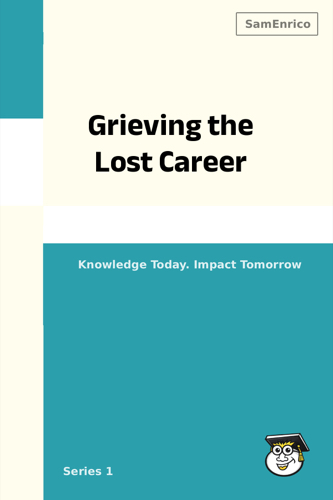
Grieving the Lost Career eBook
Process the emotional stages of job loss before di
Process the emotional stages of job loss before diving into job applications.
Formats
Free sample
Chapter 1: The Empty Desk...--–- The morning after I was laid off, I made coffee, opened my laptop, and stared at my inbox for forty-seven minutes. Nothing came. No emergency. No meeting request. No passive-aggressive email from marketing.
Just silence. And in that silence, something I hadn't expected: I missed the chaos. I missed the weight of too many tabs open, the Slack notifications I used to resent, the calendar back-to-back until 4pm. I missed my desk. Not the actual desk—a gray cubicle farm with flickering overhead lights and a chair that squeaked when I leaned back.
I missed what the desk meant: that I had a place to go, people who expected me, problems that were mine to solve. Without it, I wasn't just unemployed. I was unmoored.This is not a book about finding a new job. There are thousands of those. They will teach you how to optimize your resume, how to network your way into a hidden market, how to answer "Tell me about yourself" without bursting into tears.
Those books assume you are a rational actor who simply needs better tactics. They assume that your primary problem is a lack of information or strategy. They assume you are ready.You might not be ready.If you are reading this within days or weeks of losing your career, you are likely not ready. You are still bleeding. And the worst thing you can do is update your resume while you are still bleeding.
Yet that is exactly what conventional wisdom demands of you. "Get back out there." "Don't take it personally." "Everything happens for a reason." "This is actually an opportunity." These phrases are not helpful. They are emotional bypass surgery performed without anesthesia. They skip over the wound and pretend it isn't there.I wrote this book because no one else has written it. In the entire self-help and career-advice publishing industry, there is no book that says: Stop.
Sit down. Feel this. Your career loss is real grief, and you need to mourn before you rebuild. There are books about grief after death. There are books about career transition as a logistical problem.
There is almost nothing that sits in the uncomfortable middle, acknowledging that losing a career can hurt as much as losing a person—not because careers are more important than people, but because careers are intertwined with who we are.This chapter is an invitation to stop running. It is a permission slip to admit that you are not okay. And it is a challenge to the most harmful myth in modern work culture: that job loss is merely a problem to be solved, not a loss to be grieved.The Myth of "Just Get Another Job"Let me name the lie directly. The lie is this: losing your job is a temporary setback, and the correct response is immediate, aggressive action. The lie says that any time spent not applying is time wasted.
The lie says that grief is for funerals, not for severance agreements.This lie is perpetuated by people who mean well. Your spouse says it because they are scared about the mortgage. Your friend says it because they don't know what else to say. Linked In says it in every post about "embracing the journey." Career coaches say it because their business model depends on you believing that action is always better than inaction. Even the well-intentioned "You'll find something better" is a form of this lie, because it dismisses what you lost in favor of what you might gain.I am not saying you will never find another job.
You probably will. I am not saying you should stay in grief forever. You shouldn't. But the path to a healthy next chapter does not run through denial. It runs through the valley.
And you cannot skip the valley by running faster.The myth of "just get another job" causes real harm. When you rush to apply before you have grieved, you apply to jobs that are wrong for you. You take interviews from a place of desperation, and desperation smells. You accept offers that repeat the same patterns that made your last role unsustainable. Or worse, you don't get offers at all, and the rejection compounds your grief, convincing you that you are not just unemployed but unemployable.
The rushing does not protect you. It exposes you to more wounds.Research supports this. Psychologists who study job loss have found that individuals who allow themselves a period of emotional processing before job searching report better outcomes six months later—not just in mental health, but in salary and job fit. The runners burn out. The grievers rebuild.What You Actually Lost (It's Not Just a Paycheck)To understand why job loss hurts so much, you have to name what you lost.
Most people can only say "my job" or "my income." That's like saying losing your home is just losing a roof. It's technically true, but it misses everything.Your career gave you at least six things beyond money. Let me name each one, because you cannot mourn what you cannot name.First: identity. When someone asked "What do you do?" at a party, you had an answer. That answer wasn't just a description of your labor.
It was a shorthand for your place in the world. "I'm a teacher" says something about your values. "I'm an engineer" says something about how your mind works. "I'm a manager" says something about your relationship to authority and responsibility. Your job title became a stand-in for your self.
You might not have chosen this. You might have resented the question. But the answer was there, and now it's not. When people ask now, you stumble. You say "I'm between roles" or "I'm taking some time" or you lie and say you're consulting.
That stumble is not just awkwardness. It is the sound of a missing piece of identity.Second: purpose. Every workday gave you problems to solve. They might have been stupid problems. They might have been meaningless in the grand scheme of the universe.
But they were yours. You woke up knowing what needed to be done. That knowing is precious. Without it, days blur. You find yourself at 2pm on a Tuesday having accomplished nothing measurable, and that absence of accomplishment feels like an absence of self.Third: community.
You spent more waking hours with your coworkers than with your family. You knew whose kid was sick, who was training for a marathon, who made the good coffee in the break room. You had inside jokes. You had grudges that were so familiar they became affectionate. You had people who expected you to show up, and you expected them.
When you lose your job, you don't just lose your desk. You lose the daily texture of human contact. And those people—your work friends—do not know how to show up for you. They are still at the office. They are still in the group chat that you have been removed from.
They text you once, maybe twice, and then they stop, not because they don't care, but because they don't know what to…
This is the end of the free sample. Get the eBook to keep going. Buy now
About this book
Details
- Author
- Mclean Zenaida
- Publisher
- SamEnrico
- Language
- English
- Genre
- Non-Fiction, Self-Help
- Released
- 2026-06-09
- Pages (approx.)
- 141
- Available as
- eBook, Audiobook

Read better in the ZLOADR app
Your eBooks on your phone or tablet. Sign in with your SamEnrico account and start reading.
More by Mclean Zenaida
 Self Hypnosis for Sickle Cell PainMclean Zenaida$11.99
 Anger at Childs SchoolMclean Zenaida$11.99
 Looking Up and RightMclean Zenaida$11.99
 Crawford Slip MethodMclean Zenaida$11.99
 Self Esteem for NursesMclean Zenaida$11.99
 Small Talk for LaundromatsMclean Zenaida$11.99
 Design Thinking for GovernmentMclean Zenaida$11.99
 Rising Suns: The Asian Formula 1 Champions Who Defied the OddsMclean Zenaida$11.99
 The Last Emperor Who Walked Away: Haile Selassie’s Silent AbdicationMclean Zenaida$11.99
 A Collector's Handbook to the Steyr 8Mclean Zenaida$11.99
 How to Produce Optoelectronic DisplaysMclean Zenaida$11.99
 A Beginners Guide to Popinjay (Volume 1)Mclean Zenaida$11.99
You may also like
 Hong Kong Handover 1997Dunn Johnnie$11.99
 Zumba For Postnatal Recovery CourseNeal Christian$11.99
 Zumba for BeginnersLadner Nikia$11.99
 YouTube Comment Mining GuideHumes Pandora$12.99
 Worry Box MeditationCarlin Rudy$11.99
 Workplace Stress MeditationNguyen Lynn$11.99
 Workplace Stress and Sleep RepairHawley Ivory$11.99
 Workplace Perfectionism CureDelaney Jeffry$11.99
 Workplace Injustice Anger GuideWallen Isabelle$11.99
 Work Addiction and Burnout LinkGreenwood Ester$11.99
 Women in Yoga and WellnessBeattie Galina$11.99
 Women in Stand Up ComedyChun Evangeline$11.99