
Non-FictionInformativeEducational
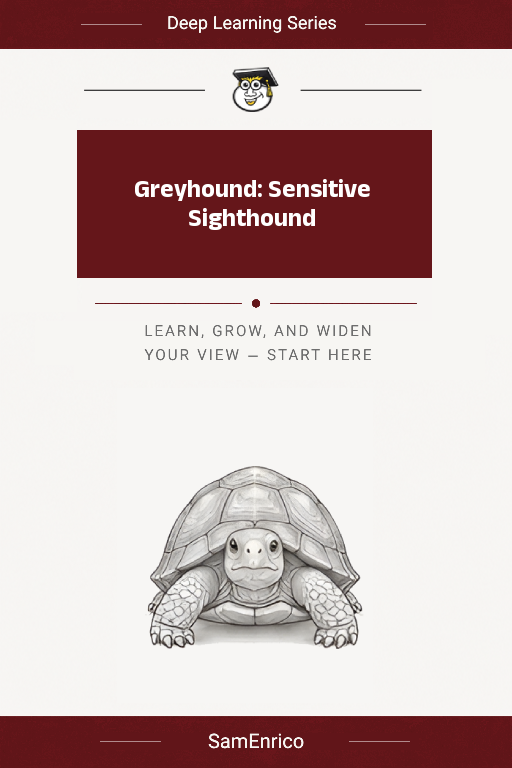
Greyhound: Sensitive Sighthound eBook
This publication, published by SamEnrico, covers G
This publication, published by SamEnrico, covers Greyhound: Sensitive Sighthound
Formats
Free sample
Chapter 1: 8,000 Years...--The first Greyhound did not bark at the moon. It did not guard a village or herd sheep or retrieve a fallen bird. It did nothing that we now recognize as "dog work" in the modern suburban sense.Instead, the first Greyhound ran.It ran across the deserts of ancient Egypt, its body stretched so flat that its belly nearly brushed the sand, its long legs eating up ground in a way that seemed to defy the laws of physics. It ran after gazelles and hares and wild asses, chasing not because it was hungry—though hunger was always present—but because the sight of a fleeing animal triggered something deep and irresistible in its brain. The chase was not a choice.
It was a compulsion, written in the same genetic code that gave the Greyhound its narrow skull and its deep chest and its astonishing, almost absurd, speed.And when the chase ended—when the prey was caught and the hunt was over—the first Greyhound did something else that seems, on the surface, to contradict everything about its nature. It curled up at the feet of a human and went to sleep.This is the paradox that has defined the Greyhound for eight thousand years. The fastest land animal on the planet, capable of reaching forty-five miles per hour in just three strides, is also one of the gentlest, laziest, most emotionally sensitive creatures you will ever meet. The Greyhound is a study in contradictions: a killer who prefers naps, an athlete who hates the rain, a hunter who startles at loud noises, a noble companion who will happily sleep on a pile of laundry.To understand the Greyhound—really understand it, not just admire it from a distance—you have to go back to the beginning. You have to trace the long, winding road from the deserts of antiquity to the couches of the modern world.
You have to see how eight thousand years of selective breeding, cultural obsession, and plain old luck produced a dog that is simultaneously the most capable and the most fragile companion you will ever love.This chapter is that journey. It is the story of how the Greyhound became the Greyhound: the lean runner, the gentle hunter, the sensitive sighthound.The Egyptian Origins: Dogs of the Pharaohs The earliest unambiguous evidence of greyhound-like dogs comes from the Nile Valley, where the ancient Egyptians left behind a rich record of their lives—and their animals—in tomb paintings, sculptures, and hieroglyphics. The oldest of these depictions date to the Old Kingdom, approximately 4600 years ago, though some scholars argue that greyhound-type dogs appear in even earlier Predynastic artifacts.The Egyptian dog was known as the Tesem, a slender, long-legged animal with a narrow head and a curved tail that curled upward at the tip. Unlike many modern breeds, which were created for specific tasks through intensive Victorian-era breeding, the Tesem appears to have been a natural type: a landrace that emerged from the unique ecological and cultural conditions of the Nile Valley.What made the Tesem special was not its appearance but its function. The ancient Egyptians hunted across vast, open terrain, chasing game that could run for miles without stopping.
They needed dogs that could keep up, that could sustain a chase across the desert without collapsing from heat exhaustion or losing focus. The Greyhound's deep chest, which houses an oversized heart and lungs, evolved to meet this need. Its light bones and aerodynamic shape minimized energy expenditure at high speeds. Its exceptional eyesight—sighthounds hunt with their eyes, not their noses—allowed it to spot prey from tremendous distances.But the Egyptians did not value the Tesem only for its hunting ability. Tomb paintings show these dogs lying under the chairs of their owners, receiving affectionate pats, and even being led on leashes through gardens.
One famous relief from the tomb of Pharaoh Tutankhamun depicts the young king hunting ostriches with a pack of greyhounds, the dogs shown in mid-stride, their bodies stretched impossibly long. Another shows a Greyhound wearing a collar of precious stones, a sign of status and affection.The Tesem was both tool and treasure. It killed so that its owner could eat. And it slept so that its owner could rest.This duality—the working animal and the beloved companion—has persisted in the Greyhound ever since. The breed was never purely utilitarian.
From its earliest days, the Greyhound occupied a special place in the human heart, a place reserved for creatures that are both useful and beautiful, both deadly and dear.The Tesem in Mythology and Religion The Egyptians did not merely live alongside their greyhounds. They worshipped them.Several Egyptian deities were depicted with canine features, though the most famous—Anubis, the god of embalming and the afterlife—had the head of a jackal, not a Greyhound. But other gods were more directly associated with the Tesem. The goddess Wepwawet, whose name means "opener of the ways," was portrayed as a white greyhound-like dog who guided the souls of the dead through the underworld. Hunters prayed to Wepwawet before setting out, asking for swift success and a safe return.The Greeks, who inherited much of their culture from Egypt, also wove the Greyhound into their mythology.
The most famous story, which we touched on briefly in the introduction to this chapter, is the tale of Laelaps, the hound that always catches its prey. According to the myth, Laelaps was given to the goddess Europa as a gift from Zeus, a creature of such supernatural speed that no animal could outrun it.The problem, as these myths often reveal, was that Laelaps was too perfect. When it was set to chase the Teumessian fox—a fox that was destined to never be caught—the universe broke. A hound that always catches. A fox that never is caught.
The paradox was so profound that Zeus, recognizing the impossibility, turned both animals into stone and placed them in the stars as constellations.The Greeks understood something about Greyhounds that modern owners still discover. They are not merely fast. They are obsessive. When a Greyhound locks onto a moving target—a rabbit, a squirrel, a plastic bag skittering across a field—the rest of the world disappears. There is only the chase.
This is not a behavior that can be trained out of them. It is woven into their neurobiology, a gift from the ancient hunters who bred them to focus entirely on the fleeing prey.The myth of Laelaps also contains a warning. The perfect hunter, left to its own devices, will chase until the world breaks. That is why Greyhounds can never be trusted off-leash in unfenced areas. That is why every adoption group will ask you about your fencing before they ask about your income.
The chase is not a choice for these dogs. It is a destiny, written in their bones.From the Nile to the North: The Greyhound Spreads The Greyhound did not remain in Egypt for long. As trade routes expanded and empires rose and fell, these swift dogs traveled outward, carried by merchants, soldiers, and kings who recognized their value. By…
This is the end of the free sample. Get the eBook to keep going. Buy now
About this book
Details
- Author
- Forney Stevie
- Publisher
- SamEnrico
- Language
- English
- Genre
- Non-Fiction, Informative, Educational
- Released
- 2026-05-06
- Pages (approx.)
- 108
- Available as
- eBook, Audiobook

Read better in the ZLOADR app
Your eBooks on your phone or tablet. Sign in with your SamEnrico account and start reading.
More by Forney Stevie
 The CPR App GuideForney Stevie$11.99
 Carpet Fiber ForensicsForney Stevie$11.99
 Dark Side Social Media GuideForney Stevie$11.99
 SRS vs Cramming StudyForney Stevie$11.99
 The Athletic Micronutrient GuideForney Stevie$11.99
 Teen Child Loss MemoirForney Stevie$11.99
 Félix Houphouët Boigny Ivory CoastForney Stevie$11.99
 Trying Again After LossForney Stevie$11.99
 The Great Leap: How a Village Built Asia's First Modern StadiumForney Stevie$11.99
 The Crown and the Codebreaker: How a Royal Hacker Changed the MonarchyForney Stevie$11.99
 How to Produce FlasksForney Stevie$11.99
 DoorDash Scrum for Logistics StartupsForney Stevie$12.99
You may also like
 Hong Kong Handover 1997Dunn Johnnie$11.99
 Zumba For Postnatal Recovery CourseNeal Christian$11.99
 Zumba for BeginnersLadner Nikia$11.99
 YouTube Comment Mining GuideHumes Pandora$12.99
 Worry Box MeditationCarlin Rudy$11.99
 Workplace Stress MeditationNguyen Lynn$11.99
 Workplace Stress and Sleep RepairHawley Ivory$11.99
 Workplace Perfectionism CureDelaney Jeffry$11.99
 Workplace Injustice Anger GuideWallen Isabelle$11.99
 Work Addiction and Burnout LinkGreenwood Ester$11.99
 Women in Yoga and WellnessBeattie Galina$11.99
 Women in Stand Up ComedyChun Evangeline$11.99