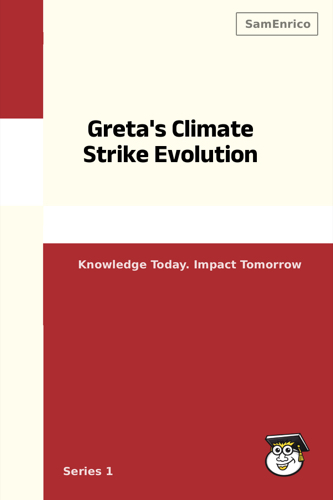
Greta's Climate Strike Evolution eBook
Traces how one strike grew into the largest climat
Traces how one strike grew into the largest climate protest in history.
Formats
Free sample
Chapter 1: The Girl Who Stopped Talking...--2010 | Stockholm, Sweden | Greta, age 7The first thing you need to understand about Greta Thunberg is that she was not born a protester. She was not born with a sign in her hand or fire in her eyes. She was born, by all accounts, a perfectly ordinary child—happy, talkative, and so relentlessly social that her parents sometimes struggled to keep up with her.She sang. She danced. She performed in school plays and theater productions, a tiny diva in training, following in the footsteps of her mother, Malena Ernman, one of Sweden's most celebrated opera singers.
She was, by every measure, a child who seemed to belong to the world—and who expected the world to belong to her right back.Then, somewhere around the age of eight, something shifted. Not dramatically at first. Not with a bang or a screaming fit or a dramatic announcement. It was quieter than that, and in some ways, more terrifying.She stopped talking.Not all at once, and not to everyone. But the girl who had once chattered endlessly about everything and nothing began to retreat into herself, syllable by syllable, word by word.
The singing stopped first. Then the laughing. Then the eating.Her parents watched, helpless, as their daughter slowly disappeared into a darkness they could not name or understand.The Silence That Spoke Volumes Selective mutism is a cruel disorder, not least because of its name. The word "selective" makes it sound like a choice—like the child is simply deciding, for reasons of her own, not to speak. But anyone who has lived through it, or loved someone who has, knows the truth: selective mutism is not a refusal to speak.
It is an inability. The words are there, fully formed, pressing against the inside of the throat. But something—anxiety, fear, an overwhelming flood of sensory information—locks the door, and the words cannot escape.For Greta, the silence began as a trickle and became a flood. By the time she was nine, she was speaking only to her immediate family: her father Svante, her mother Malena, and her younger sister Beata. Everyone else—teachers, classmates, distant relatives, strangers—existed behind an invisible wall she could not cross."We called it the 'selective mutism,'" her father later explained, the word still sounding foreign and wrong in his mouth.
"She didn't speak to anyone but me, my wife, and her little sister. Maybe for three years." -10Three years of silence. Three years of watching other children laugh and play and argue while she stood apart, her voice locked inside her like a prisoner. Three years of teachers assuming she was shy, or stubborn, or simply difficult. Three years of classmates whispering behind her back, inviting her to nothing, treating her as something less than a person because she could not perform the basic social rituals that everyone else seemed to master without thinking.The silence was not the only symptom.
As Greta retreated from the world, she also retreated from food. Her eating became ritualized, restricted, almost impossibly narrow. She would eat only small amounts of rice, avocado, and gnocchi—nothing else, nothing that felt unfamiliar or unsafe. Her weight dropped dramatically. In the span of a few months, she lost more than twenty pounds.
-7Her parents took her to doctors. They took her to therapists. They took her to specialists who nodded gravely and used words like "obsessive-compulsive disorder" and "Asperger's syndrome" and "high-functioning autism." They received diagnoses, which at least gave a name to the thing that had stolen their daughter. But a name is not a cure. A diagnosis is not a roadmap.The Thunberg household, once filled with music and laughter, became a war zone of worry.
Svante and Malena fought—not because they were angry at each other, but because they were terrified, and terror has nowhere else to go. Beata, younger and less able to understand what was happening, watched her sister fade and wondered if she was somehow to blame. Greta herself cycled between long stretches of hollow-eyed silence and explosive meltdowns that left everyone exhausted and bruised."She was slowly disappearing into some kind of darkness," Malena wrote later, the words scraped raw with grief. "She stopped playing the piano. She stopped laughing.
She stopped talking. And she stopped eating." -7The Hidden Key What no one understood at the time—not the doctors, not the therapists, not even Greta's own parents—was that the silence and the starvation were not the problem. They were symptoms. The real disease was something else entirely, something hiding in plain sight, waiting to be named.The breakthrough came not in a doctor's office but in a classroom. Greta, then eleven years old, was shown a film about climate change.
The documentary featured images that most children would forget by the next period—plastic-choked oceans, starving polar bears, melting ice caps, rising seas. For most of her classmates, the film was a momentary disturbance, a brief brush with discomfort that was quickly smoothed over by the natural resilience of childhood.For Greta, the film was a wound that would not close.She could not unsee what she had seen. The images burned themselves into her brain, replaying endlessly, a horror loop she could not turn off. She began to understand, with a clarity that felt less like knowledge and more like a physical blow, that the world was burning—and that the adults who were supposed to protect it were doing nothing."Greta can't reconcile any of this with any of what she has just seen," her mother wrote. "She saw what the rest of us did not want to see.
It was as if she could see our CO2 emissions with her naked eye." -7This is the thing about Greta Thunberg that most people misunderstand. Her activism did not emerge despite her autism. It emerged because of it. The same brain that locked her into silence, that restricted her eating, that made social interaction feel like a foreign language, also gave her the ability to see the climate crisis with a clarity that most adults spend their entire lives avoiding.She describes her Asperger's as feeling like she is "playing a video game where everyone else knows the cheat codes." While neurotypical brains are wired to filter, to prioritize, to decide what matters and what can be safely ignored, Greta's brain does not have that filter. Everything matters equally.
A melting ice cap is as real and as urgent as a hungry stomach. A promise broken by a politician carries the same weight as a promise broken by a friend.This is exhausting. It is also, in the context of a planetary emergency, a superpower."Sometimes I feel like it would be good if everyone had a bit more Asperger's, at least when it comes to the climate," Greta later said. She was not being flippant. She was making a serious point: the polite social fictions that allow adults to ignore the apocalypse are not a sign of wisdom.
They are a sign of willful blindness. And Greta, blessedly and tragically, cannot be willfully blind. -3The Family Awakening The…
This is the end of the free sample. Get the eBook to keep going. Buy now
About this book
Details
- Author
- Mccloskey Loreta
- Publisher
- SamEnrico
- Language
- English
- Genre
- Non-Fiction, Biography, Activism
- Released
- 2026-06-12
- Pages (approx.)
- 124
- Available as
- eBook, Audiobook

Read better in the ZLOADR app
Your eBooks on your phone or tablet. Sign in with your SamEnrico account and start reading.
More by Mccloskey Loreta
 Professional Conference Small Talk HandbookMccloskey Loreta$11.99
 Nobel Laureates In CRISPR EthicsMccloskey Loreta$11.99
 Socratic Questioning Food ChoicesMccloskey Loreta$11.99
 Mindful Walking for VeteransMccloskey Loreta$11.99
 Frozen Echoes: The Arctic's Ancient Whispers of HumanityMccloskey Loreta$11.99
 Frostborn: The Last Troll King of JotunheimMccloskey Loreta$11.99
 Understanding Gonadal Dysgenesis, Xx TypeMccloskey Loreta$17.99
 Premium Experience HostMccloskey Loreta$11.99
 One Page TikTok Strategy PrimerMccloskey Loreta$12.99
 Freemium Time Based GuideMccloskey Loreta$12.99
 How to Become a Cleaner IiiMccloskey Loreta$11.99