
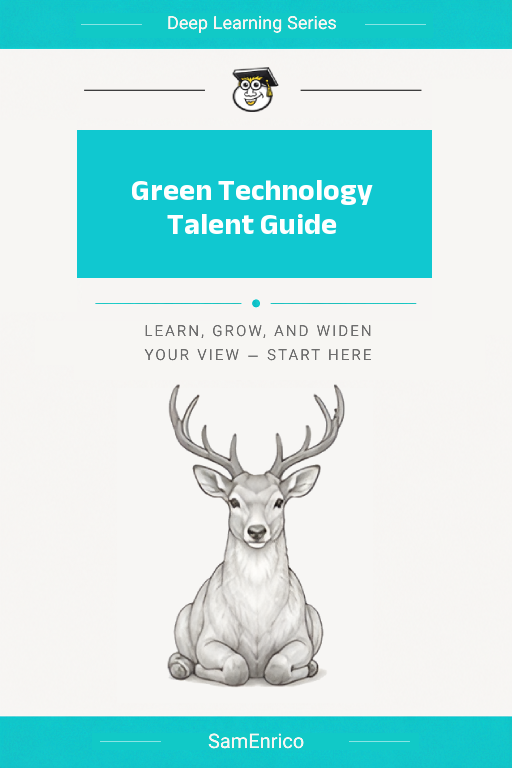
Non-FictionForecast & OutlookGreen Careers
Green Technology Talent Guide eBook
Project hiring demand for environmental engineers,
by Kendall Elly
Project hiring demand for environmental engineers, sustainability analysts, and climate scientists.
Formats
Free sample
Chapter 1: The Talent Trap--The email arrived at 11:47 PM on a Tuesday. Maria Vasquez, a climate scientist with a Ph D in atmospheric modeling and eight years of experience at a respected research institute, had been casually browsing job postings for exactly two weeks. She hadn't updated her Linked In profile in three years. She hadn't told a single colleague she was looking. And yet, by midnight, she had received three interview requests, two technical assessments, and one offer letter—all from Fortune 500 companies she had never directly applied to.The offer letter was for $187,000, plus a 20% bonus, full relocation, and a commitment that she would spend no more than 30% of her time on internal reporting.
The recruiter's note read: "Maria, your work on downscaled flood projections for the Pacific Northwest is exactly what we need. Our chief risk officer wants you on a call tomorrow. Name your start date."Maria stared at the screen. She wasn't a unicorn. She wasn't a celebrity in her field.
She had published three papers, presented at two conferences, and maintained a Git Hub repository that exactly twelve people had ever starred. By every traditional measure, she was a solid, competent, unspectacular climate scientist.And she had just received a quarter-million-dollar offer from a company that had never met her.This is the state of green technology hiring in 2026. It is not a war for talent. It is a rout. Demand is overwhelming supply.
Organizations are poaching from one another at unprecedented rates. And the fundamental problem is not that there aren't enough environmental professionals—it is that the professionals available do not look like the professionals most companies think they need.This chapter exposes the Talent Trap: the self-defeating pattern by which organizations use outdated hiring criteria that systematically exclude the very candidates best equipped to solve their green technology challenges. We will examine the data behind the talent gap, deconstruct the myth of the "perfect candidate," and lay the foundation for a new approach that will be developed throughout this book.The 7.7% vs. 4.3% Death Spiral Let us begin with two numbers that should terrify every executive with a net-zero pledge.According to the Linked In Global Green Skills Report 2026, green job postings globally are growing at an annual rate of 7.7 percent. That is nearly double the growth rate of the overall job market.
Renewable energy project managers, carbon accounting specialists, climate risk analysts, ESG data scientists, sustainable infrastructure engineers—these roles are proliferating across every sector, from oil and gas to retail banking, from agriculture to software development.Now the second number: the skilled talent pool for these roles is growing at just 4.3 percent annually. That is the combined growth rate of graduates from environmental science programs, engineering schools, and sustainability master's degrees, plus professionals transitioning from adjacent fields. It is simply not enough.At current rates, by 2030, the United States alone will face a shortfall of approximately 4.2 million green tech workers. The European Union projects a similar gap of 3.1 million. And these estimates are conservative; they assume no acceleration in the green transition, no new regulatory pressure, and no increase in corporate climate commitments.
All three are accelerating.This is not merely a recruitment challenge. It is a strategic risk. Every delayed solar farm, every inaccurate carbon report, every flood risk assessment that arrives too late traces back to one root cause: a shortage of people who can do the work. Your net-zero pledge is only as strong as the team you can assemble to execute it. And that team is already being poached by your competitors.Consider the mathematics of poaching.
When a single climate scientist leaves Organization A for Organization B, two vacancies are created: the new role at B (which may not have existed before) and the vacated role at A. If both organizations attempt to backfill, they are competing for the same limited pool of candidates. The result is a zero-sum game in which salaries inflate, time-to-hire extends, and neither organization ends up with a full team. This is the death spiral.The only escape is to expand the pool. And the only way to expand the pool is to stop looking in the same places, with the same criteria, as everyone else.The Passion Trap: Why Caring Is Not a Competency Before we can fix the hiring process, we must diagnose the most common failure mode in green technology recruitment.
I call it the Passion Trap.The Passion Trap is the well-intentioned but costly assumption that a candidate's enthusiasm for environmental issues is a reliable proxy for their ability to execute technical work. It manifests in job descriptions that list "passion for sustainability" as a requirement, in interview questions that ask "why do you care about the planet?" and in hiring decisions that prioritize mission alignment over demonstrable skills.Here is the uncomfortable truth: passion is cheap. Proficiency is hard.A candidate can care deeply about climate change and still not know how to run a Net CDF model, calculate Scope 3 emissions, or design a stormwater management system. Conversely, a candidate with strong technical skills but a more measured public commitment to environmentalism may produce better outcomes simply because they can execute.I am not arguing that mission alignment is irrelevant. Chapter 5 of this book will explore employer branding for mission-driven workers in depth, and we will see that values matter enormously for retention.
But for the initial hiring decision—the assessment of whether someone can do the job—passion is a dangerously misleading signal.The data bears this out. A 2025 study by the National Bureau of Economic Research examined 1,200 hiring decisions for environmental engineering roles across forty organizations. Candidates who were rated "highly passionate" by interviewers were offered positions at a 34 percent higher rate than candidates rated "moderately passionate." Yet when those same hires were evaluated six months later on objective performance metrics—project completion rates, technical accuracy, team contributions—the correlation between passion and performance was statistically indistinguishable from zero. The passionate candidates did not do better work. They were simply more likable in interviews.Meanwhile, candidates with demonstrable technical portfolios—Git Hub repositories, published models, open-source contributions—were hired at lower rates because they "didn't seem as committed to the mission." This is the Passion Trap in action.
We are selecting for the wrong attributes and then wondering why our teams underperform.The solution, which will be developed throughout this book, is to replace passion with proficiency as the primary screening criterion. That does not mean ignoring values. It means assessing values separately and secondarily, after technical competency has been established. Chapter 3 will provide tools for skills-based job descriptions. Chapter 6 will offer technical assessment frameworks.
And Chapter 7 will introduce the climate communication test, which evaluates the one soft skill that actually predicts success.The Myth of the Unicorn Candidate If the Passion Trap is one side of the problem, the Unicorn Hunt is the other.Every hiring manager I have interviewed for this book—and I have interviewed more than eighty—has described a version of the same fantasy: a candidate who can design green infrastructure, run complex climate models, produce ESG reports, communicate with the C-suite, manage a team, write code in Python and R, understand…
This is the end of the free sample. Get the eBook to keep going. Buy now
About this book
Details
- Author
- Kendall Elly
- Publisher
- SamEnrico
- Language
- English
- Genre
- Non-Fiction, Forecast & Outlook, Green Careers
- Released
- 2026-05-29
- Pages (approx.)
- 146
- Available as
- eBook, Audiobook

Read better in the ZLOADR app
Your eBooks on your phone or tablet. Sign in with your SamEnrico account and start reading.
More by Kendall Elly
 Resentment at Work SupervisorKendall Elly$11.99
 Spiritual Retreat Career ValueKendall Elly$11.99
 Gambling Addiction and Theft ConsequencesKendall Elly$11.99
 Ketogenic Diet Microbiome ShiftKendall Elly$11.99
 Body Language for Hotel StaffKendall Elly$11.99
 The Silent Revolution: How the 1973 Oil Crisis Froze the WorldKendall Elly$11.99
 Brand Partnerships ManagerKendall Elly$11.99
 Slow Mover Identification ManualKendall Elly$12.99
 How to Start a Strength Development Center BusinessKendall Elly$11.99
You may also like
 Hong Kong Handover 1997Dunn Johnnie$11.99
 Zumba For Postnatal Recovery CourseNeal Christian$11.99
 Zumba for BeginnersLadner Nikia$11.99
 YouTube Comment Mining GuideHumes Pandora$12.99
 Worry Box MeditationCarlin Rudy$11.99
 Workplace Stress MeditationNguyen Lynn$11.99
 Workplace Stress and Sleep RepairHawley Ivory$11.99
 Workplace Perfectionism CureDelaney Jeffry$11.99
 Workplace Injustice Anger GuideWallen Isabelle$11.99
 Work Addiction and Burnout LinkGreenwood Ester$11.99
 Women in Yoga and WellnessBeattie Galina$11.99
 Women in Stand Up ComedyChun Evangeline$11.99