
Non-FictionForecast & OutlookSustainable Logistics
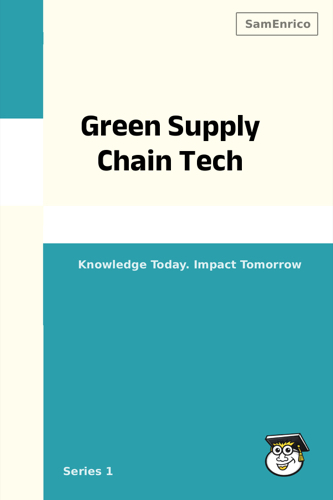
Green Supply Chain Tech eBook
Deploy carbon tracking and route optimization for
by Knott Davida
Deploy carbon tracking and route optimization for emissions reduction with this guide.
Formats
Free sample
Chapter 1: The Profit Paradox--–- The CFO of a $12 billion logistics firm once told me, “I’ll green the fleet when it saves me money, not a day sooner.” That was 2022. Eighteen months later, the same CFO presented a board-approved $47 million investment in route optimization software, electric delivery vans, and real-time carbon tracking. What changed? Not his values. The math did.This chapter begins where most books on green supply chains get it wrong: they assume altruism.
They open with melting ice caps and dying coral reefs, hoping to shame logistics managers into action. That approach fails because supply chain decisions are made by procurement officers, logistics directors, and CFOs who are measured on cost per mile, on-time delivery, and inventory turns—not on planetary health. If a sustainability initiative raises operating costs by even 2%, it dies in the quarterly review.But something fundamental has shifted in the last 36 months. Carbon emissions have become a direct profit lever. The same route optimization that reduces fuel consumption by 8-15% also reduces carbon by exactly the same percentage.
The same load consolidation that eliminates empty backhauls cuts both CO₂ and cost-per-pallet. The same telematics that identify idling trucks save diesel and emissions simultaneously. There is no trade-off anymore. The greenest route is now the cheapest route.This is the Profit Paradox of green supply chain technology: the actions that most aggressively reduce emissions also most aggressively reduce operating costs. And the companies that have figured this out are not quietly hugging trees—they are quietly destroying their less-efficient competitors on price.The Walmart Lesson: 6 Million Tons Without a Single Carbon Offset In 2017, Walmart announced Project Gigaton, a seemingly impossible goal: remove one gigaton (one billion metric tons) of emissions from its supply chain by 2030.
The skeptical response from Wall Street was predictable: “This is a PR stunt. They’ll just buy cheap offsets from a forestry project in Guatemala and claim victory.”That is not what happened.By 2024, Walmart had already removed over 600 million metric tons—not primarily through offsets, but through a relentless, technology-driven attack on operational inefficiency. The centerpiece was a proprietary routing and load consolidation platform called the “Walmart Logistics Optimization System.” It did not measure carbon as a separate metric. It measured cost per mile, fuel burn per delivery, and empty miles. The carbon reduction was the byproduct.Here is what the system actually did, stripped of sustainability jargon:First, it analyzed every delivery route from every distribution center to every store, factoring in left turns (which increase idling time), right turns (which are more efficient in right-hand traffic countries), time of day, traffic patterns, and even the gradient of hills.
The algorithm recalculated routes not for shortest distance but for lowest fuel consumption.Second, it created a live load-matching marketplace. Instead of sending a truck back to the distribution center empty after a delivery, the system found nearby suppliers who needed freight moved in that direction. The truck got paid twice for the same trip. Emissions per revenue mile dropped by over 30%.Third, it integrated telematics from 10,000+ trucks, flagging every instance of excessive idling, under-inflated tires, and aggressive acceleration—all of which burn extra fuel. Drivers received real-time coaching through in-cab tablets.
The result was a 6 million metric ton reduction in the first four years. Not from offsets. From efficiency.The Profit Paradox in action: Walmart’s operating costs per delivery dropped. Their on-time performance improved (because the algorithm avoided traffic). And their carbon footprint shrank.
There was no moment where someone had to “sacrifice” profit for planet.Why Traditional “Green” Initiatives Fail Before we go further, we must confront an uncomfortable truth: most corporate sustainability programs fail to reduce logistics emissions. Not because the intention is absent, but because the approach is backwards. They start with carbon targets and then look for ways to hit them, rather than starting with operational inefficiencies and watching carbon fall as a byproduct.Consider the three most common failed approaches:The Offset Trap. A mid-sized retailer calculates its fleet emits 50,000 tons of CO₂ annually. Instead of changing how trucks are routed or loaded, it spends $500,000 on certified carbon offsets—planting trees, capturing landfill methane, whatever.
The emissions ledger says “net zero.” But the trucks still burn the same diesel, still run empty half the time, still idle at loading docks for 45 minutes per stop. The company has paid for the sin, not solved the problem. Worse, it has spent capital that could have funded actual technology improvements. Offsets have their place for residual emissions that truly cannot be eliminated, but they are a last resort, not a strategy.The Piecemeal Pilot. A logistics director installs telematics on 20 trucks in one depot.
The data shows high idling. A memo is sent: “Drivers, please idle less.” No one changes behavior because no one has an incentive to change. The pilot produces a report, not a transformation. The technology is abandoned as “not delivering ROI.” The real failure was treating technology as a magic wand rather than a management system.The Green Vehicle Fallacy. A company replaces 10% of its diesel delivery vans with expensive electric vehicles (EVs).
It issues a press release: “Fleet now 10% electric.” But the EVs are routed exactly the same way as the diesels—long distances, high speeds, inconsistent charging. The EVs spend half their day at charging stations, missing delivery windows. Drivers hate them. The company concludes EVs “aren’t ready.” The real problem was that the routing algorithm was not redesigned for EV constraints. The technology is blamed for a process failure.These failures share a common root: they prioritize the appearance of green over the reality of efficiency.
The companies that succeed do the opposite. They obsess over cost per mile, asset utilization, and route productivity—and carbon reporting becomes a simple conversion factor, not a separate initiative.The GHG Protocol: Your Carbon Map To understand why route optimization and carbon tracking are now inseparable, you need a basic map of the territory. The global standard for corporate carbon accounting is the GHG Protocol, developed by the World Resources Institute and the World Business Council for Sustainable Development. It divides emissions into three buckets, and supply chain technology touches all of them.Scope 1: Direct Emissions. These come from sources your company owns or controls directly.
For logistics, that means the diesel burned in your trucks, the natural gas heating your warehouses, the gasoline in your company cars. If you operate the fleet, it is Scope 1. This is where route optimization yields the most immediate, measurable returns.Scope 2: Indirect Emissions from Energy. These come from the electricity you purchase to run your warehouses, offices, and EV charging stations. If your local utility burns coal, your Scope 2 emissions are high.
If the utility uses wind and solar, they are low. You cannot optimize Scope 2 through routing, but you can through warehouse energy management (smart lighting, automated HVAC) and by locating EV charging where grid carbon intensity is lowest.Scope 3: Other Indirect Emissions. This is the monster. Scope 3 includes everything else in your value chain: the emissions from suppliers’ factories, from the trucks your carriers operate (if you do not own the trucks), from the rail and air…
This is the end of the free sample. Get the eBook to keep going. Buy now
About this book
Details
- Author
- Knott Davida
- Publisher
- SamEnrico
- Language
- English
- Genre
- Non-Fiction, Forecast & Outlook, Sustainable Logistics
- Released
- 2026-06-06
- Pages (approx.)
- 153
- Available as
- eBook, Audiobook

Read better in the ZLOADR app
Your eBooks on your phone or tablet. Sign in with your SamEnrico account and start reading.
More by Knott Davida
 CrossFit Weightlifting PrimerKnott Davida$11.99
 Anki For LSAT LogicKnott Davida$11.99
 The Sobriety Relapse PreventionKnott Davida$11.99
 Resource Utilization for EngineersKnott Davida$11.99
 Professional Attire ConfidenceKnott Davida$11.99
 The Mathematicians of Meroë: The Golden Calculations of the Kushite ScholarsKnott Davida$11.99
 Mindfulness for LonelinessKnott Davida$11.99
 Interruption Management for NursesKnott Davida$11.99
 The Magic Lantern’s First Spark: How the Lumières Brought Animation to Life (1790s)Knott Davida$11.99
 The Essential Guide to Praise & WorshipKnott Davida$11.99
 Corporate Event Risk ManagementKnott Davida$12.99
 UK Business Credit for Sole Traders BlueprintKnott Davida$12.99
You may also like
 Hong Kong Handover 1997Dunn Johnnie$11.99
 Zumba For Postnatal Recovery CourseNeal Christian$11.99
 Zumba for BeginnersLadner Nikia$11.99
 YouTube Comment Mining GuideHumes Pandora$12.99
 Worry Box MeditationCarlin Rudy$11.99
 Workplace Stress MeditationNguyen Lynn$11.99
 Workplace Stress and Sleep RepairHawley Ivory$11.99
 Workplace Perfectionism CureDelaney Jeffry$11.99
 Workplace Injustice Anger GuideWallen Isabelle$11.99
 Work Addiction and Burnout LinkGreenwood Ester$11.99
 Women in Yoga and WellnessBeattie Galina$11.99
 Women in Stand Up ComedyChun Evangeline$11.99