
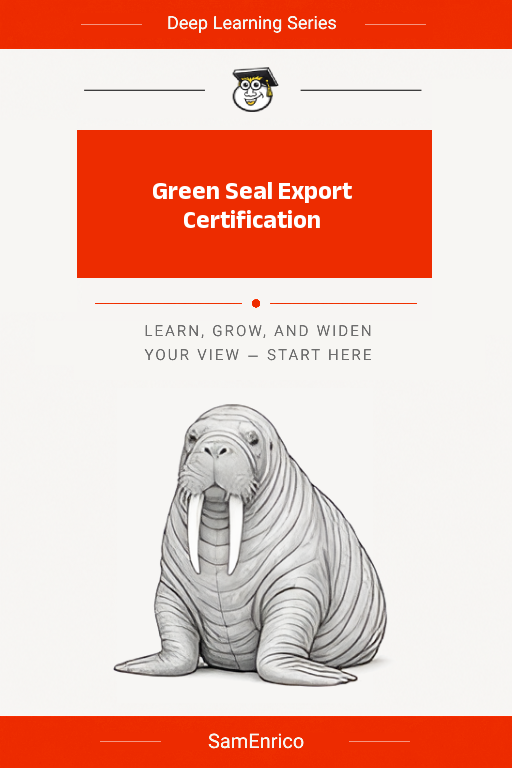
Green Seal Export Certification eBook
Certify cleaning and paper products under Green Se
Certify cleaning and paper products under Green Seal, meeting US federal procurement standards and LEED building certification requirements.
Formats
Free sample
Chapter 1: The Compliance Cliff--–- In 2026, a mid-sized German manufacturer of industrial cleaning concentrates lost a $47 million GSA contract not because their product failed to clean, nor because their price was too high, but because a single chemical they had never heard of—a fluorinated surfactant used in 0.003% concentration as a foam suppressant—was discovered during a routine document review. That chemical belonged to a family of over 12,000 substances called PFAS. The manufacturer had no idea it was even in their supply chain. Their competitor, who had secured Green Seal certification eighteen months earlier, walked away with the contract. This story is not an anomaly.
It is the new normal.Welcome to the compliance cliff. For the past two decades, ecolabels like Green Seal were viewed by most manufacturers outside the United States as optional marketing accents—nice to have on a product data sheet, useful for a press release, but hardly essential for market access. You could sell cleaning products into the US federal market without Green Seal. You could specify paper towels for a LEED-certified building without Green Seal. You could win bids, build relationships, and grow your export business while treating certification as a decorative afterthought.
Those days ended on September 15, 2023, when the Biden-Harris administration released its final PFAS reduction plan, explicitly naming Green Seal-certified products as the benchmark for federal procurement. They ended again on March 1, 2025, when LEED v5 went live, doubling the point value for Green Seal-certified cleaning products from one point to two points—a shift that moved sustainable cleaning from a "nice bonus" to a non-negotiable component of any serious LEED submission. And they ended definitively on January 1, 2026, when the General Services Administration (GSA) updated its Schedule 75 (office supplies and cleaning products) to require third-party certification for any product claiming PFAS-free status—with Green Seal listed as the primary acceptable certifier.This book is written for the manufacturers, export managers, and regulatory affairs professionals who woke up on that January morning and realized that their existing product portfolio, which had been selling successfully into the US market for years, was now functionally non-compliant. It is written for the German chemical company that lost $47 million. It is written for the South Korean paper manufacturer whose tissue products were removed from three federal bid lists because they could not prove chain-of-custody for recycled content.
And it is written for the Canadian distributor who suddenly found that their customers—hospital systems, university campuses, commercial office towers pursuing LEED certification—were demanding Green Seal documentation that no one in their supply chain had ever produced.The gap between where your products are now and where they need to be to access the US federal and LEED markets is bridgeable. But it requires a systematic understanding of three interconnected domains: the chemistry of Green Seal standards, the documentation requirements of federal procurement, and the point-chasing logic of LEED v5. Most manufacturers fail not because their products are chemically unsuitable, but because they misunderstand how these three domains intersect. They treat Green Seal certification as a chemistry problem when it is equally a supply chain problem. They treat federal procurement as a paperwork problem when it is equally a marketing problem.
They treat LEED as a building problem when it is equally a product problem.This chapter establishes the foundation for everything that follows. We will examine the three market drivers that have transformed Green Seal from a voluntary ecolabel into a mandatory compliance passport. We will quantify the financial stakes for manufacturers—what a missed contract costs, what a delayed certification costs, and what the ROI of early certification looks like in hard numbers. We will dissect the "carrot and stick" dynamics that now govern the US sustainable procurement landscape, with particular attention to how the federal government and the private green building sector have converged on Green Seal as the common denominator. And we will introduce the core thesis that animates this entire book: Green Seal certification is no longer about virtue signaling; it is about market access, period.The Landscape Before the Cliff To understand how drastically the rules have changed, you need to understand how they operated before 2023.
For most of Green Seal's thirty-year history, certification was a boutique pursuit. The organization was founded in 1989—the same year the Exxon Valdez spilled eleven million gallons of crude oil into Prince William Sound, galvanizing public demand for environmental standards. Green Seal's first standard, GS-1 for printing and writing paper, was published in 1992. GS-37 for industrial and institutional cleaners followed in 1998. For nearly two decades, these standards were adopted primarily by mission-driven companies and early movers who saw environmental certification as a brand differentiator rather than a competitive necessity.The federal government began encouraging ecolabels in the late 1990s, but the language was consistently permissive rather than mandatory.
The Federal Acquisition Regulation (FAR) was updated to include Environmentally Preferable Purchasing (EPP) provisions, but agencies were instructed to consider environmental attributes "to the maximum extent practicable"—a phrase that procurement officers interpreted broadly and, often, ignored entirely. If a non-certified product was cheaper or more familiar, it won the bid. Green Seal certification gave you a talking point in your bid narrative; it rarely decided the outcome.LEED followed a similar pattern. The US Green Building Council (USGBC) launched LEED v1.0 in 1998, and from the beginning, cleaning products were included in the Materials & Resources category. But the requirements were weak.
Early versions of LEED simply awarded a point for having a "green cleaning policy" in place—no verification required, no specific standard cited. LEED v4 (2013) tightened this by requiring that cleaning products meet either Green Seal or Eco Logo (now UL Ecologo) standards, but even then, the point was relatively easy to achieve. Building owners could use certified products for just a few high-visibility categories—glass cleaner, bathroom spray—and claim compliance while using conventional products everywhere else.The result was a stable equilibrium: Green Seal certification was beneficial but not essential. Manufacturers could treat it as a strategic investment for certain market segments—school districts, healthcare systems, progressive corporate campuses—while ignoring it for others. The cost of certification (typically 5,000to5,000 to 5,000to15,000 per standard plus annual fees) was high enough to discourage casual adoption but low enough that committed players could justify it as a marketing expense.That equilibrium shattered in 2023.
The shattering was caused by three forces that converged simultaneously: a regulatory mandate from the executive branch, a technical update from the green building industry, and a legal shift in how PFAS are regulated under federal law. Each force alone would have been significant. Together, they created a compliance cliff.Force One: The PFAS Mandate Per- and polyfluoroalkyl substances—PFAS—are a class of synthetic chemicals characterized by carbon-fluorine bonds, among the strongest in organic chemistry. That strength is precisely the problem. PFAS do not break down in the environment.
They bioaccumulate in human tissue. They have been linked to cancer, thyroid disease, ulcerative colitis, and developmental toxicity. And they are everywhere: in non-stick cookware, waterproof clothing, food packaging, and, crucially, cleaning products.PFAS appear in cleaning formulations for several reasons. Fluorinated surfactants lower surface tension, making water spread more evenly and dry more quickly. They…
This is the end of the free sample. Get the eBook to keep going. Buy now
About this book
Details
- Author
- Sessions Tiffanie
- Publisher
- SamEnrico
- Language
- English
- Genre
- Non-Fiction, Business Brief
- Released
- 2026-05-30
- Pages (approx.)
- 153
- Available as
- eBook, Audiobook

Read better in the ZLOADR app
Your eBooks on your phone or tablet. Sign in with your SamEnrico account and start reading.
More by Sessions Tiffanie
 Law Firm Precedent Transaction GuideSessions Tiffanie$11.99
 Byron Nelson Mr GolfSessions Tiffanie$11.99
 Business Creativity Without Art SkillsSessions Tiffanie$11.99
 Hypertensive Crisis GuideSessions Tiffanie$11.99
 Canada Startup Visa RouteSessions Tiffanie$11.99
 Alcohol and Diabetes GuideSessions Tiffanie$11.99
 Weapon Focus Effect on MemorySessions Tiffanie$11.99
 Postpartum Master GuideSessions Tiffanie$11.99
 Orpheus Unbroken: The Lyre That Moved the GodsSessions Tiffanie$11.99
 The Golden Theorem: Proclus and the Byzantine Legacy of MathematicsSessions Tiffanie$11.99
 A Collector's Handbook to the Ford Zephyr I EottaSessions Tiffanie$11.99
 Warner Bros Remote InternshipSessions Tiffanie$12.99
You may also like
 Hong Kong Handover 1997Dunn Johnnie$11.99
 Zumba For Postnatal Recovery CourseNeal Christian$11.99
 Zumba for BeginnersLadner Nikia$11.99
 YouTube Comment Mining GuideHumes Pandora$12.99
 Worry Box MeditationCarlin Rudy$11.99
 Workplace Stress MeditationNguyen Lynn$11.99
 Workplace Stress and Sleep RepairHawley Ivory$11.99
 Workplace Perfectionism CureDelaney Jeffry$11.99
 Workplace Injustice Anger GuideWallen Isabelle$11.99
 Work Addiction and Burnout LinkGreenwood Ester$11.99
 Women in Yoga and WellnessBeattie Galina$11.99
 Women in Stand Up ComedyChun Evangeline$11.99