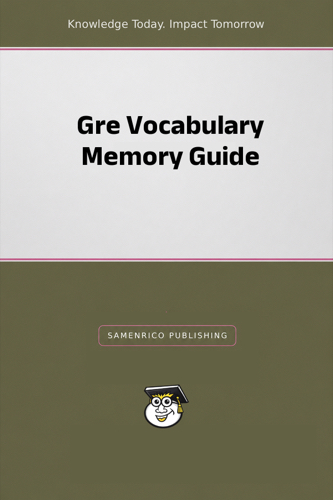
Gre Vocabulary Memory Guide
Uses keyword method and loci for high-scoring word
by Shinn Gay
Uses keyword method and loci for high-scoring word retention.
Formats
About this book
Free sample
Chapter 1: The Forgetting Curve--–- You have already forgotten something today. Not your keys or your phone—those are trivial. You have forgotten a word you studied with genuine intent, perhaps as recently as yesterday. You saw it, repeated it, maybe even wrote it down. And now it is gone, as if your brain deliberately deleted it.
This is not a personal failing. It is not a sign of low intelligence or poor work ethic. It is, in fact, the predictable, measurable, and utterly normal behavior of the human memory system when confronted with the wrong kind of input.The word that haunts most GRE students is abrogate. It appears on nearly every high-frequency word list. It is a fine word meaning to repeal, cancel, or do away with something formally—a law, a treaty, a contract.
You have probably encountered it. You might have studied it for twenty minutes yesterday. And if I asked you right now to define abrogate, a significant portion of you would hesitate. Some of you would confuse it with abdicate (to renounce a throne) or abjure (to renounce under oath) or abnegate (to deny oneself). Others would feel the shape of the word on your tongue—ab-ro-gate—without any meaning attached.
A few would recall something about cancellation but could not say whether it applies to laws, promises, or feelings.This is not your fault.The Fault Is in the Method For decades, GRE vocabulary preparation has followed a single, deeply flawed assumption: that repetition alone, applied to flat lists of words, will eventually force those words into long-term memory. This assumption is wrong. It is wrong because it ignores everything cognitive psychology has discovered about how the brain actually encodes, stores, and retrieves verbal information.Let me be precise about what flat lists do to your brain. When you study a list like this—abrogate – to repealabscond – to leave secretlyabjure – to renounceabnegate – to deny oneself—your brain faces a problem called proactive interference. Each word looks and sounds similar to the others.
They share the same Latin prefix *ab-* (away from). They are roughly the same length. They belong to the same…
This is the end of the free sample. Get the eBook to keep going. Buy now
Contents
- Chapter 1
- Chapter 2
- Chapter 3
- Chapter 4
- Chapter 5
- Chapter 6
- Chapter 7
- Chapter 8
- Chapter 9
- Chapter 10
- Chapter 11
- Chapter 12
Details
- Author
- Shinn Gay
- Publisher
- SamEnrico
- Language
- English
- Genre
- Non-Fiction, Self-Help, GRE Prep
- Released
- 2026-06-05
- Pages (approx.)
- 125
- Available as
- eBook, Audiobook

Read better in the ZLOADR app
Your eBooks on your phone or tablet. Sign in with your SamEnrico account and start reading.
More by Shinn Gay
 Creative Mind Sleep AidShinn Gay$11.99
 Separate Bedrooms Stress GuideShinn Gay$11.99
 Racing Thoughts Taming GuideShinn Gay$11.99
 Short Chain Fatty Acid InterpretationShinn Gay$11.99
 Croatia Remote Tax GuideShinn Gay$11.99
 Restful Awareness ExplainedShinn Gay$11.99
 Neuropathic Pain TipsShinn Gay$11.99
 Bipolar Medication Tracker AppShinn Gay$11.99
 The Phoenix of the Ice: How Figure Skater Michelle Kwan Rose from Heartbreak to LegendShinn Gay$11.99
 The Whispering Lanterns of Obon: Japan's Ghostly Lantern FestivalShinn Gay$11.99
 The Last Waltz: How a Single Performance Saved a Dying ArtShinn Gay$11.99
 Growing Eryngium (Eryngo, Sea Holly)Shinn Gay$11.99