
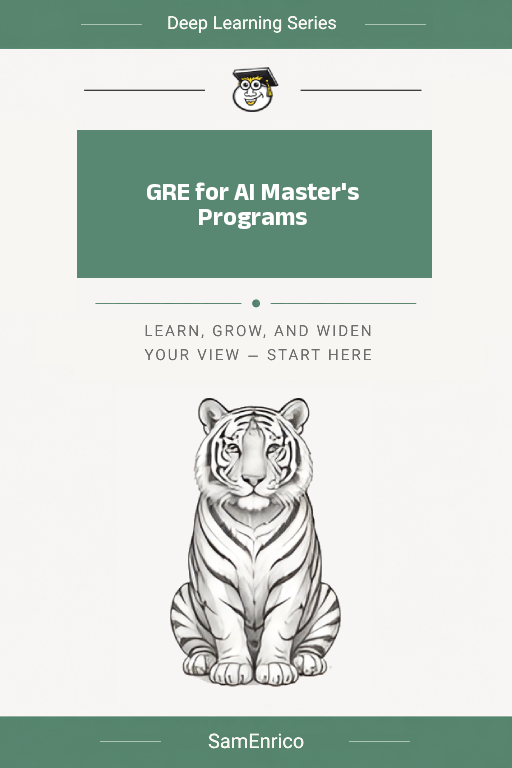
Non-FictionStudent's ShortcutGRE Prep
GRE for AI Master's Programs eBook
Determines which AI master's require GRE, competit
by Neil Danilo
Determines which AI master's require GRE, competitive scores, and test preparation strategies for top programs.
Formats
Free sample
Chapter 1: The Three Categories--–- The email arrived on a Tuesday afternoon, three weeks before the application deadline. "We have reviewed your file," it read, "and your application is incomplete. Please submit your GRE scores by December 15th."I stared at the screen in disbelief. Every website I had checked said the program was test-optional. Every forum post from the previous year confirmed it.
I had built my entire application strategy around not taking the GRE. And now, with three weeks left, I was being told I needed scores I did not have.That night, I dug deeper. Buried on the program's admissions page, under a subheading labeled "International Applicants," was a single sentence I had missed: "Applicants whose undergraduate degree is from a non-US institution must submit GRE scores regardless of other qualifications." The test-optional policy applied only to domestic applicants. I was neither.I took the GRE twelve days later, scored decently but not exceptionally, and was rejected. The rejection letter was polite.
The real rejection had happened the moment I failed to understand the category I fell into.That experience taught me the first rule of GRE strategy for AI master's programs: before you study a single practice question, before you register for the test, before you spend a dollar on prep materials, you must understand what category of applicant you are. Because the answer to "Do I need the GRE?" is never a simple yes or no. It depends on three variables that most applicants never consider.The Three Categories of GRE Requirements After analyzing the admissions policies of the top fifty AI master's programs in the United States, a clear pattern emerges. GRE requirements fall into three distinct categories. Understanding which category applies to you is the single most important step you will take in this process.Category One: Required with Waivers Available This is the most common category.
Programs in this category require the GRE for everyone by default, but they offer waivers under specific circumstances. The waiver conditions vary by program, but they generally fall into four buckets.The first bucket is GPA-based waivers. Oakland University, for example, waives the GRE requirement for applicants with a cumulative undergraduate GPA of 3.0 or higher from a US regionally accredited institution. The University of South Florida sets the bar higher, requiring a 3.5 GPA for a waiver. If you have a strong GPA from a recognized institution, you may never need to take the GRE.The second bucket is degree-based waivers.
If you already hold a master's degree or Ph D from an accredited institution, many programs will waive the GRE requirement. The logic is simple: you have already demonstrated graduate-level academic ability. Another standardized test adds little value.The third bucket is work experience-based waivers. Oakland University waives the GRE for applicants with at least two years of engineering work experience in the United States. Other programs have similar provisions for applicants with significant industry experience.
If you have been working in tech for several years, your professional track record may speak louder than any test score.The fourth bucket is accreditation-based waivers. Some programs waive the GRE for applicants whose undergraduate programs hold specific accreditations. ABET accreditation for engineering programs is the most common example.The key insight for Category One is that the GRE is not an absolute requirement. It is a default requirement that can be overcome with alternative evidence of your qualifications. If you fall into any of the waiver buckets, request the waiver before you register for the test.Category Two: Required for International Applicants Only This category creates a two-tier system that catches many applicants by surprise, as it caught me.
Domestic applicants from accredited US programs may be exempt from the GRE, while international applicants must submit scores.San Jose State University exemplifies this category. The university explicitly requires GRE scores for applicants whose undergraduate program is not ABET-accredited. Since most international programs lack ABET accreditation, this effectively means GRE required for international applicants. The minimum scores are 305 combined Verbal and Quantitative, with an Analytical Writing score of 3.0 or higher.This two-tier system is particularly common at public universities, where state funding priorities and accountability measures favor domestic applicants. The logic is partly practical and partly political.
Practically, admissions committees are more familiar with the grading standards of US institutions. Politically, public universities face pressure to demonstrate that they are serving in-state and domestic students.If you are an international applicant, you must assume that Category Two applies to you unless you have verified otherwise. Do not assume that a program's website applies equally to domestic and international applicants. Read the fine print. Look for sections labeled "International Applicants" or "Additional Requirements." These sections often contain the GRE requirement that is hidden elsewhere.Category Three: Optional or Not Considered A growing number of top programs have made the GRE optional or have eliminated it entirely.
This category includes some of the most prestigious names in AI education.Stanford University's MS in Computer Science, which includes the AI track, does not require the GRE. The university's admissions website states clearly that GRE scores are optional. However, there is an important nuance: the university also notes that strong scores "can't hurt." Submitting a high Quant score can still benefit your application, even though it is not required. The same applies to the University of California-Berkeley and several other top programs.MIT presents a cautionary tale about the shifting landscape. The university made the GRE optional during the pandemic, as many programs did.
But for the 2025 application cycle, MIT restored GRE requirements. A program that is test-optional this year may require scores next year. You cannot rely on last year's information.The lesson is clear: for Category Three programs, you have a strategic choice. You can choose not to take the GRE at all, saving time and money. Or you can take the GRE and submit strong scores to strengthen an otherwise borderline application.
The right choice depends on the rest of your profile, which we will discuss in Chapter 9.Why AI Programs Care About the GRE (And Why You Should Too)Before we go further, let me address a question that every applicant asks: why do AI programs care about the GRE at all? The answer is not what you might expect.AI programs are drowning in applications. Carnegie Mellon University's Machine Learning master's program receives thousands of applications for fewer than one hundred seats. The acceptance rate is below ten percent. At MIT, it is approximately seven percent.
At Stanford, approximately eight percent.With those volumes, admissions committees cannot read every application closely. They need filtering mechanisms. The GRE, particularly the Quantitative section, serves as an efficient filter. A low Quant score signals that an applicant may lack the mathematical preparation for graduate-level AI coursework. A high Quant score signals readiness.This is not arbitrary.
The first graduate-level AI course you take will assume fluency in linear algebra, multivariate calculus, probability theory, and optimization. These are exactly the foundations tested by the GRE Quantitative section. A student who cannot derive a gradient descent update rule will not succeed in a machine learning course, regardless of their programming ability or passion…
This is the end of the free sample. Get the eBook to keep going. Buy now
About this book
Details
- Author
- Neil Danilo
- Publisher
- SamEnrico
- Language
- English
- Genre
- Non-Fiction, Student's Shortcut, GRE Prep
- Released
- 2026-05-30
- Pages (approx.)
- 102
- Available as
- eBook, Audiobook

Read better in the ZLOADR app
Your eBooks on your phone or tablet. Sign in with your SamEnrico account and start reading.
More by Neil Danilo
 Divorce And Workplace GuideNeil Danilo$11.99
 Naturopathy for Travel HealthNeil Danilo$11.99
 Remote Company Retreats Crisis ManagementNeil Danilo$11.99
 The Gulf Region Talent Import ForecastNeil Danilo$11.99
 Ossetian Daur Priest SpiritsNeil Danilo$11.99
 The Golden Voyages of Admiral Udai: Africa's Maritime Empire BuildersNeil Danilo$11.99
 Franchise Construction Global GuideNeil Danilo$12.99
 Registered Private Wealth Client AssociateNeil Danilo$11.99
 How to Start a National Library of Wales Business (Beginners Guide)Neil Danilo$11.99
 Understanding Seemanova–lesny SyndromeNeil Danilo$17.99
You may also like
 Hong Kong Handover 1997Dunn Johnnie$11.99
 Zumba For Postnatal Recovery CourseNeal Christian$11.99
 Zumba for BeginnersLadner Nikia$11.99
 YouTube Comment Mining GuideHumes Pandora$12.99
 Worry Box MeditationCarlin Rudy$11.99
 Workplace Stress MeditationNguyen Lynn$11.99
 Workplace Stress and Sleep RepairHawley Ivory$11.99
 Workplace Perfectionism CureDelaney Jeffry$11.99
 Workplace Injustice Anger GuideWallen Isabelle$11.99
 Work Addiction and Burnout LinkGreenwood Ester$11.99
 Women in Yoga and WellnessBeattie Galina$11.99
 Women in Stand Up ComedyChun Evangeline$11.99