
Non-FictionInformativeEducational
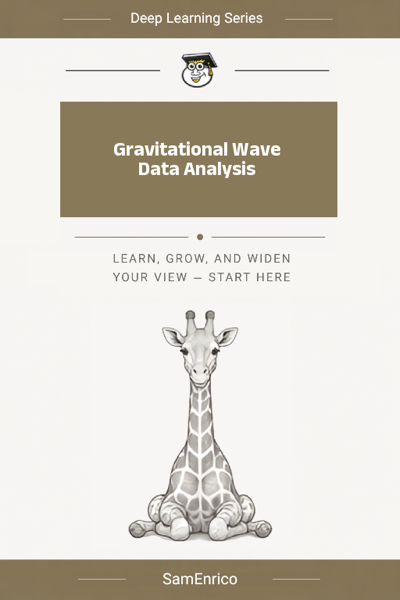
Gravitational Wave Data Analysis eBook
A Coursebook on Gravitational Wave Data Analysis
A Coursebook on Gravitational Wave Data Analysis
Formats
Free sample
Chapter 1: The Spacetime Whisperer--–- On September 14, 2015, at 9:50:45 UTC, a pair of 29-year-old postdoctoral researchers named Marco Drago and Duncan Mac Leod sat in separate control rooms 3,002 kilometers apart—one in Hanford, Washington, one in Livingston, Louisiana—watching computer screens that had displayed nothing but noise for months. At that precise moment, a signal arrived from 1.3 billion light-years away. It traveled across the universe for longer than multicellular life has existed on Earth, passed through the Earth's core, and caused the mirrors in both detectors to move by one ten-thousandth the diameter of a proton. Marco saw it first. He typed into the collaboration chat: "Interesting event in Livingston." Seconds later, Duncan replied: "Also in Hanford." That exchange was the first human acknowledgment that we had heard the universe in an entirely new way.Before that moment, gravitational waves were theoretical curiosities—elegant predictions from Einstein's equations that most physicists assumed would never be measured directly.
After that moment, gravitational wave astronomy became a field of experimental science. This chapter is about what those waves are, why they matter, and how you, by the end of this book, will know how to find them in data. But let us begin not with equations, but with a question: what does it mean to hear spacetime?The Silence Before the Symphony Imagine standing in a completely dark room, wearing noise-canceling headphones, trying to detect a single vibration so faint that it displaces the air less than the width of a single atom. That is roughly the challenge faced by gravitational wave astronomers, except the room is the entire universe, the headphones are state-of-the-art lasers and mirrors, and the vibration is not air but the fabric of reality itself.Gravitational waves are ripples in spacetime—distortions that propagate outward from accelerating masses, just as electromagnetic waves propagate from accelerating charges. When a massive object accelerates, it does not simply move through a pre-existing spacetime background; it warps the geometry of spacetime around it, and changes in that geometry travel outward at the speed of light.
A binary system of two black holes orbiting each other is like two heavy bowling balls on a trampoline: they create a deep indentation, and as they move, that indentation ripples outward. Those ripples are gravitational waves.But here is the crucial difference between gravitational waves and the waves we experience in everyday life. Sound waves are compressions and rarefactions of air molecules. Water waves are displacements of water molecules. Electromagnetic waves are oscillations of electric and magnetic fields.
Gravitational waves are oscillations of spacetime itself. They stretch and squeeze the distances between objects without any physical medium involved. When a gravitational wave passes through you, your height changes by a few parts in 102110^{21}1021—an amount so absurdly small that it defies intuition.This is why gravitational wave detection was considered impossible for most of the 20th century. The first serious attempt came from Joseph Weber in the 1960s, who built aluminum cylinders several meters long and instrumented them with piezoelectric sensors. His idea was simple: a passing gravitational wave would cause the cylinder to resonate like a struck bell.
Weber reported detections in 1969, but no one could replicate his results. His cylinders were too small, too noisy, and too crude. But he was not wrong in principle—only in technology. It would take another four decades and an investment of more than a billion dollars to build instruments sensitive enough to hear what Weber only dreamed of.What Einstein Actually Said To understand gravitational waves, we must begin with Einstein's general theory of relativity, published in 1915. The core idea is deceptively simple: mass and energy tell spacetime how to curve, and curved spacetime tells matter how to move.
Einstein expressed this in his famous field equations:Gμν=8πGc4TμνG_{\mu\nu} = \frac{8\pi G}{c^4} T_{\mu\nu}Gμν=c48πGTμνThe left side, GμνG_{\mu\nu}Gμν, describes the curvature of spacetime. The right side, TμνT_{\mu\nu}Tμν, describes the distribution of mass and energy. The equation says that curvature and matter-energy are two sides of the same coin—you cannot have one without the other.Now, what happens when masses accelerate? The field equations are nonlinear and notoriously difficult to solve exactly. But for weak gravitational fields—far from any massive object—we can approximate.
We write the full spacetime metric gμνg_{\mu\nu}gμν as the flat Minkowski metric ημν\eta_{\mu\nu}ημν (the geometry of special relativity) plus a small perturbation hμνh_{\mu\nu}hμν:gμν=ημν+hμν,∣hμν∣≪1g_{\mu\nu} = \eta_{\mu\nu} + h_{\mu\nu}, \quad |h_{\mu\nu}| \ll 1gμν=ημν+hμν,∣hμν∣≪1Plugging this into Einstein's equations and keeping only terms linear in hμνh_{\mu\nu}hμν yields the linearized Einstein equations. In vacuum (far from any matter source), these simplify dramatically to a wave equation:□hˉμν=0\Box \bar{h}_{\mu\nu} = 0□hˉμν=0where □=−1c2∂2∂t2+∇2\Box = -\frac{1}{c^2}\frac{\partial^2}{\partial t^2} + \nabla^2□=−c21∂t2∂2+∇2 is the d'Alembert operator (the wave operator), and hˉμν=hμν−12ημνh\bar{h}_{\mu\nu} = h_{\mu\nu} - \frac{1}{2}\eta_{\mu\nu}hhˉμν=hμν−21ημνh is the "trace-reversed" perturbation. This equation has plane wave solutions:hˉμν=Aμνei(kρxρ)\bar{h}_{\mu\nu} = A_{\mu\nu} e^{i(k_\rho x^\rho)}hˉμν=Aμνei(kρxρ)where kρk_\rhokρ is the wave vector. The dispersion relation kρkρ=0k_\rho k^\rho = 0kρkρ=0 tells us that these waves travel at the speed of light. This was a non-obvious prediction: Einstein initially thought gravitational waves might propagate at the speed of light, but he was not sure.
The linearized theory confirmed it.But here is where it gets subtle. The metric perturbation hμνh_{\mu\nu}hμν is not directly observable because it contains gauge degrees of freedom—artificial components that can be changed by coordinate transformations without changing the physical geometry. In electromagnetism, we fix the gauge by requiring ∇⋅A=0\nabla \cdot \mathbf{A} = 0∇⋅A=0 (Coulomb gauge). In general relativity, we fix the gauge by imposing conditions on hμνh_{\mu\nu}hμν.The standard choice for gravitational wave analysis is the transverse-traceless (TT) gauge. This gauge imposes three conditions:Transverse: The waves are perpendicular to their direction of propagation.
If a wave travels in the zzz-direction, then htz=hxz=hyz=0h_{tz} = h_{xz} = h_{yz} = 0htz=hxz=hyz=0.Traceless: The trace of the spatial part vanishes: hxx+hyy+hzz=0h_{xx} + h_{yy} + h_{zz} = 0hxx+hyy+hzz=0.Synchronous: htμ=0h_{t\mu} = 0htμ=0, meaning the time components vanish.In TT gauge, the only non-zero components are the spatial ones transverse to propagation, and they are traceless. For a wave traveling in the zzz-direction, the metric perturbation takes the simple form:hμνTT=(00000h+h×00h×−h+00000)h_{\mu\nu}^{\text{TT}} = \begin{pmatrix} 0 & 0 & 0 & 0 \\ 0 & h_+ & h_\times & 0 \\ 0 & h_\times & -h_+ & 0 \\ 0 & 0 & 0 & 0 \end{pmatrix}hμνTT=00000h+h×00h×−h+00000The two independent components, h+h_+h+ and h×h_\timesh×, are called the plus and cross polarizations. They describe how a gravitational wave stretches and squeezes space in perpendicular directions. If a plus-polarized wave passes through a ring of test particles, the ring stretches along the x-axis and squeezes along the y-axis, then…
This is the end of the free sample. Get the eBook to keep going. Buy now
About this book
Details
- Author
- Haywood Wilfredo
- Publisher
- SamEnrico
- Language
- English
- Genre
- Non-Fiction, Informative, Educational
- Released
- 2026-06-02
- Pages (approx.)
- 157
- Available as
- eBook, Audiobook

Read better in the ZLOADR app
Your eBooks on your phone or tablet. Sign in with your SamEnrico account and start reading.
More by Haywood Wilfredo
 Hawking Alien WarningsHaywood Wilfredo$11.99
 Compassion for Other DriversHaywood Wilfredo$11.99
 The Gambling Harm Reduction CourseHaywood Wilfredo$11.99
 The Parent Death Meditation GuideHaywood Wilfredo$11.99
 Remote Worker Flexibility RescueHaywood Wilfredo$11.99
 The Midnight Vote: Nixon’s Resignation and the 1974 Impeachment CrisisHaywood Wilfredo$11.99
 The Lost Fleet of the Chola Dynasty: India's Ancient Mariners of the Indian OceanHaywood Wilfredo$11.99
 One Page Seasonal Marketing PlanHaywood Wilfredo$12.99
 Cohort Insurance Spending HandbookHaywood Wilfredo$12.99
 Understanding Barrett SyndromeHaywood Wilfredo$17.99
 10 Ways to Use Chicken Leg (Recipe Book)Haywood Wilfredo$11.99
You may also like
 Hong Kong Handover 1997Dunn Johnnie$11.99
 Zumba For Postnatal Recovery CourseNeal Christian$11.99
 Zumba for BeginnersLadner Nikia$11.99
 YouTube Comment Mining GuideHumes Pandora$12.99
 Worry Box MeditationCarlin Rudy$11.99
 Workplace Stress MeditationNguyen Lynn$11.99
 Workplace Stress and Sleep RepairHawley Ivory$11.99
 Workplace Perfectionism CureDelaney Jeffry$11.99
 Workplace Injustice Anger GuideWallen Isabelle$11.99
 Work Addiction and Burnout LinkGreenwood Ester$11.99
 Women in Yoga and WellnessBeattie Galina$11.99
 Women in Stand Up ComedyChun Evangeline$11.99