
Non-FictionHealth & WellnessGratitude Science
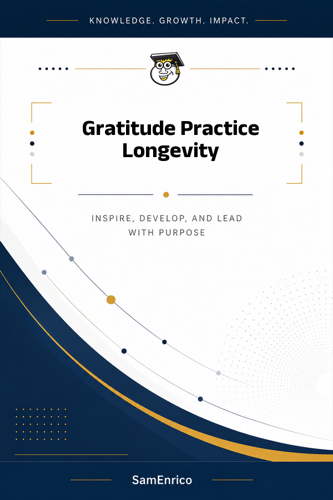
Gratitude Practice Longevity eBook
Express gratitude daily, a common practice among t
Express gratitude daily, a common practice among the world's oldest people.
Formats
Free sample
Chapter 1: The Longevity Paradox--Let me tell you about a mystery that has haunted longevity researchers for decades.In the blue zones—those rare regions of the world where people routinely live past one hundred with remarkably few chronic diseases—scientists have studied everything. They have analyzed soil composition, measured portion sizes, tracked physical activity, sequenced DNA, and cataloged every bite of food consumed over countless meals. The result? A tidy list of common denominators: plant-based diets, regular low-intensity movement, strong social bonds, a sense of purpose, moderate alcohol consumption, and faith-based community involvement.But here is the paradox that no one talks about. If you take these same lifestyle factors—the diet, the exercise, the community—and transplant them into a Western setting, you do not get the same results.
People in California who adopt a Mediterranean diet live longer than people who do not, yes. But they do not become centenarians at the rate of Sardinians. People in New York who walk everywhere live longer than sedentary New Yorkers. But they do not outlive the Okinawans. Something is missing from the list.
Something that the blue zone researchers have observed, noted, and then largely failed to incorporate into their formal recommendations.That something is gratitude.I have spent years reading the blue zone literature, and the pattern is unmistakable. In Okinawa, elders practice hatsu gan—a daily ritual of recalling what they are grateful for, often tied to their Buddhist and ancestor veneration traditions. In Sardinia, the world's longest-lived men gather regularly for communal meals where storytelling and expressing appreciation for family and friends are woven into the fabric of every gathering. In Nicoya, Costa Rica, centenarians speak of plan de vida, a deep sense of life purpose that is almost always accompanied by daily expressions of thanks for the simple fact of being alive. The researchers mention these practices.
They describe them in colorful vignettes. Then they move on to the lentils and the red wine and the walking.This book is the move they never made. It is the systematic, evidence-based, week-by-week translation of what the world's oldest people do naturally into a practice that you can do deliberately, regardless of where you live, how old you are, or what your genetic inheritance looks like.What the Oldest People Know That You Do Not I want to introduce you to someone. Her name was Ushi Okushima, and she lived in Okinawa until she was 106 years old. When researchers asked her the secret to her longevity, she did not talk about diet or exercise.
She laughed and said, "I eat what I want and I move when I need to." Then she grew serious. "But every morning, I look at my hands. I look at my wrinkled, old hands. And I say thank you. These hands have held my children.
These hands have planted vegetables. These hands have wiped tears. These hands are still here. That is enough."Ushi was not unusual among Okinawan centenarians. The practice of hatsu gan—which translates roughly to "remembering what you have received"—is a daily ritual.
It is not journaling in the Western sense. It is not therapy. It is a quick, heartfelt, often verbal acknowledgment of the good that exists in one's life, even when that life includes poverty, loss, and the inevitable physical decline of extreme old age. The Okinawans do not practice gratitude because they are happy. They practice gratitude because it is how they survive the hardships that happiness cannot erase.The same pattern appears in Loma Linda, California, home to a community of Seventh-day Adventists who live, on average, a decade longer than other Americans.
The Adventists do not drink or smoke. Many are vegetarian. They keep the Sabbath holy. But they also practice what they call "gratitude prayers" before every meal—not just a rote blessing, but a genuine acknowledgment of the specific people who grew, transported, and prepared the food. In interviews, Adventist centenarians consistently rank "feeling thankful" as one of the most important factors in their long lives.
When researchers press them to explain, they often say something like, "Being thankful keeps you from being bitter. And bitter people die young."In Icaria, Greece, where one in three residents lives into their nineties, the practice is less formal but no less present. Icarian elders gather in the village square each evening. They talk. They laugh.
They argue. And somewhere in the conversation, someone will inevitably say, "Efharisto" —thank you. For the wine. For the friend who showed up. For the sun that set over the Aegean.
For another day on the right side of the grass. The thanks are quick, casual, almost throwaway. But they are constant. They are the background music of daily life.The Missing Link in Longevity Science Here is what frustrates me about the longevity field. We have thousands of studies on diet.
Tens of thousands on exercise. Hundreds of thousands on medications. But the number of randomized controlled trials on gratitude and longevity can be counted on one hand. We know more about the effect of statins on 70-year-olds than we know about the effect of daily thanks on 90-year-olds. This is not because gratitude is unimportant.
It is because gratitude is free. You cannot patent it. You cannot sell it. You cannot put it in a pill and charge ninety-nine dollars a month.But the evidence we do have is compelling, and it is growing. The Harvard study on 49,000 older women that opened this chapter is just the beginning.
A 2021 study from the University of California, San Diego, found that grateful heart failure patients had lower levels of inflammatory markers and better sleep quality than less grateful patients, even after controlling for medication adherence. A 2019 study from the University of Utah tracked older adults with hypertension and found that a simple eight-week gratitude journaling program reduced systolic blood pressure by an average of 10 points—comparable to the effect of a low-dose blood pressure medication. A 2020 meta-analysis of 26 studies on gratitude and well-being in older adults concluded that gratitude interventions consistently improve psychological well-being, reduce depressive symptoms, and enhance sleep quality, all of which are robust predictors of longevity.None of these studies prove that gratitude causes longer life. But they build a consistent, plausible case. Gratitude reduces stress.
Chronic stress ages you. Therefore, gratitude slows aging. The pathway is not mysterious. It is not magical. It is biological.Why You Are Not Grateful Enough (And Why It Is Not Your Fault)Before we go any further, let me clear something up.
If you are reading this book, you are almost certainly not as grateful as you could be. This is not because you are a bad person. It is because your brain is working exactly as evolution designed it.The human brain has a negativity bias. Psychologists have known this for decades. We remember insults more vividly than compliments.
We dwell on losses longer than we savor gains. We scan for threats before we appreciate beauty. This bias kept our ancestors alive on the savanna. If you ignored the rustle in the grass that might be a lion, you died. If you ignored the beautiful sunset, you…
This is the end of the free sample. Get the eBook to keep going. Buy now
About this book
Details
- Author
- Gillespie Eulah
- Publisher
- SamEnrico
- Language
- English
- Genre
- Non-Fiction, Health & Wellness, Gratitude Science
- Released
- 2026-06-06
- Pages (approx.)
- 133
- Available as
- eBook, Audiobook

Read better in the ZLOADR app
Your eBooks on your phone or tablet. Sign in with your SamEnrico account and start reading.
More by Gillespie Eulah
 Birth Prep Pelvic ExercisesGillespie Eulah$11.99
 Train Journey Sleep GuideGillespie Eulah$11.99
 Comparison in GriefGillespie Eulah$11.99
 The Make Peace With Food GuideGillespie Eulah$11.99
 The Corsair of Florence: Andrea Doria and the Art of Naval DominanceGillespie Eulah$11.99
 The Breeder's Guide to Devon Or Beef Devon CattleGillespie Eulah$11.99
 Non Resident LLC Currency RiskGillespie Eulah$12.99
 Kigali Startup EventsGillespie Eulah$12.99
 How to Become a Package-dyeing-machine OperatorGillespie Eulah$11.99
 Employee Relations ManagerGillespie Eulah$11.99
You may also like
 Hong Kong Handover 1997Dunn Johnnie$11.99
 Zumba For Postnatal Recovery CourseNeal Christian$11.99
 Zumba for BeginnersLadner Nikia$11.99
 YouTube Comment Mining GuideHumes Pandora$12.99
 Worry Box MeditationCarlin Rudy$11.99
 Workplace Stress MeditationNguyen Lynn$11.99
 Workplace Stress and Sleep RepairHawley Ivory$11.99
 Workplace Perfectionism CureDelaney Jeffry$11.99
 Workplace Injustice Anger GuideWallen Isabelle$11.99
 Work Addiction and Burnout LinkGreenwood Ester$11.99
 Women in Yoga and WellnessBeattie Galina$11.99
 Women in Stand Up ComedyChun Evangeline$11.99