
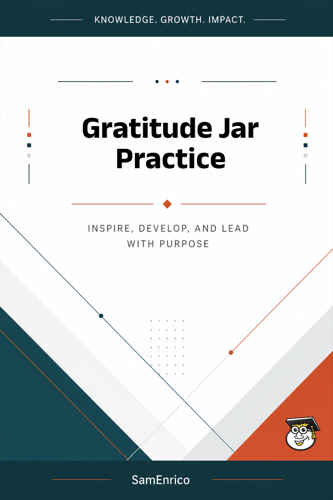
Gratitude Jar Practice eBook
Write appreciations on paper notes and review them
Write appreciations on paper notes and review them at year end.
Formats
Free sample
Chapter 1: The Leaking Vessel--Every morning, you wake up with a vessel inside your chest. It is not made of bone or blood, but of attention and memory. Into this vessel, the world pours a constant stream of moments—some sweet, some bitter, most neutral. By the time you lay your head on the pillow at night, that vessel should be full. But for most people, it is nearly empty.
The sweet moments have evaporated. The bitter ones have crystallized into stone. And you are left wondering why a perfectly good day felt, somehow, like a loss.This is the problem that no one taught you to name: you are living inside a leaking vessel.The human brain, for all its genius, is not designed for happiness. It is designed for survival. And survival, in evolutionary terms, depends on noticing what might kill you, not what delights you.
Your ancient ancestors who paused to savor the beauty of a sunset were eaten by predators. Your ancestors who hyper-vigilantly scanned for threats lived long enough to reproduce. You are the descendant of worriers, not wonderers. The result is a neurological quirk called the negativity bias: the brain’s default setting to remember criticism more than praise, struggles more than joys, and losses more than gains.This bias is not a moral failure. It is not a sign of depression or pessimism.
It is simply the factory setting of the human mind. And it is the reason why, on a day when nine good things happen and one bad thing happens, you will fall asleep replaying the bad thing. The vessel leaks. The joy drains out. And you are left with the weight of what went wrong.But here is the truth that changes everything: the vessel can be sealed.
Not by pretending that bad things don’t happen. Not by toxic positivity or forced smiles. But by building a second container—one that sits outside your leaky brain, made of glass and paper and intention. A container that does not forget. A container that compounds.
A container that, over time, rewires the very architecture of your mind.This book is about building that container. It is called the Gratitude Jar.Chapter 1 is not a set of instructions. It is a diagnosis. Before you write a single note, before you choose a jar, before you learn any method, you must understand why you need this practice in the first place. You must see the leak.
You must feel the weight of what you have been losing. And you must meet the woman who, at the bottom of her own despair, discovered that a simple jar could do what years of therapy and medication could not: seal the vessel and fill it, slowly, with joy.The Negativity Bias: Your Brain’s Factory Settings Let us begin with a thought experiment. Imagine that you are walking through a forest. You see a beautiful waterfall, a patch of wildflowers, and a deer standing perfectly still in a shaft of sunlight. Then, ten feet to your left, you see a snake coiled on a rock.
Which image will your brain encode into long-term memory? The snake. Not because you are broken, but because you are human. The snake could kill you. The wildflowers cannot.This is the negativity bias in action.
It was first identified by psychologists Roy Baumeister and Ellen Bratslavsky in a landmark 2001 paper titled "Bad Is Stronger Than Good." Their research, and the thousands of studies that followed, demonstrated a consistent pattern across virtually every domain of human experience: negative events are more powerful than positive events of equal magnitude. A single criticism stings more than a single compliment pleases. A single loss hurts more than a single gain satisfies. A single betrayal erodes trust more than a single act of loyalty builds it.The numbers are striking. In marital relationships, researchers have found that it takes five positive interactions to outweigh the damage of a single negative interaction.
In financial decision-making, the pain of losing $100 is roughly twice as intense as the pleasure of gaining $100. In memory recall, negative events are remembered with more vivid detail and emotional intensity than positive events, even when the positive events occurred more recently.Why? Because the brain’s amygdala—the almond-shaped cluster of neurons responsible for threat detection—is wired to light up like a Christmas tree at the slightest sign of danger. Once activated, it sends cascading signals to the hippocampus (which encodes memory) and the prefrontal cortex (which directs attention). The result is that your attention is hijacked by the negative, and your memory is cemented around the threatening.
The positive moments never stood a chance.Consider a typical day in your own life. You wake up. You drink coffee that tastes just right. You receive a kind text from a friend. You complete a task at work that has been hanging over your head.
Your child hugs you unprompted. You hear a song you love. The sun sets in shades of orange and pink. That is six positive moments before dinner. Now imagine that, at 7:00 PM, your partner says something careless that hurts your feelings.
Which event will you describe to a friend the next day? Which event will replay in your mind as you try to fall asleep? Which event will feel, by morning, like the summary of your entire day?The negativity bias is not a bug. It is a feature. It kept your ancestors alive.
But in the modern world—where predators do not lurk behind every bush and survival is largely guaranteed—that feature has become a liability. You are walking around with a brain that treats a rude email like a saber-toothed tiger. And the result is a chronic, low-grade sense that life is harder than it should be, that joy is fleeting, and that the vessel is always leaking.The Gratitude Solution: More Than Positive Thinking For decades, the self-help industry has offered a solution to the negativity bias: think positive. Visualize success. Affirm your worth.
Smile until you mean it. The problem is that these interventions, while well-intentioned, are fighting against the brain’s hardware. Telling a negativity-biased brain to “think positive” is like telling a nearsighted person to “see better.” The structure of the eye—or the structure of the amygdala—does not change simply because you issue a command.Gratitude, however, operates differently. It does not ask you to ignore the negative or pretend that struggles do not exist. Instead, it asks you to deliberately, systematically, and repeatedly notice the positive—not in opposition to the negative, but alongside it.
The negative remains. The snake is still there. But the wildflowers are given equal weight. Over time, through the mechanism of neuroplasticity, the brain’s attentional filters begin to shift. The reticular activating system (RAS)—the brain’s gatekeeper for what you notice—starts scanning for joy as automatically as it once scanned for threats.The scientific evidence for gratitude is among the most robust in positive psychology.
Dr. Robert Emmons of the University of California, Davis, has spent two decades studying gratitude and its effects. In a series of randomized controlled trials, Emmons…
This is the end of the free sample. Get the eBook to keep going. Buy now
About this book
Details
- Author
- Hanson Antoinette
- Publisher
- SamEnrico
- Language
- English
- Genre
- Non-Fiction, Self-Help, Rituals
- Released
- 2026-06-06
- Pages (approx.)
- 143
- Available as
- eBook, Audiobook

Read better in the ZLOADR app
Your eBooks on your phone or tablet. Sign in with your SamEnrico account and start reading.
More by Hanson Antoinette
 Laundromat SundaysHanson Antoinette$11.99
 TM For Weight Management CourseHanson Antoinette$11.99
 Performing Arts EQ GuideHanson Antoinette$11.99
 The Five Minute Mindfulness Starter GuideHanson Antoinette$11.99
 The Nubian Pharaohs of Kush: Masters of the Nile and BeyondHanson Antoinette$11.99
 A&H UnderwriterHanson Antoinette$11.99
 Understanding Myhre–ruvalcaba–Graham SyndromeHanson Antoinette$17.99
 How to Start a Music Arrangers - Independent BusinessHanson Antoinette$11.99
 Break-Even Formula ManualHanson Antoinette$12.99
 Lam Research SWOT GuideHanson Antoinette$12.99
You may also like
 Hong Kong Handover 1997Dunn Johnnie$11.99
 Zumba For Postnatal Recovery CourseNeal Christian$11.99
 Zumba for BeginnersLadner Nikia$11.99
 YouTube Comment Mining GuideHumes Pandora$12.99
 Worry Box MeditationCarlin Rudy$11.99
 Workplace Stress MeditationNguyen Lynn$11.99
 Workplace Stress and Sleep RepairHawley Ivory$11.99
 Workplace Perfectionism CureDelaney Jeffry$11.99
 Workplace Injustice Anger GuideWallen Isabelle$11.99
 Work Addiction and Burnout LinkGreenwood Ester$11.99
 Women in Yoga and WellnessBeattie Galina$11.99
 Women in Stand Up ComedyChun Evangeline$11.99