
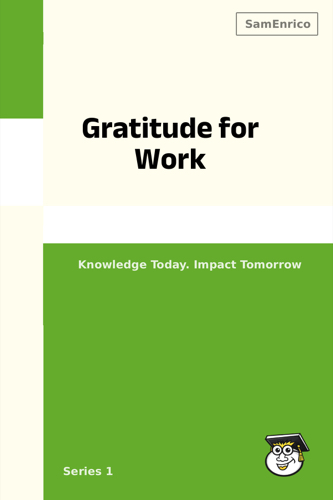
Gratitude for Work eBook
undefined
undefined
Formats
Free sample
Chapter 1: The Sunday Scaries Lie--You are not anxious because your job is hard.You are anxious because you have been trained to see your work as a sentence rather than a gift, an obligation rather than an opportunity, and a transaction rather than a transformation. The feeling that settles into your chest every Sunday afternoon—that specific weight, that subtle dread, that quiet wish for just one more day—is not a sign that you need a vacation. It is not evidence that you chose the wrong career. It is not a personality flaw or a failure of resilience.It is data.And for years, you have been misreading it.This chapter will teach you to read it correctly. More importantly, this chapter will give you a 90-second tool that rewires how your brain experiences the boundary between rest and work.
By the time you finish these pages, you will never look at a Sunday evening the same way again. And you will finally understand why the most successful, most fulfilled professionals you know do not dread Monday morning—they prepare for it with something that looks suspiciously like anticipation.But first, we need to talk about what the Sunday Scaries actually are. Because most people get this wrong.The Geography of Dread Let us name the enemy. The Sunday Scaries—that term you have probably used casually, almost fondly, as if it were a harmless quirk of adult life—are not a joke. They are a physiological and psychological event with measurable consequences.
Researchers who study the transition between weekend and workweek have found that cortisol levels (the stress hormone) begin rising in most workers as early as 2 PM on Sunday afternoon. Heart rate variability decreases. Sleep quality on Sunday night is, for the average worker, 34 percent worse than sleep quality on Friday night. And here is the cruelest finding: most people spend an average of seven hours and twelve minutes per week in what psychologists call "anticipatory dread"—the time spent worrying about work that has not yet happened.Seven hours and twelve minutes.That is nearly a full workday. Every week.
Spent on nothing but the feeling of dread.Over a decade of your career, that adds up to 3,744 hours. Nearly two full years of your waking life. Two years spent not working, not resting, not being with people you love, not doing anything productive or joyful—just sitting in the low-grade anxiety that Sunday afternoon has become for you.And here is the secret that changes everything: your grateful peers do not experience this.Not because their jobs are easier. Not because they are less ambitious. Not because they have somehow tricked themselves into enjoying things that are genuinely unpleasant.
But because they have learned something you have not yet learned. They have learned the difference between state gratitude and trait gratitude. And they have learned to treat their Sunday Scaries as a compass rather than a curse.The Two Gratitudes You Need to Know Most people think gratitude is a feeling. You receive a compliment, you feel grateful. Someone helps you with a project, you feel grateful.
You get a promotion, you feel grateful. Then the feeling passes, and you go back to normal. Psychologists call this state gratitude—a temporary emotional response to a specific positive event. It comes. It goes.
It leaves no lasting trace.State gratitude is not enough to change your life. It is not enough to kill the Sunday Scaries. It is a rainstorm in the desert: welcome when it arrives, but gone by morning.What you need is trait gratitude.Trait gratitude is not a feeling. It is a habit of attention. It is the learned, practiced, automatic tendency to notice what is going well before you notice what is going wrong.
It is the difference between walking into your office and seeing a to-do list versus walking into your office and seeing a set of problems you have the privilege of solving. It is not toxic positivity—it does not ask you to ignore real difficulties. It asks you to see the full picture, including the parts that are already working.Dr. Robert Emmons, the world's leading researcher on gratitude at the University of California, Davis, has spent two decades studying the difference between people with high trait gratitude and people with low trait gratitude. His findings are astonishing.
People with high trait gratitude sleep better, exercise more, have stronger immune systems, report less pain, maintain more supportive relationships, and—relevant to this chapter—experience significantly lower levels of anticipatory dread. They do not fear Monday morning because they have trained their brains to see Monday morning not as an interruption of their real life but as a continuation of it.The Sunday Scaries, in other words, are not caused by your job. They are caused by a gap between your expectations and your attention. You are paying attention to what you are losing (the weekend) rather than what you are gaining (the opportunity to contribute). And until you close that gap, no amount of vacation time, no raise, no new job will fix the feeling.
Because the problem is not external. The problem is the lens.The 94 Percent Illusion Here is where most gratitude advice goes wrong. Most books and podcasts and wellness influencers will tell you to "count your blessings" or "keep a gratitude journal" or "write down three things you're thankful for every morning." And these are not bad suggestions. They just miss the point entirely when it comes to work.Because when most people try to practice gratitude for their jobs, they focus on the wrong things. They focus on the big wins: the promotion, the bonus, the nice email from a client, the recognition from a boss.
These are the peaks. They are rare. They are memorable. They are also almost entirely out of your control. You cannot manufacture a promotion every week.
You cannot force a client to send a thank-you note. If your gratitude practice depends on rare, uncontrollable events, it will fail.The solution is to shift your attention from the peaks to the valleys. From the exceptional to the mundane. From what you hope will happen to what is already happening, every single day, whether you notice it or not.Here is a radical reframe: your paycheck is approximately 6 percent of what your job actually gives you.The other 94 percent is invisible. It is the fact that you have a chair to sit in.
That the chair is not broken. That the room has heating in the winter and air conditioning in the summer. That the lights turn on when you flip the switch. That your computer boots up. That the Wi-Fi connects.
That there is coffee in the break room. That the bathroom has toilet paper. That your commute, however long, is possible at all. That you have colleagues who, even if they are not your favorite people, do not actively sabotage you. That your paycheck arrives on time, every time, because an entire system of payroll software, human resources staff, and banking infrastructure works silently in the background.You take all of this for granted.
And that is the problem.Entitlement is not a personality flaw. It is a failure of attention. When you assume that…
This is the end of the free sample. Get the eBook to keep going. Buy now
About this book
Details
- Author
- Reilly Marlena
- Publisher
- SamEnrico
- Language
- English
- Genre
- Non-Fiction, Self-Help / Work
- Released
- 2026-06-06
- Pages (approx.)
- 127
- Available as
- eBook, Audiobook

Read better in the ZLOADR app
Your eBooks on your phone or tablet. Sign in with your SamEnrico account and start reading.
More by Reilly Marlena
 The NEAT Increase MethodReilly Marlena$11.99
 Bipolar Sleep Management GuideReilly Marlena$11.99
 Sustainability PositioningReilly Marlena$11.99
 Public Speaking for YouTubersReilly Marlena$11.99
 Improv for ParentsReilly Marlena$11.99
 The Infertility Difficult TalkReilly Marlena$11.99
 Therapy For Parental AngerReilly Marlena$11.99
 Silk and Steel: The Love That Defied the XiongnuReilly Marlena$11.99
 Woodstock '99: The Festival That Almost Burned Down the WorldReilly Marlena$11.99
 How to Become a Aviation Support Equipment RepairerReilly Marlena$11.99
 A Collector's Handbook to the Talbot 45, 65Reilly Marlena$11.99
 Workers Compensation Even for OneReilly Marlena$12.99
You may also like
 Hong Kong Handover 1997Dunn Johnnie$11.99
 Zumba For Postnatal Recovery CourseNeal Christian$11.99
 Zumba for BeginnersLadner Nikia$11.99
 YouTube Comment Mining GuideHumes Pandora$12.99
 Worry Box MeditationCarlin Rudy$11.99
 Workplace Stress MeditationNguyen Lynn$11.99
 Workplace Stress and Sleep RepairHawley Ivory$11.99
 Workplace Perfectionism CureDelaney Jeffry$11.99
 Workplace Injustice Anger GuideWallen Isabelle$11.99
 Work Addiction and Burnout LinkGreenwood Ester$11.99
 Women in Yoga and WellnessBeattie Galina$11.99
 Women in Stand Up ComedyChun Evangeline$11.99