
Non-FictionSelf-HelpResilience
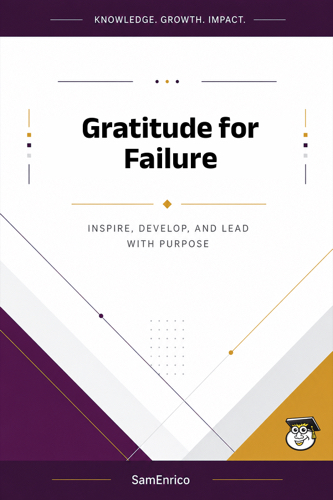
Gratitude for Failure eBook
Find thankfulness in mistakes and setbacks as lear
Find thankfulness in mistakes and setbacks as learning opportunities.
Formats
Free sample
Chapter 1: The River Never Straight...--There is a specific kind of loneliness that arrives the moment you realize your life does not look like the ones you were promised. You are not standing on a stage accepting an award. You are not posting a triumphant "I made it" photograph. You are not even sure you are moving forward. Instead, you are sitting in a parked car, or staring at a ceiling at 2:00 AM, or scrolling through someone else's highlight reel while your own stomach churns with the quiet certainty that you have somehow taken a wrong turn and no one has bothered to tell you.This is not a feeling of catastrophic failure—not yet.
This is something more subtle and more corrosive. It is the suspicion that everyone else received a map and you did not. That their paths are straight lines from ambition to achievement, and yours is a snarl of dead ends, detours, and embarrassing reversals. You compare your messy, unfinished backstory to their polished, published biographies, and you come up short. The calculation is merciless: if success is a straight line, and your line is crooked, then you must be doing it wrong.But here is the first and most important lie this book will ask you to unlearn: successful people do not have straight lines.
No one does. The straight line is a myth manufactured by memoirists who edit out the humiliating parts, by social media algorithms that reward only the highlights, and by our own desperate need to believe that the chaos we feel is unique to us. The truth is much stranger and much more liberating. The most interesting, resilient, and wise people in any field are not the ones who avoided failure. They are the ones who learned to read their failures the way a sailor reads wind shifts—not as betrayals, but as data.This book is about learning to read that data.
It is about the specific, trainable skill of extracting wisdom from setbacks without pretending the setbacks did not hurt. We are going to call that skill gratitude for failure, but we need to be very clear about what that phrase means and—just as importantly—what it does not mean.The Definition That Changes Everything Let me say this as plainly as I can: gratitude for failure is not a feeling. You do not have to feel happy about losing money, getting fired, ending a relationship, or making a public mistake. Anyone who tells you to "just be grateful" while you are in active pain is not offering wisdom. They are offering spiritual bypassing—a convenient way to avoid the messiness of real human suffering.Instead, here is the definition that will guide every chapter of this book:Gratitude for failure is the practiced ability to extract useful data from a negative outcome without denying the pain.
It is not a feeling. It is a skill.Think of it this way. A paramedic does not feel grateful for a car accident. But she is grateful for the training that taught her how to respond to one. A scientist does not feel grateful for an experiment that explodes.
But she is grateful for the data the explosion revealed about what does not work. In both cases, the gratitude is not directed at the pain itself. It is directed at the extraction process—the disciplined, repeatable habit of asking "What can I learn?" instead of "Why did this happen to me?"That extraction process is a skill because it can be practiced, improved, taught, and measured. Some people are naturally better at it, just as some people are naturally better at running. But anyone can get better with training.
And the training is what this book provides.The Compare-and-Despair Loop Before we build the skill, we have to understand what we are up against. The straight-line myth does not just make us feel bad about ourselves. It actively prevents us from learning.Psychologists have a name for the cognitive pattern that happens when we compare our internal chaos to someone else's external polish. They call it social comparison theory, but I prefer a more vivid term: the compare-and-despair loop. Here is how it works.
You see a curated version of someone else's life—a promotion, a wedding, a book deal, a transformation. You compare it to your uncurated reality—the spreadsheet that will not balance, the conversation you keep replaying with shame, the project that stalled. The comparison generates a feeling of inadequacy. That feeling triggers a search for explanation: why am I behind? And the easiest explanation—the one our culture supplies for free—is that you must have made a mistake they did not make.
You failed where they succeeded. The loop tightens. You feel worse. You take fewer risks. And because you take fewer risks, you actually do fall further behind.The compare-and-despair loop is not just unpleasant.
It is a learning disability. When you believe that successful people have straight lines, you interpret every setback as evidence that you are on the wrong path entirely. You do not ask "What can I learn from this?" You ask "What is wrong with me?" The first question leads to extraction. The second leads to shame. And shame, as we will see in Chapter 5, is the single greatest enemy of gratitude for failure.Post-Traumatic Growth: The Science of Getting Stronger The straight-line myth is not just contradicted by common sense.
It is contradicted by decades of psychological research. One of the most robust findings in the study of adversity is a phenomenon called Post-Traumatic Growth (PTG).Here is what PTG research has discovered. Between 50 and 70 percent of people who experience a significant trauma—a life-threatening illness, a natural disaster, the sudden loss of a loved one, a violent attack—report not just recovery but positive change in the aftermath. They describe deeper relationships, a greater appreciation for life, a stronger sense of personal strength, a richer spiritual life, and new possibilities they would never have pursued without the adversity.Let me repeat that number. Fifty to seventy percent.
The majority of people who go through hell come out the other side with something they did not have before. Not despite the hell. Because of it.This does not mean trauma is good. It does not mean we should seek out suffering or romanticize pain. But it does mean that the human system is wired to do something remarkable with difficulty.
The same way a muscle tears under stress and grows back stronger, the human psyche can fracture under pressure and reorganize into a more resilient configuration. The key variable is not the presence or absence of failure. The key variable is whether you have a framework for making sense of it.That framework is what this book provides. PTG does not happen automatically. It happens when people have the right tools for extraction.
This book is the toolbox.The Kierkegaard Principle: Understanding Backward The Danish philosopher Søren Kierkegaard famously observed that "life can only be understood backwards, but it must be lived forwards." This single sentence contains the entire justification for learning gratitude for failure.When you are in the middle…
This is the end of the free sample. Get the eBook to keep going. Buy now
About this book
Details
- Author
- Bunch Shirely
- Publisher
- SamEnrico
- Language
- English
- Genre
- Non-Fiction, Self-Help, Resilience
- Released
- 2026-06-11
- Pages (approx.)
- 131
- Available as
- eBook, Audiobook

Read better in the ZLOADR app
Your eBooks on your phone or tablet. Sign in with your SamEnrico account and start reading.
More by Bunch Shirely
 Assertive Communication Skills GuideBunch Shirely$11.99
 Senior Regret Acceptance GuideBunch Shirely$11.99
 Working Poor Car RepairBunch Shirely$11.99
 Beginner Loving Kindness MeditationBunch Shirely$11.99
 Tamerlane's Blood Moon: The Conqueror Who Shattered Empires (1389)Bunch Shirely$11.99
 Understanding Myoclonic EpilepsyBunch Shirely$17.99
 Variance Analysis Formula GuideBunch Shirely$12.99
 Tesla SWOT Analysis Library GuideBunch Shirely$12.99
 Battery Jump-start Service (Mall/garage)Bunch Shirely$11.99
 How to Become a Documentation SupervisorBunch Shirely$11.99
You may also like
 Hong Kong Handover 1997Dunn Johnnie$11.99
 Zumba For Postnatal Recovery CourseNeal Christian$11.99
 Zumba for BeginnersLadner Nikia$11.99
 YouTube Comment Mining GuideHumes Pandora$12.99
 Worry Box MeditationCarlin Rudy$11.99
 Workplace Stress MeditationNguyen Lynn$11.99
 Workplace Stress and Sleep RepairHawley Ivory$11.99
 Workplace Perfectionism CureDelaney Jeffry$11.99
 Workplace Injustice Anger GuideWallen Isabelle$11.99
 Work Addiction and Burnout LinkGreenwood Ester$11.99
 Women in Yoga and WellnessBeattie Galina$11.99
 Women in Stand Up ComedyChun Evangeline$11.99