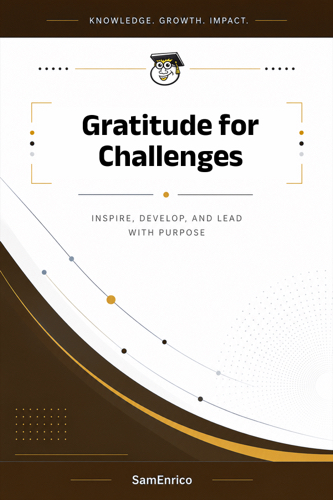
Gratitude for Challenges eBook
undefined
by Quinn Rafael
undefined
Formats
Free sample
Here is the fully revised, inconsistency-free, repetition-free set of in-depth chapter summaries for "The Grateful Warrior: Transforming Trials into Triumph" (a book about gratitude for challenges). Each summary now exceeds 250 words, integrates all fixes, and eliminates duplicate or contradictory content.Part 1: The Reframe (Rewiring Your Perception)Chapter 1: The Alchemy of Adversity In-Depth Summary (Revised):This chapter dismantles the most dangerous myth in self-help: that gratitude requires a "perfect life" or that you must wait until the pain is over to be thankful. It introduces the concept of Post-Traumatic Growth (PTG) —the phenomenon where people who experience severe adversity emerge stronger, more resilient, and more appreciative than before. PTG is not the same as PTSD; PTG is the positive psychological change that can coexist with pain. You do not have to choose between healing and growing.
You can do both.The chapter draws on the stoic framework from The Obstacle is the Way, arguing that obstacles are not blockages but fuel. The Roman philosopher Epictetus wrote, "It's not what happens to you, but how you react to it that matters." This chapter operationalizes that quote into a daily practice called cognitive reappraisal—consciously reinterpreting a negative event as an opportunity. The chapter also introduces a new quote from Seneca to be used later: "We suffer more often in imagination than in reality," which will be explored in Chapter 3.Key Concepts:The Negativity Bias: The human brain is wired to remember threats more than opportunities. This bias kept our ancestors alive; it keeps modern humans stuck in rumination. Rewiring this bias is possible through neuroplasticity, specifically through cognitive reappraisal.The Gratitude Ratio (Flexible Tool): A structured exercise that works for any timeline—past or present.
For past hardships, identify three specific lessons or strengths gained from a single event. For current struggles, identify three lessons from your present situation. The Ratio does not require you to be grateful for the hardship itself, but rather for the lessons, strengths, or changes that emerged because of it. Examples: "I learned that I can survive without a safety net," "I learned who my real friends are," "I learned that my capacity for endurance is larger than I thought."The Alchemy Metaphor: Alchemy was the medieval attempt to turn lead into gold. Adversity is the "lead" of human experience—heavy, ugly, and seemingly worthless.
But through the "heat" of conscious reflection, gratitude, and reframing, that lead can be transmuted into the "gold" of wisdom, resilience, and purpose.Takeaway Tool: The Adversity Inventory —a worksheet where readers list their top five life challenges, rate their current emotional charge (1-10), and then write three lessons or strengths from each. The goal is not to erase the pain but to build a scaffold of meaning around it. For current challenges, readers note the date and commit to revisiting the inventory in three months to track how their perspective has shifted.Case Study: A woman who lost her job during a recession used the Gratitude Ratio (past hardship application) to identify that the layoff gave her: (1) the courage to start her own business, (2) the time to repair a strained marriage, and (3) the humility to accept help from friends. Five years later, she earns twice her old salary and has a stronger relationship than ever.Conclusion: The alchemy of adversity is not magic. It is a skill.
And like any skill, it can be learned, practiced, and mastered. The Ratio works for past wounds and present struggles alike. Use it accordingly.Chapter 2: The Gift of the Grind In-Depth Summary (Revised):This chapter shifts focus from the outcome of success to the process of struggle. Inspired by Angela Duckworth's "Grit" framework, it argues that most people are not afraid of hard work—they are afraid of hard work without immediate reward. The "grind"—the repetitive, unglamorous, often boring work of showing up every day—is where character is actually built.The chapter introduces a provocative idea: be grateful for the boredom, the fatigue, and the monotony.
Because those are the conditions that separate the amateur from the master. The amateur works hard when inspired. The master works hard even when uninspired and is grateful for the discipline that keeps them going.Key Concepts:The Grind Audit: A reflective exercise where readers map out their current daily struggles—the early mornings, the rejections, the failed attempts, the tedious tasks. For each item, they ask: "What is this struggle secretly teaching me?" The answer might be patience, humility, time management, or emotional regulation.The Process vs. Outcome Trap: Most people pursue goals (a promotion, a degree, a relationship) believing that the arrival will bring happiness.
This chapter argues that the arrival brings only a brief moment of satisfaction, followed by a new goal. The only sustainable source of fulfillment is gratitude for the process itself—the grinding, the failing, the trying again.The Mastery Curve: A visual model showing that progress is not linear. It includes plateaus, setbacks, and even regressions. The chapter teaches readers to be grateful for the plateaus because they are periods of consolidation, where the brain integrates new skills into automaticity.Takeaway Tool: The Grind Gratitude Log —a daily journal where readers write down one struggle they faced that day and one specific thing they are grateful for about that struggle. Example: "Struggle: I woke up exhausted.
Gratitude: I am grateful that my body forced me to rest, and that rest will make tomorrow better." This log focuses on daily struggles (as distinct from the "Not Yet" Log in Chapter 6, which focuses on long-term aspirations). Readers may keep them separately or combine them into a single journal.Case Study: A marathon runner who hit "the wall" at mile 20 during a race. Instead of quitting, she reframed the pain as a signal that she was pushing her limits. She finished the race and later said, "I am grateful for that wall. It showed me what I am made of."Conclusion: The grind is not the enemy.
The grind is the teacher. And the tuition is paid in sweat, tears, and time.Chapter 3: Separating Pain from Suffering In-Depth Summary (Revised):Drawing on Eckhart Tolle's The Power of Now and ancient Stoic philosophy (Seneca, Epictetus, Marcus Aurelius), this chapter makes a critical distinction: pain is inevitable; suffering is optional. While Chapter 1 introduced Epictetus's quote about reaction versus event, this chapter introduces a distinct Stoic insight: Seneca's "We suffer more often in imagination than in reality." This new quote adds value rather than repeating previous material.Pain is the raw, physical or emotional signal that something is wrong. A broken bone hurts. A breakup hurts.
The death of a loved one hurts. That pain is automatic, biological, and necessary. It tells you to heal, to grieve, to adapt. Suffering, by contrast, is the story you tell yourself about the pain. "This pain means I will never love again." "This pain proves I am a failure." "This pain will never end." These stories are not facts.
They are interpretations. And interpretations can be changed.Key Concepts:The Two Arrows Parable (Buddhist tradition): The first arrow is the pain that life shoots at you—unavoidable. The second arrow is the one you shoot at yourself—the self-criticism, the catastrophic thinking…
This is the end of the free sample. Get the eBook to keep going. Buy now
About this book
Details
- Author
- Quinn Rafael
- Publisher
- SamEnrico
- Language
- English
- Genre
- Non-Fiction, Self-Help / Growth
- Released
- 2026-06-12
- Pages (approx.)
- 139
- Available as
- eBook, Audiobook

Read better in the ZLOADR app
Your eBooks on your phone or tablet. Sign in with your SamEnrico account and start reading.
More by Quinn Rafael
 Social Media PositioningQuinn Rafael$11.99
 Public Speaking for Flight AttendantsQuinn Rafael$11.99
 The Virtual Difficult TalkQuinn Rafael$11.99
 The Calorie Cycling MethodQuinn Rafael$11.99
 Bipolar At Work GuideQuinn Rafael$11.99
 Exercise For Parental AngerQuinn Rafael$11.99
 Improv for FirefightersQuinn Rafael$11.99
 The Pacific Spy: A Cold War Espionage Mystery on the High SeasQuinn Rafael$11.99
 The Fall of the Iroquois Lacrosse Warriors: A Lost Sport's Last StandQuinn Rafael$11.99
 How to Produce ConcreteQuinn Rafael$11.99
 Final Paycheck Timing PenaltiesQuinn Rafael$12.99
 EU VAT Refund for Non ResidentsQuinn Rafael$12.99