
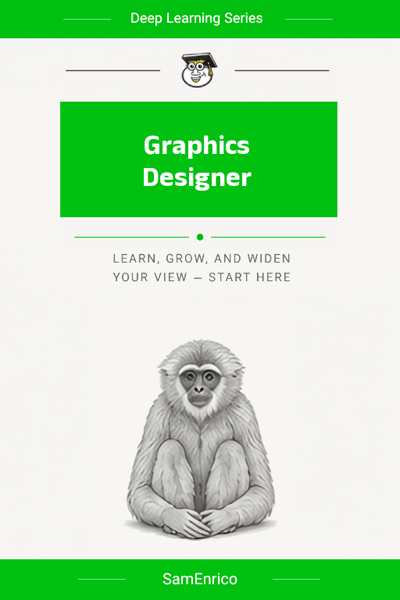
Non-FictionInformativeEducational
Graphics Designer eBook
A Coursebook on Graphics Designer
by Correa Malik
A Coursebook on Graphics Designer
Formats
Free sample
Chapter 1: The Problem-Solving Eye...--–- Before you ever open software, before you sketch a single line, before you call yourself a graphic designer, you must unlearn what most people believe the job to be. Walk into any coffee shop and ask ten people what a graphic designer does. At least seven will say something about making things look pretty. Two will mention logos. One might say “Photoshop magic.” Almost none will say what actually matters: graphic designers solve problems with visual language.
This misunderstanding is not harmless. It leads to clients who treat you as a pair of hands rather than a brain, to portfolios full of decoration without strategy, and to careers that burn out because “pretty” is subjective while “effective” is measurable. This chapter rewires your understanding of the profession from the ground up. You will learn the five-phase design thinking framework that underpins every successful project in this book, the ethical responsibilities that separate professionals from amateurs, and the mindset that allows you to absorb criticism without breaking. By the end, you will never again introduce yourself as someone who “makes things look good.” You will say: “I solve communication problems visually.
What problem do you need solved?”The Myth of the Artist-Decorator The most damaging myth in graphic design is that designers are artists who happen to work commercially. Artists begin with their own voice, their own emotion, their own vision. They ask: “What do I want to express?” The work stands or falls on its authenticity to the artist’s internal state. A graphic designer does the opposite. A designer begins with someone else’s problem, someone else’s audience, someone else’s message.
The designer asks: “What does the client need to communicate? What does the audience need to understand?” The measure of success is not self-expression but effectiveness. Did the poster sell tickets? Did the website reduce support calls? Did the logo communicate trust in under two seconds?
This does not mean design lacks creativity. It means creativity serves a purpose beyond itself. The most celebrated designs in history – the “I ♥ NY” logo, the Fed Ex arrow, the Coca-Cola script – are not celebrated because their creators poured out their souls. They are celebrated because they solved specific problems so elegantly that the solution feels inevitable. Milton Glaser did not wake up one morning feeling like drawing a heart.
He was hired to increase tourism to a struggling New York. That constraint produced the genius. Constraint is not the enemy of creativity. Constraint is creativity’s engine.The second damaging myth is that designers are marketers. Marketers work in data, psychology, and conversion funnels.
They ask: “How do we drive behavior?” Designers work in form, hierarchy, and visual logic. They ask: “How do we make meaning visible?” The two roles overlap but are not identical. A marketer might decide that a call-to-action button should say “Buy Now” because data shows urgency converts. A designer decides that button should be red (complementary to the blue background), sized 48 pixels tall, placed in the upper right of the card, and surrounded by 24 pixels of white space. Both decisions matter.
But they are different skills. This book teaches the designer’s side of that partnership. You will learn to speak the language of marketing without being a marketer, just as you will learn to speak the language of printing without being a press operator.The Design Thinking Framework: Your Operating System Every project in this book runs on the same five-phase engine. You will see these phases referenced in later chapters – Chapter 7’s logo process, Chapter 9’s prototyping workflow, Chapter 11’s client feedback loops. Memorize them now.
They will save you from the most common beginner mistake: falling in love with your first idea and skipping straight to execution.Phase One: Empathize Before you solve a problem, you must understand who experiences it. Empathy means research. It means interviews, surveys, observation, and the uncomfortable admission that you are not the user. A designer who designs for pregnant mothers but has never been pregnant must study their reality. A designer creating a website for wheelchair users must understand screen reader software and door width regulations.
Empathy is not pity. Pity says “I feel sorry for them.” Empathy says “Let me understand their constraints so well that I can design for them without guessing.” The tools of empathy include user personas (fictional archetypes based on real data), journey maps (step-by-step walkthroughs of how someone uses your design), and simple conversations. If you never speak to the people who will use your work, you are not designing – you are decorating.Phase Two: Define Define is where empathy becomes actionable. You synthesize everything you learned into a single, clear problem statement. Bad definition: “Design a logo for a coffee shop.” Good definition: “Design a logo for a neighborhood coffee shop that must appeal to remote workers seeking quiet (60% of revenue) and parents with toddlers seeking convenience (40% of revenue), while differentiating from three competitors within two blocks.” The good definition contains audience, context, constraints, and success criteria.
Without this, you will wander. With it, you have a compass. Chapter 11 will teach you how to extract this definition from a client brief. For now, practice turning vague requests into sharp problem statements. When someone says “make it pop,” your job is to ask: “What specific reaction are you hoping for?
Who is the audience? Where will they see this?” That is the define phase in action.Phase Three: Ideate Ideation is the permission to be prolific and terrible. Most beginners generate three ideas, fall in love with the second one, and spend days polishing mediocrity. Professional designers generate dozens or hundreds of ideas. Quantity breeds quality because the first ideas are always obvious.
The obvious solution is everyone’s solution. The tenth idea might be interesting. The twentieth might be original. The fiftieth might be genius. Ideation techniques include mind mapping (write a central word, branch out with associations), brainwriting (write ideas silently, pass to someone who builds on them), and the worst-possible-idea method (intentionally generate terrible solutions to bypass self-censorship).
Sketching is the core tool of ideation. Sketching is cheap. Sketching is fast. Sketching does not require talent – stick figures and boxes are fine. The goal is volume, not beauty.
Vector software (see Chapter 6) comes later. For now, use paper and a pen that cannot be erased. Erasing kills the messy connections that lead to breakthroughs.Phase Four: Prototype A prototype is any version of your solution that can be tested. Low-fidelity prototypes might be paper sketches taped to a wall, a cardboard model of a package, or a grayscale wireframe. High-fidelity prototypes look almost finished.
The right fidelity depends on what you are testing. If you are testing layout (where the logo goes, how the navigation flows), low-fidelity works fine and saves hours. If you are testing color and typography, you need higher fidelity. The key insight of prototyping is that you do not build the final thing and then test it. You build the smallest testable version, learn, then iterate.
Chapter 7’s logo mockups on coffee cups and billboards are prototypes. Chapter 9’s clickable Figma files are prototypes. Even this…
This is the end of the free sample. Get the eBook to keep going. Buy now
About this book
Details
- Author
- Correa Malik
- Publisher
- SamEnrico
- Language
- English
- Genre
- Non-Fiction, Informative, Educational
- Released
- 2026-05-07
- Pages (approx.)
- 148
- Available as
- eBook, Audiobook

Read better in the ZLOADR app
Your eBooks on your phone or tablet. Sign in with your SamEnrico account and start reading.
More by Correa Malik
 Improv Games for BusinessCorrea Malik$11.99
 Impatient Colleague Anger Control WorkbookCorrea Malik$11.99
 Financial Stress MindfulnessCorrea Malik$11.99
 The Caregiver Resentment GuideCorrea Malik$11.99
 Joy Behar Outspoken ItalianCorrea Malik$11.99
 The Last Pharaoh's Getaway: Cleopatra's Secret Island EscapeCorrea Malik$11.99
 How to Start a Organic Compounds Including Wood Distillation Products Business (Beginners Guide)Correa Malik$11.99
 Qualtrics Sales-Led GuideCorrea Malik$12.99
 Export Payment Provider ComparisonCorrea Malik$12.99
 Understanding Radiation Induced Angiosarcoma of The BreastCorrea Malik$17.99
You may also like
 Hong Kong Handover 1997Dunn Johnnie$11.99
 Zumba For Postnatal Recovery CourseNeal Christian$11.99
 Zumba for BeginnersLadner Nikia$11.99
 YouTube Comment Mining GuideHumes Pandora$12.99
 Worry Box MeditationCarlin Rudy$11.99
 Workplace Stress MeditationNguyen Lynn$11.99
 Workplace Stress and Sleep RepairHawley Ivory$11.99
 Workplace Perfectionism CureDelaney Jeffry$11.99
 Workplace Injustice Anger GuideWallen Isabelle$11.99
 Work Addiction and Burnout LinkGreenwood Ester$11.99
 Women in Yoga and WellnessBeattie Galina$11.99
 Women in Stand Up ComedyChun Evangeline$11.99