
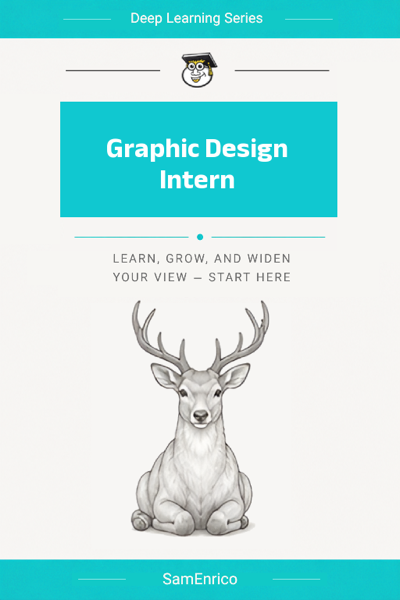
Non-FictionInformativeEducational
Graphic Design Intern eBook
A Coursebook on Graphic Design Intern
by Weldon Judie
A Coursebook on Graphic Design Intern
Formats
Free sample
Chapter 1: The Portfolio Lie...--You have been lied to.Not maliciously. Your professors genuinely believe what they are teaching. Your peers are repeating the same myths. The glossy design blogs you follow are selling you an idea that feels good but does not work. And the result is that ninety percent of design portfolios look exactly the same—and most of them never get a single internship interview.The lie is this: Your portfolio should show your best work.
Your best work should be beautiful. Beauty gets you hired.None of that is true for an internship.Creative directors do not hire interns because they saw a pretty poster on Behance. They hire interns because they saw evidence that someone can think, revise under pressure, handle vague feedback, and deliver usable files without constant hand‑holding. Beauty is a bonus. Process is the requirement.This chapter is going to hurt a little.
That is intentional. Most design students have spent three or four years being praised for their aesthetics and never once critiqued on their documentation. You have been graded on final renders while your messy folders, missing process work, and vague project descriptions were ignored. An internship has no grades. It has consequences.
A messy file means a senior designer stays late. A vague project description means you build the wrong thing for three days. A beautiful poster with no evidence of iteration means you do not get a call back.So let us reset the table. By the end of this chapter, you will understand exactly what a creative director scans for in the first ninety seconds of looking at your portfolio. You will learn why three well‑documented projects beat twelve shallow ones.
And you will walk away with a sixty‑second script that forces you to talk about your work like a professional—not an artist.Most importantly, you will stop making the mistake that kills ninety percent of internship applications before anyone even clicks on your PDF.Let us begin.The Ninety‑Second Audit A creative director at a mid‑sized agency receives between fifty and two hundred internship applications for every open position. They do not have time to study your work. They have time to scan it.Here is what happens in the first ninety seconds:Seconds 0–10: The CD opens your portfolio link or PDF. They look at the first project. If the first image is a flat, uncontextualized logo on a white background, they already suspect you have no real‑world experience.
If the first image is a beautifully photographed mockup of a poster on a brick wall, they take a breath and keep looking.Seconds 10–30: They scroll quickly. They are not reading your text yet. They are looking for variety of constraints. Did you do a poster? A website?
A social media campaign? A brand identity? If every project is the same format (three posters, three album covers, three t‑shirt designs), they assume you cannot handle different media.Seconds 30–60: They stop scrolling. They pick one project to inspect. They look for process.
Do you show sketches? Do you show a bad version that you improved? Do you explain why you made a change? Or do you just show five perfect final renders with no evidence of struggle?Seconds 60–90: They check your file organization and naming conventions. Not literally—but they check your professionalism.
Is your PDF named “Portfolio_Final_v3.pdf” or “Jane Doe_Intern_Portfolio_2025.pdf”? Is your website slow? Do your image links break? Every small friction tells them you will be high‑maintenance.After ninety seconds, they have made a preliminary decision: Interview or No. The rest of the time is just confirming that decision.Here is the brutal truth: Most portfolios fail in the first thirty seconds.
Not because the work is ugly—but because the work is unreadable. The CD cannot tell what problem you solved, what constraints you worked under, or whether you can take direction.Your job in this chapter is to become readable.The Three‑Project Rule You have twelve projects in your student portfolio. Delete nine of them. I am serious.The most common mistake young designers make is more. More projects feel safer.
More projects show range. More projects prove you worked hard. But more projects also prove you do not know how to edit yourself, and more importantly, they guarantee that each project is shallow.A creative director would rather see three projects with:A clear problem statement Evidence of research Three to five iterations (including failed attempts)A rationale for the final direction Metrics or feedback that prove it worked…than twelve projects that are just a headline, a hero image, and a “designed for a class project” caption.Let me say this again because it is the most important sentence in this chapter: Depth of process is the only thing that differentiates an intern portfolio from a student portfolio.Every design student knows how to make something pretty. That is what school teaches you. What school does not teach you—what you have to learn on your own or in this book—is how to show your thinking.
How to prove you can take a vague request and turn it into a specific solution. How to demonstrate that you listen, that you revise, that you do not fall in love with your first idea.Three projects. Each one treated like a case study. That is your new portfolio.Student Portfolio vs. Intern Portfolio Let me draw a very clear distinction.The student portfolio is what most of you have right now.
It features:Final renders only, no process Vague descriptions like “Exploration of form and color” or “Personal branding project”Projects that were assigned by a professor with a clear brief File names like “final_FINAL_3.ai”A focus on aesthetics over outcomes The intern portfolio is what gets you hired. It features:Sketches, wireframes, rejected versions, and final outcomes Descriptions that answer: What was the problem? What were the constraints? What was your solution? How did it perform?Projects you defined yourself or that came from ambiguous real‑world constraints Professional file naming and organization A focus on why over what Look at your current portfolio.
Which column does it match? Be honest. If it looks more like the student portfolio, do not panic. That is why you are reading this book. You are going to rebuild everything.The Elevator Critique: Your 60‑Second Script You have sixty seconds to explain any project in your portfolio.
Not ten minutes. Not a dramatic backstory about your artistic journey. Sixty seconds.Here is the exact formula:“The problem was X. The constraint was Y. My solution was Z.
Here is how it performed.”That is it. No jargon. No “I wanted to explore the tension between chaos and order.” No “This represents my personal aesthetic journey.” Just problem, constraint, solution, result.Let me give you an example.Bad (student) pitch: “This is a poster I made for a music festival. I was really inspired by Swiss modernism and wanted to use a lot of negative space and a bold color palette. I think it communicates energy and movement.”Good (intern) pitch: “The problem…
This is the end of the free sample. Get the eBook to keep going. Buy now
About this book
Details
- Author
- Weldon Judie
- Publisher
- SamEnrico
- Language
- English
- Genre
- Non-Fiction, Informative, Educational
- Released
- 2026-06-03
- Pages (approx.)
- 140
- Available as
- eBook, Audiobook

Read better in the ZLOADR app
Your eBooks on your phone or tablet. Sign in with your SamEnrico account and start reading.
More by Weldon Judie
 Nairobi Female Angel Network GuideWeldon Judie$11.99
 Exam Anxiety Memory ProtocolWeldon Judie$11.99
 The Menopause Body ScanWeldon Judie$11.99
 Testosterone and Blood PressureWeldon Judie$11.99
 Presenteeism and Burnout RecoveryWeldon Judie$11.99
 The Phantom Ledger: How a 19th-Century Banker Outsmarted the WorldWeldon Judie$11.99
 Seams of Scandal: The Unraveling of John GallianoWeldon Judie$11.99
 Darwin Study And PR GuideWeldon Judie$12.99
 Cooperative Value AdditionWeldon Judie$12.99
 Understanding Charge SyndromeWeldon Judie$17.99
 How to Become a Bulk-sealer OperatorWeldon Judie$11.99
You may also like
 Hong Kong Handover 1997Dunn Johnnie$11.99
 Zumba For Postnatal Recovery CourseNeal Christian$11.99
 Zumba for BeginnersLadner Nikia$11.99
 YouTube Comment Mining GuideHumes Pandora$12.99
 Worry Box MeditationCarlin Rudy$11.99
 Workplace Stress MeditationNguyen Lynn$11.99
 Workplace Stress and Sleep RepairHawley Ivory$11.99
 Workplace Perfectionism CureDelaney Jeffry$11.99
 Workplace Injustice Anger GuideWallen Isabelle$11.99
 Work Addiction and Burnout LinkGreenwood Ester$11.99
 Women in Yoga and WellnessBeattie Galina$11.99
 Women in Stand Up ComedyChun Evangeline$11.99