
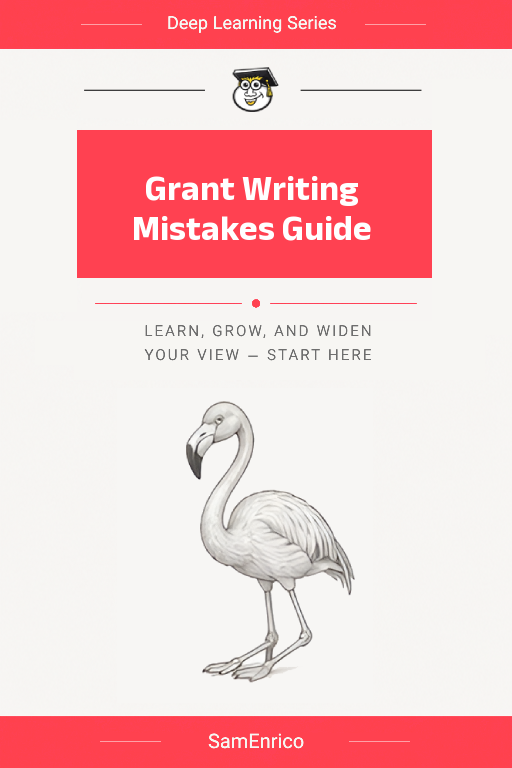
Non-FictionProfessional's Cheat SheetFunding Proposals
Grant Writing Mistakes Guide eBook
Avoid common grant writing mistakes in US, UK, and
Avoid common grant writing mistakes in US, UK, and Kenya. Eligibility, formatting, and deadline issues.
Formats
Free sample
Chapter 1: The Compliance Wall--Most grant writers believe a lie. The lie is comforting, seductive, and almost universally held by first-time applicants and seasoned professionals alike. The lie sounds like this: If our project is impactful enough, if our need is urgent enough, if our solution is innovative enough, the funder will see past minor errors and fund us anyway. This chapter exists to murder that lie.Based on an analysis of 1,000 rejected proposals across the United States, the United Kingdom, and Kenya, nearly one-third—thirty-one percent, to be precise—failed before a single reviewer ever evaluated the quality of the proposed project. These applications were rejected not because the idea was weak, not because the budget was padded, and not because the logic model was flawed.
They were rejected because they violated a non-negotiable compliance rule. They hit what we call the Compliance Wall: a binary, pass/fail barrier that stands between submission and review. You do not score points for clearing the Compliance Wall. You simply pass through it, or you do not. And if you do not, nothing else matters.This chapter is the foundation of every mistake documented in this book.
If you understand why good ideas lose to bad compliance, you will stop wasting months of work on proposals that never had a chance. You will learn to read a Request for Proposals like a contract, not a suggestion. And you will never again utter the phrase, “But our project is so needed.”The Anatomy of the Compliance Wall The Compliance Wall is not mysterious. It is not subjective. It is a collection of explicit, written requirements that a funder places between the applicant and the review process.
Think of it as a locked door. Behind the door are reviewers who might fall in love with your project. In front of the door are the compliance rules. The key to the door is not a great narrative. The key is a set of checkboxes, attestations, and formatting decisions.In the United States, the Compliance Wall is constructed primarily from federal regulations, Uniform Guidance, and the specific authorizing statute of each grant program.
Ignore any of these, and you will not pass go.In the United Kingdom, the Compliance Wall includes the Charities Act 2011, data protection requirements, and the specific charitable object clauses that determine which organizations can apply for which funds.In Kenya, the Compliance Wall is shaped by the Public Finance Management Act (PFMA) for national grants, the County Integrated Development Plans (CIDPs) for county grants, and the NGO Coordination Board registration requirements that apply to virtually all non-governmental funding.What unites these three countries is a simple truth: Compliance is scored before impact. A reviewer does not read your needs statement and then check your compliance. They check your compliance first. If you fail, your needs statement is never read.Case Study Number One: The $2 Million Mistake A mid-sized health nonprofit in Chicago spent six months developing a proposal for a federal grant from the National Institutes of Health. The program was elegant: a community health worker intervention to reduce maternal mortality in three underserved neighborhoods.
The logic model was airtight. The budget was conservative. Letters of support from three hospitals and two city agencies were attached. The lead writer, a veteran with twelve years of experience, was confident.The proposal was rejected within seventy-two hours of submission. The reason cited: “The applicant did not meet the eligibility requirements of the authorizing statute.”What happened?
The grant was authorized under a specific NIH appropriation for clinical trials of medical interventions. The community health worker model was not a clinical trial. It did not involve a regulated medical product, a control group, or FDA oversight. The nonprofit had applied to the wrong grant program entirely. They had seen the words “maternal mortality” in the RFP and stopped reading.The program officer, in a rare act of kindness, took a fifteen-minute call with the executive director.
“Your project is excellent,” she said. “But I cannot legally give you this money. The law that created this grant says I can only fund clinical trials. If I funded you, I would be breaking the law. I am not going to break the law.”The Compliance Wall is not a suggestion.
It is the law.Case Study Number Two: The Charities Act Trap A small community organization in Manchester, England, had been running after-school programs for low-income children for eight years. They were not a registered charity. They were an unincorporated association with a bank account and a passion for their work. They applied to a £50,000 grant from a National Lottery fund that explicitly required applicants to be “registered charities with the Charity Commission for England and Wales.”They were rejected in eleven days. The rejection letter was two sentences long.
The organization’s director called the funder, confused. “But we do the work,” she said. “We help children every day. Why does our legal status matter?”The program officer explained: the National Lottery Act, which authorizes the distribution of lottery funds, requires that grants go only to registered charities. This is not a preference.
It is a statutory requirement. The funder had no discretion. The organization could not apply until it completed the registration process with the Charity Commission—a process that takes between six and eighteen months.The Compliance Wall does not care about your passion. It cares about your paperwork.Case Study Number Three: The PFMA and the Missing CIDPA community-based organization in Kisumu County, Kenya, had been working on agricultural extension services for four years. They had an excellent track record.
They had letters of support from the county government. They applied for a national government grant from the Ministry of Agriculture.The application was rejected as “non-compliant with the Public Finance Management Act.”What went wrong? Under Kenya’s 2010 Constitution, agriculture extension services are a devolved function. They belong to county governments, not the national government. The national Ministry of Agriculture does not fund agricultural extension at the village level.
It funds policy, research, and international agreements. The organization had applied to the wrong level of government entirely.But there was a second error buried in the first. Even if they had applied to the county government, their project was not listed in the county’s five-year County Integrated Development Plan (CIDP). The CIDP is the county government’s blueprint for all projects it will fund. If a project is not in the CIDP, the county cannot legally allocate funds to it.
This is not a guideline. It is a requirement of the PFMA.The organization had made two compliance errors in a single application: wrong level of government, and no CIDP alignment. The rejection was automatic. The reviewers never saw their excellent track record.Why the Compliance Wall Is Not Taught Enough Most grant writing books and training programs focus on narrative quality, logic models, and budget construction. These are important skills.
But they are secondary skills. You cannot deploy them if you never reach the reviewer’s desk.There is a structural reason for this. Grant writing instructors are often former grant writers or program officers. They succeeded in the field, which means they…
This is the end of the free sample. Get the eBook to keep going. Buy now
About this book
Details
- Author
- Mcgehee Bridgett
- Publisher
- SamEnrico
- Language
- English
- Genre
- Non-Fiction, Professional's Cheat Sheet, Funding Proposals
- Released
- 2026-06-01
- Pages (approx.)
- 137
- Available as
- eBook, Audiobook

Read better in the ZLOADR app
Your eBooks on your phone or tablet. Sign in with your SamEnrico account and start reading.
More by Mcgehee Bridgett
 The Full Body Stretching RoutineMcgehee Bridgett$11.99
 Parenting With Partner EsteemMcgehee Bridgett$11.99
 Channel Strategy For StartupsMcgehee Bridgett$11.99
 Persuasion for ParentingMcgehee Bridgett$11.99
 Iron Crown: Charlemagne's Shadow War for EuropeMcgehee Bridgett$11.99
 How to Start a Pickling of Fruit and Vegetables Business (Beginners Guide)Mcgehee Bridgett$11.99
 Learn to Play the KobzaMcgehee Bridgett$11.99
 Meat PackerMcgehee Bridgett$11.99
You may also like
 Hong Kong Handover 1997Dunn Johnnie$11.99
 Zumba For Postnatal Recovery CourseNeal Christian$11.99
 Zumba for BeginnersLadner Nikia$11.99
 YouTube Comment Mining GuideHumes Pandora$12.99
 Worry Box MeditationCarlin Rudy$11.99
 Workplace Stress MeditationNguyen Lynn$11.99
 Workplace Stress and Sleep RepairHawley Ivory$11.99
 Workplace Perfectionism CureDelaney Jeffry$11.99
 Workplace Injustice Anger GuideWallen Isabelle$11.99
 Work Addiction and Burnout LinkGreenwood Ester$11.99
 Women in Yoga and WellnessBeattie Galina$11.99
 Women in Stand Up ComedyChun Evangeline$11.99