
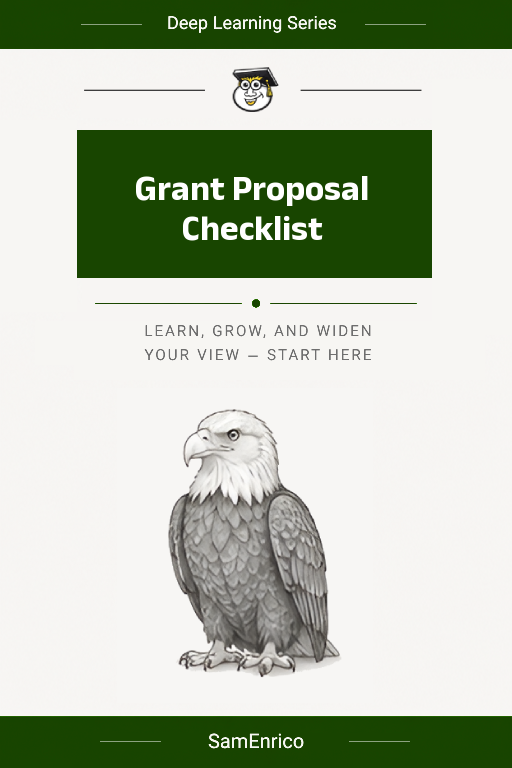
Non-FictionProfessional's Cheat SheetChecklist
Grant Proposal Checklist eBook
50-point checklist for grant proposal completeness
50-point checklist for grant proposal completeness before submission.
Formats
Free sample
Chapter 1: The 24-Hour Miracle--–- Most grant writers discover their fatal error at 11:47 PM on the night of the deadline. Not at 9 AM, when they were fresh. Not at 2 PM, when they had help. At 11:47 PM, alone, with caffeine shakes and a cursor blinking over a submission button that cannot be un-pressed. That moment—the space between knowing and acting—is where this book begins.This is not a book about how to write a grant proposal.
There are already dozens of excellent books that will teach you how to craft a compelling needs statement, how to align your outcomes with a funder's priorities, and how to budget for indirect costs. If you need those skills, buy those books. Read them. Highlight them. This book assumes you already know how to write.
What you do not yet know is how to verify.Verification is the difference between a 12 percent win rate and a 47 percent win rate. It is the difference between submitting a proposal that you hope will win and submitting a proposal that you know cannot be rejected for compliance reasons. Every grant reviewer who has ever read a proposal has a stack of dead applications that failed不是因为 bad writing, but because the writer missed a requirement. A font that was 11.5 points instead of 12. A margin that was 0.9 inches instead of 1.
A hidden text box revealed only by clicking "No." A portal warning treated as optional. A signature page uploaded as a Word document instead of a PDF. A budget narrative that forgot to explain the indirect cost rate. A letter of support addressed to "To Whom It May Concern."Each of these errors, by itself, is small. Each one, in isolation, could be dismissed as a typo or an oversight.
But grant reviewers are not paid to forgive. They are paid to follow a rubric. And the rubric has no column for "close enough."This chapter introduces the central paradox of grant writing: The closer you get to the deadline, the less capable your brain becomes of catching errors. That is not a character flaw. It is neurology.
And the solution is not working harder or staying later. The solution is a system. Specifically, the 50-point pre-submission verification system that gives this book its name, its structure, and its reason for existing.The RFP Blindness Phenomenon Every professional grant writer knows the feeling. You have read the Request for Proposals (RFP) seventeen times. You have highlighted key sections.
You have created a compliance matrix. You have checked off every requirement on your list. And then, after submission, you receive the rejection notice. Buried in the reviewer comments is a single sentence: "The proposal did not address the requirement for a data sharing agreement as specified on page 12 of the RFP."You go back to page 12. The requirement is there, in plain text.
You read it eighteen times and never saw it. This is not a failure of effort. It is a failure of perception. Cognitive psychologists call this inattentional blindness—the well-documented phenomenon where focused attention on one task causes you to miss unexpected stimuli in your visual field. When you have read an RFP repeatedly, your brain stops processing it as a set of instructions and starts processing it as a familiar pattern.
You are no longer reading; you are recognizing. And recognition skips over details.I call this specific form of inattentional blindness RFP Blindness. It is the single most common cause of grant failure among experienced writers. Beginners fail because they do not know the rules. Experienced writers fail because they think they already know the rules and stop seeing them.Consider a study conducted by researchers at the University of Illinois in 2019.
They asked two groups of grant writers—novices with less than one year of experience and experts with more than five years—to review the same RFP and identify all compliance requirements. The novices found an average of 68 percent of requirements. The experts found an average of 71 percent. The difference was statistically insignificant. But here is the crucial finding: the experts were more confident in their answers, even when they were wrong.
They had stopped questioning their own perception.The 50-point checklist is not a tool for beginners. It is a tool for experts who have become blind to their own blind spots. It forces you to verify every component, every time, regardless of how many times you have done it before. It is the cognitive equivalent of a pre-flight checklist used by commercial pilots—not because pilots are unskilled, but because skill does not protect against the brain's natural tendency to skip steps.The 24-Hour Rule: Why Waiting Until the Last Minute Is a Mathematical Mistake Every grant writer has a story about the deadline that almost killed them. The portal crashed at 11:55 PM.
The internet went out during a thunderstorm. The authorized signatory was on a flight to Tokyo with no Wi-Fi. The PDF corrupted during upload. The system rejected the file name because it contained a space.These stories are treated as cautionary tales. They should be treated as data points.
The question is not whether something will go wrong in the final hour before a deadline. The question is how many things will go wrong, and whether you have built enough buffer to survive them.The 24-Hour Rule is simple: submit a full 24 hours before the published deadline. Not 23 hours. Not 12 hours. Not "by midnight the day before." Twenty-four hours.
This rule synthesizes advice from Writing to Win Federal Grants, AFSCME's grant management resources, and the Federal Grants Management Improvement Act, all of which document the same pattern: the final hour before a deadline is the highest-risk period for technical failure, and that risk is entirely avoidable.Let me be explicit about what the 24-Hour Rule is not. It is not a recommendation to finish writing 24 hours early. That would be absurd for complex proposals. You will write until 48 hours before the deadline, create your final PDF at 48 hours, and then spend the next 24 hours in verification and review. The submission itself happens at 24 hours.
This timeline—which I call the Master Submission Timeline—is the first of the 50 checkpoints in this book.Here is the Master Submission Timeline in full:T-72 hours (three days before deadline): All narrative writing is complete. No new content is added after this point. Only editing, formatting, and verification remain.T-48 hours (two days before deadline): The final PDF is created from the master document. This PDF is frozen. No further changes are made to the source document unless a critical error is discovered during verification.
If a change is required, a new PDF is created and the clock resets to T-48.T-36 hours (one and a half days before deadline): The internal blind review occurs. A colleague with no prior involvement in the proposal reads the PDF and completes the 50-point checklist. Any errors found are corrected in the source document, and a new PDF is created.T-24 hours (one day before deadline): The proposal is uploaded to the portal. All attachments are uploaded. All portal fields are completed.
The submit button is clicked. The confirmation screen is captured. This is not a dry run. This is the actual…
This is the end of the free sample. Get the eBook to keep going. Buy now
About this book
Details
- Author
- Veal Candance
- Publisher
- SamEnrico
- Language
- English
- Genre
- Non-Fiction, Professional's Cheat Sheet, Checklist
- Released
- 2026-05-27
- Pages (approx.)
- 145
- Available as
- eBook, Audiobook

Read better in the ZLOADR app
Your eBooks on your phone or tablet. Sign in with your SamEnrico account and start reading.
More by Veal Candance
 Cannabis Withdrawal Sleep AidVeal Candance$11.99
 Strong Lifts 5x5 ExplainedVeal Candance$11.99
 The Vineyard Hill GuideVeal Candance$11.99
 Five Minute Meditation Habit CourseVeal Candance$11.99
 Parent Death in Nursing HomeVeal Candance$11.99
 The Whispering Lanterns of Obon: A Yokai's Path to RedemptionVeal Candance$11.99
 The Unseen Hands: How Lobbyists Shaped the Paris AgreementVeal Candance$11.99
 Employee Jury Duty TrapVeal Candance$12.99
 Understanding Glycogen Storage DiseaseVeal Candance$17.99
 MimeVeal Candance$11.99
 How to Become a Transfer ClerkVeal Candance$11.99
You may also like
 Hong Kong Handover 1997Dunn Johnnie$11.99
 Zumba For Postnatal Recovery CourseNeal Christian$11.99
 Zumba for BeginnersLadner Nikia$11.99
 YouTube Comment Mining GuideHumes Pandora$12.99
 Worry Box MeditationCarlin Rudy$11.99
 Workplace Stress MeditationNguyen Lynn$11.99
 Workplace Stress and Sleep RepairHawley Ivory$11.99
 Workplace Perfectionism CureDelaney Jeffry$11.99
 Workplace Injustice Anger GuideWallen Isabelle$11.99
 Work Addiction and Burnout LinkGreenwood Ester$11.99
 Women in Yoga and WellnessBeattie Galina$11.99
 Women in Stand Up ComedyChun Evangeline$11.99