
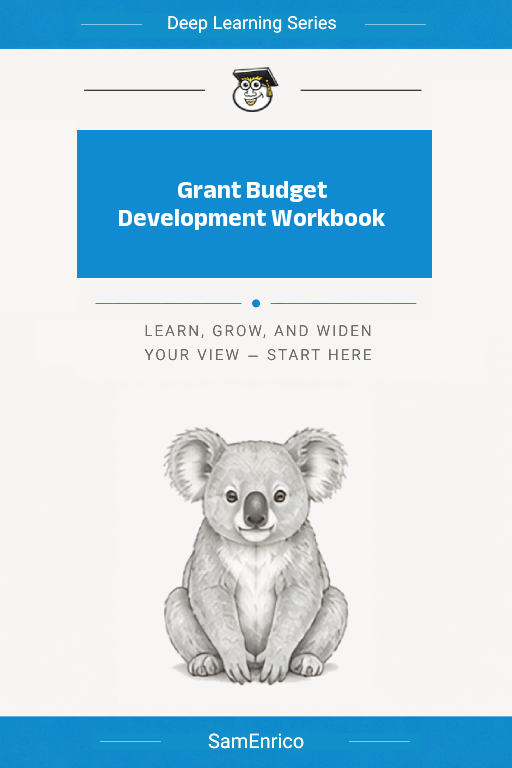
Non-FictionProfessional's Cheat SheetBudgeting
Grant Budget Development Workbook eBook
Build compliant budgets including personnel, equip
by Dunn Johnnie
Build compliant budgets including personnel, equipment, indirect costs, and match requirements.
Formats
Free sample
Chapter 1: The Golden Thread--–- Every year, millions of dollars in grant proposals are rejected not because the science was weak, not because the community need was trivial, and not because the organization lacked capacity. They are rejected because the budget and the narrative told two different stories.You have likely seen this happen. A proposal describes an ambitious plan to train five hundred community health workers across three states. The narrative sings with detail about travel to remote clinics, printed curricula in four languages, and follow-up mentorship sessions. Then you flip to the budget.
The travel line shows two trips to a single city. The supplies line includes a vague $500 for "training materials." There is no line for consultants or translators. The math is correct, but the story has collapsed.This chapter exists to ensure that never happens to you. We call it The Golden Thread – the unbreakable line of sight between every dollar you request and every activity you promise. A budget without a golden thread is not a budget at all.
It is a spreadsheet of wishes. A narrative without a golden thread is not a proposal. It is a daydream.In this chapter, you will learn why most budget failures are narrative failures, not math failures. You will master the four legal pillars that govern every federal grant dollar: allowable, allocable, reasonable, and consistent. You will complete a worksheet that forces you to map every single line item to a specific page and paragraph in your proposal.
And you will walk away with a budget that does not merely support your narrative – it becomes a second, more rigorous version of your narrative, one that reviewers trust because it adds up in more ways than one.Why Most Budgets Fail Before the Math Is Checked Let me share a story that illustrates how quickly a promising proposal can unravel.A mid-sized nonprofit once applied for a federal grant to run a workforce development program for unemployed veterans. The narrative was excellent. It described twelve weeks of classroom training, eight weeks of paid internships with local employers, and intensive case management throughout. The budget included a full-time project director, two job coaches, classroom materials, and travel to employer sites. The total request was $450,000.
The math was flawless.The proposal was rejected.The review panel's summary noted a single fatal flaw: the budget included a $60,000 line item for "evaluation consultant" but the narrative never mentioned evaluation. Not once. The narrative described outputs – number of veterans trained, number placed in jobs – but never described any method for measuring those outputs. The budget had a cost that was not allocable to any activity in the narrative. The golden thread was broken.The nonprofit had hired an evaluator early in the planning process, assumed evaluation was required (it was not), and added the cost without updating the narrative.
One missing paragraph. One rejected proposal. Four hundred fifty thousand dollars.This is not an unusual story. It happens every day. Reviewers are not mind readers.
They cannot infer that a cost is necessary just because it appears on a spreadsheet. The budget and the narrative must speak the same language. If your narrative says you will conduct "monthly community advisory board meetings," your budget must show either a line item for catering, stipends for board members, or meeting space rental – or a clear statement that these costs are covered by match. If your narrative says you will "develop a mobile application for participants," your budget must show either a consultant line for a developer, a supplies line for software licenses, or an explanation that existing staff will do the development within their effort percentage.Every action requires resources. Every resource requires a line item.
Every line item requires an action. That is the golden thread.The Four Pillars of Every Compliant Dollar Before you can align your budget with your narrative, you need to understand the rules that govern whether a cost can be charged to a federal grant at all. These rules come from the Uniform Administrative Requirements, Cost Principles, and Audit Requirements for Federal Awards – known as 2 CFR Part 200, or simply "Uniform Guidance." Within that dense regulation are four core tests that every cost must pass.Allowable means the cost is not explicitly prohibited by the funding agency or by federal regulation. This sounds obvious, but the list of prohibited costs is longer than most applicants realize. For example, you cannot charge entertainment costs to a federal grant.
You cannot charge lobbying expenses. You cannot charge alcoholic beverages. You cannot charge fines or penalties. Some agencies add their own prohibitions. The Department of Justice, for instance, often prohibits the purchase of firearms and ammunition.
The Department of Education frequently prohibits the purchase of food for staff meetings. The first question you must ask about any potential cost is not "Can we use this?" but "Does anyone explicitly forbid this?" Chapter 2 provides a complete NOFO scanner to catch these prohibitions before you start calculating. (A full list of commonly disallowed costs also appears in Chapter 2's Red Flag Alert.)Allocable means the cost benefits the grant and only the grant. If a cost benefits multiple projects, you may charge only the portion that directly serves this specific grant. This is where effort reporting becomes critical.
If a program manager spends twenty percent of her time on this grant and eighty percent on other activities, you may charge twenty percent of her salary to the grant – no more. The same principle applies to equipment, office space, and supplies. If you buy a printer that will be used equally by three different grants, you must split the cost proportionally. Allocability is the reason you cannot charge the full salary of an executive director who oversees thirty different programs. You can charge only the portion of their time that is directly tied to this specific project.Reasonable means a prudent person would pay that price under similar circumstances.
This is the most subjective of the four pillars, and therefore the one that trips up the most applicants. Reasonableness is not about the lowest possible price. It is about defensible choices. If you budget 10,000forathree−dayconferenceinamid−sizedcity,areviewerwillraiseaneyebrow.Ifyoubudgetthesame10,000 for a three-day conference in a mid-sized city, a reviewer will raise an eyebrow. If you budget the same 10,000forathree−dayconferenceinamid−sizedcity,areviewerwillraiseaneyebrow.Ifyoubudgetthesame10,000 for a three-day conference in Manhattan during peak season, with documented hotel rates at the government per diem and airfare booked twenty-one days in advance, the same reviewer will nod.
Reasonableness is demonstrated through documentation. You do not need to prove you found the absolute cheapest option. You need to prove you made a good faith effort to spend grant dollars wisely.Consistent means you treat the same types of costs the same way across all funding sources. You cannot charge fringe benefits on a grant as a percentage of salary for one project and as a flat rate for another. You cannot classify laptops as equipment when paid by one funder and as supplies when paid by another.
Consistency protects against creative accounting. It also simplifies your life. Once you establish a policy – for example, "all computers under $5,000 are classified…
This is the end of the free sample. Get the eBook to keep going. Buy now
About this book
Details
- Author
- Dunn Johnnie
- Publisher
- SamEnrico
- Language
- English
- Genre
- Non-Fiction, Professional's Cheat Sheet, Budgeting
- Released
- 2026-05-29
- Pages (approx.)
- 160
- Available as
- eBook, Audiobook

Read better in the ZLOADR app
Your eBooks on your phone or tablet. Sign in with your SamEnrico account and start reading.
More by Dunn Johnnie
 Hong Kong Handover 1997Dunn Johnnie$11.99
 Social Security Life ExpectancyDunn Johnnie$11.99
 Calm Down Fast TechniquesDunn Johnnie$11.99
 Hinton Execution Dates AvoidedDunn Johnnie$11.99
 Demand Variability Safety StockDunn Johnnie$11.99
 Memory Palace For Yoga SequencesDunn Johnnie$11.99
 Recurring Dream AnalysisDunn Johnnie$11.99
 Pomodoro for EngineersDunn Johnnie$11.99
 The Double Life of Mata Hari: A Spy’s Last DanceDunn Johnnie$11.99
 Iron Storm: The Hittites' Last Stand at KadeshDunn Johnnie$11.99
 Mastering The SternocleidomastoidDunn Johnnie$11.99
 How to Produce Pottery and EnamelDunn Johnnie$11.99
You may also like
Hong Kong Handover 1997Dunn Johnnie$11.99 Zumba For Postnatal Recovery CourseNeal Christian$11.99
 Zumba for BeginnersLadner Nikia$11.99
 YouTube Comment Mining GuideHumes Pandora$12.99
 Worry Box MeditationCarlin Rudy$11.99
 Workplace Stress MeditationNguyen Lynn$11.99
 Workplace Stress and Sleep RepairHawley Ivory$11.99
 Workplace Perfectionism CureDelaney Jeffry$11.99
 Workplace Injustice Anger GuideWallen Isabelle$11.99
 Work Addiction and Burnout LinkGreenwood Ester$11.99
 Women in Yoga and WellnessBeattie Galina$11.99
 Women in Stand Up ComedyChun Evangeline$11.99