
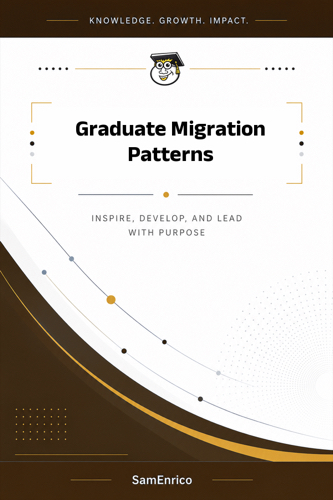
Graduate Migration Patterns eBook
Tracks where international students settle after g
by Castle Mandi
Tracks where international students settle after graduation.
Formats
Free sample
Chapter 1: The Million-Dollar Visa--–- The young woman in Seat 14C had never been on an airplane before. At twenty-three years old, Priya Sharma had spent her entire life within a forty-kilometer radius of her parents' home in Lucknow, India. Now she was thirty-thousand feet above the Arabian Sea, clutching a laminated acceptance letter from the University of Toronto like a religious talisman, her knuckles white, her heart pounding so loudly she was certain the passenger beside her could hear it.The letter said she had been admitted to a master's program in computer engineering. What the letter did not say—what no letter from any university anywhere in the world ever says—was that Priya was not really buying an education. She was buying a lottery ticket.
And like most lottery tickets, it would almost certainly lose.Her father had mortgaged their home to pay the first year's tuition: $42,000 Canadian dollars, roughly 2.6 million rupees, more money than her grandparents had earned in their entire combined lifetimes. Her mother had sold her wedding gold. Her younger brother had dropped out of college to work at a call center so the family could afford her plane ticket. None of them said the words out loud, but they all knew the unspoken calculation: if Priya could not find a way to stay in Canada after graduation, if she was forced to return home with only a degree and no permanent residency, the family would be ruined. Not metaphorically ruined.
Actually, literally, we-cannot-pay-back-the-loan ruined."You will stay," her father had told her at the airport, gripping her shoulders with hands calloused from thirty years of driving a taxi. "However you must. You will stay."He did not mean she would stay enrolled in the program. He meant she would stay in Canada. Forever.
By any means necessary.Priya did not know it yet, but she had just joined the largest unacknowledged migration stream in human history. She was not a tourist. She was not a refugee. She was something more valuable and more precarious than either: an international student on the two-step migration path, using education as the down payment on a life she had not yet built, in a country she had never seen, under rules that could change at any moment, without warning, by the whim of politicians who would never know her name.There are 6.4 million people just like Priya on the move right now. By the time you finish this chapter, approximately 120 more will have boarded planes to foreign universities.
And most of them—if the statistics hold—will fail.The $200 Billion Gamble Let us begin with a number so large it almost loses meaning: international students now generate more than $200 billion annually in tuition, housing, and living expenses across the world's wealthiest countries. That sum exceeds the total export value of coffee, tea, and spices combined. It is larger than the global market for iron ore. It is roughly equivalent to the GDP of Hungary.But the students themselves are not the primary customers of this industry. They are the product.This is the first and most important inversion you must understand to read this book correctly.
We typically think of international students as consumers—they pay tuition, they receive education, they return home enriched. That model describes perhaps fifteen percent of the international student population: the short-term exchange students, the wealthy scions on gap years, the language tourists who spend three months in Brighton and go home with an accent they acquired from watching BBC dramas.The other eighty-five percent are engaged in something altogether different. They are engaged in what migration scholars call degree mobility—the pursuit of a foreign credential not as an end in itself, but as the first step in a two-step migration process. Step one: obtain a degree from a country with a favorable immigration system. Step two: convert that degree into permanent residency, then citizenship, then a life.If you are a policymaker in Ottawa or Canberra or Berlin, you already know this.
You are not recruiting students. You are recruiting future taxpayers, future homeowners, future voters. The tuition is merely a screening mechanism—a way to ensure that only the most determined, most capable, most financially stable applicants make it through the first gate.If you are a student, you may not know this. You may believe you are simply pursuing a better education. But the immigration system knows.
The labor market knows. And the path you think you are walking is lined with traps you cannot see from the admissions office.The Map of Global Talent To understand where graduates settle after graduation, we must first understand where they study. The two are not the same thing—but they are intimately connected, like the trajectory of a bullet and the aim of the gun that fired it.Twenty years ago, the map of international student migration was simple. There were two dominant destinations: the United States and the United Kingdom. Together, they absorbed nearly sixty percent of all degree-seeking international students.
The rest scattered across Canada, Australia, and a handful of European countries, with tiny fractions going to Asia and the Middle East.That map is now obsolete.Consider these shifts:The United States still attracts more international students than any single country—approximately one million as of the most recent count. But its share of the global market has fallen from thirty percent to under twenty percent in less than a decade. The reasons are not mysterious: the H-1B visa lottery, the cap on post-graduation work authorization, the rising cost of tuition, and the perception—accurate or not—that America has become hostile to immigrants. Priya considered the United States for exactly one day before her uncle, who had been living in New Jersey on a work visa for eleven years without achieving permanent residency, talked her out of it. "You will be temporary forever," he told her.
"They will take your labor and give you nothing."The United Kingdom briefly collapsed as a destination after Brexit, losing nearly half its international enrollment between 2012 and 2018. A post-Brexit recovery has since begun, driven by the reintroduction of a two-year post-study work visa. But the UK's problem is structural: its immigration system was designed for empire, not for settlement. Most international graduates still cannot find a path to permanent residency. They work for two or three years on temporary visas, then leave.
The UK trains the world's talent and then exports it to Canada or Australia.Australia has become a powerhouse, attracting nearly 700,000 international students despite being a nation of only 25 million people. Its secret is the points-based immigration system, which explicitly rewards graduates of Australian universities with extra points toward permanent residency. The message is clear: if you study here, we will fast-track you to citizenship. That message has generated enormous loyalty—and enormous controversy, as successive governments have tightened and loosened the rules unpredictably.Germany has emerged as the unlikely champion of free movement, offering eighteen months of post-study job-seeking time and a relatively straightforward path to permanent residency after two years of work. Germany's advantage is demographic: the country is aging so rapidly that it has no…
This is the end of the free sample. Get the eBook to keep going. Buy now
About this book
Details
- Author
- Castle Mandi
- Publisher
- SamEnrico
- Language
- English
- Genre
- Non-Fiction, Forecast & Outlook, Student Mobility
- Released
- 2026-06-07
- Pages (approx.)
- 150
- Available as
- eBook, Audiobook

Read better in the ZLOADR app
Your eBooks on your phone or tablet. Sign in with your SamEnrico account and start reading.
More by Castle Mandi
 Post Trauma Phobia PTSDCastle Mandi$11.99
 Tow Truck Operator Stress GuideCastle Mandi$11.99
 Research Proposal for Ford Foundation FellowshipCastle Mandi$11.99
 Medical School Stress ResilienceCastle Mandi$11.99
 Two Part Tariff AnalysisCastle Mandi$11.99
 Darts Concentration HypnosisCastle Mandi$11.99
 Self Worth Workbook ChildhoodCastle Mandi$11.99
 Charlemagne: The Hammer of the Franks and the Dawn of EuropeCastle Mandi$11.99
 The Hurling Revolution: How Gaelic Games Stormed AmericaCastle Mandi$11.99
 Growing Disa (An Orchid Genus)Castle Mandi$11.99
 Email-Based Affiliate MarketingCastle Mandi$11.99
 South Africa Business Credit Future TrendsCastle Mandi$12.99