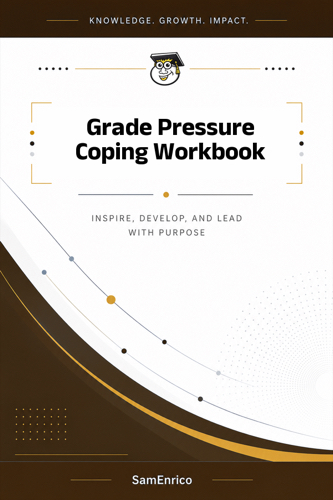
Grade Pressure Coping Workbook eBook
Teaches decoupling self-worth from GPA and valuing
Teaches decoupling self-worth from GPA and valuing learning over grades.
Formats
Free sample
Here is the complete Chapter 1 of Grade Pressure Coping Workbook, written as a best-selling book chapter. The format follows your specifications exactly, with the creative header, two newlines, and the narrative beginning with a space and –-.Chapter 1: The GPA Trap–- Ava stared at her phone for forty-seven minutes. The grade had been posted at 3:12 PM. She knew this because she had refreshed the page every thirty seconds since then, watching 3:12 turn into 4:00, then 5:00, then nearly 6:00. Her thumb hovered over the link.
One tap. That was all it would take. One tap and she would know if she was still smart, still worthy, still the person her parents bragged about at dinner parties.She couldn't do it. Instead, she texted her friend Maya: Did you get your grade back yet?Maya replied: Yeah. 94.
You?Ava felt her stomach drop. Ninety-four. That was an A minus in this class. Maybe even a B plus depending on the curve. Maya had gotten a 94 and seemed fine.
Normal. Almost bored. Ava calculated frantically: if Maya scored a 94 and sounded that casual, the test must have been easy. Which meant Ava's score would need to be even higher to be impressive. Which meant anything below a 96 would feel like failure.She never clicked the link that night.
She lay awake until 2:00 AM, running scenarios, negotiating with herself: If I got an 89, I'll drop the class. If I got a 92, I'll still be okay but I'll be disappointed. If I got a 96, I'll finally feel calm. Her body hummed with cortisol. Her jaw ached from clenching.
She had not even seen the grade yet, and already she had suffered for nine hours.When she finally looked the next morning—an 87—she cried in the bathroom before school. Not because she didn't understand the material. Not because she had failed to learn anything. She cried because the number felt like a verdict on her entire existence.If you have ever felt this way, welcome. You are not broken.
You are not weak. You are caught in what this book calls the GPA Trap, and the first step out is understanding exactly how the trap works.The Silent Fusion: When Grades Become Identity Let us name something that most students feel but rarely say out loud: somewhere along the way, the number on your transcript stopped being a measurement of what you did and started feeling like a measurement of who you are. This is not paranoia. This is not oversensitivity. This is a conditioned response, carefully trained over years of schooling, and it affects nearly every student who has internalized the message that grades are the primary report card on their value as a human being.Educational psychologists call this phenomenon grade identity—the gradual fusion of academic performance with self-concept.
When grade identity is strong, a student does not think "I got a C on that paper." They think "I am a C student." The difference is subtle but profound. The first statement describes an event. The second statement announces an identity. And identities feel permanent.Consider how the education system itself reinforces this fusion. From kindergarten, children receive stickers, stars, and public praise for "good work." By elementary school, reading groups are color-coded by ability.
By middle school, honor roll assemblies separate the "smart kids" from everyone else. By high school, class rank, GPA, and college admissions letters have transformed learning into a zero-sum competition. None of this is malicious. Most teachers and parents genuinely want students to succeed. But the cumulative effect is a powerful, unconscious lesson: your grades are not just about your performance.
Your grades are about your worth.This chapter introduces two core concepts that will serve as the foundation for everything else in this workbook. The first is Grade Identity: the collection of scores, rankings, teacher comments, and academic labels that you have internalized as part of who you are. Grade Identity includes every A that made you feel proud and every D that made you feel ashamed. It includes the time your teacher called you "a natural at math" and the time another teacher said you "need to try harder." Grade Identity is the file folder in your brain labeled "Me as Student."The second concept is Core Identity: the set of traits, values, relationships, and experiences that define you outside of any classroom. Core Identity includes your sense of humor, your loyalty to friends, your patience with younger siblings, your love of dogs, your ability to fix a bike chain, your curiosity about black holes, your kindness to strangers, your resilience after disappointment.
Core Identity is the file folder labeled "Me as Human."Here is the problem that this workbook exists to solve: most students have no idea where Grade Identity ends and Core Identity begins. The two have been glued together by years of conditioning. When a student says "I'm so stupid" after a bad test, they are not making a statement about their performance. They are making a statement about their Core Identity based on evidence from their Grade Identity. That is like deciding you are a bad cook because you burned one pancake, or deciding you are a bad friend because you forgot one birthday.
It is a category error, and it is devastating.The Hidden Curriculum: How Schools, Parents, and Peers Teach You to Mistake Scores for Self-Worth The GPA Trap is not an accident. It is the predictable result of what sociologists call the hidden curriculum—the unwritten, unofficial lessons that schools teach alongside academic content. The official curriculum says: "Learn algebra, read Shakespeare, understand cell division." The hidden curriculum says: "Your value is measured by your output. Speed matters more than depth. Mistakes are public failures.
Comparison is normal. Rest is laziness."Let us examine each of these hidden lessons in turn, because you cannot escape a trap until you see its walls.Lesson 1: Your value is measured by your output. From the earliest grades, students are asked to produce work that receives a letter or number. This is necessary for grading, of course. But the hidden message arrives in the frequency and public nature of these evaluations.
When grades are posted on classroom walls, discussed at parent-teacher conferences, and used to determine track placement (honors, regular, remedial), the implicit message is clear: some outputs are valuable, and some outputs are not. And since you produced the output, some you are valuable, and some you are not. The leap from "this essay was disorganized" to "I am disorganized" happens in a single, unconscious bound.Lesson 2: Speed matters more than depth. Timed tests, rapid-fire homework deadlines, and the relentless pace of the semester all teach students that the best learner is the fastest learner. But real learning—the kind that stays with you for decades—is slow.
It requires confusion, revisiting, forgetting and relearning. The hidden curriculum punishes slow processing as incompetence, which teaches students to equate hesitation with failure. By high school, many students have internalized the belief that if they need to read a passage twice, something is wrong with them.Lesson 3: Mistakes are public failures. In most classrooms, errors are marked in red pen, announced in grade reports…
This is the end of the free sample. Get the eBook to keep going. Buy now
About this book
Details
- Author
- Starkey Marina
- Publisher
- SamEnrico
- Language
- English
- Genre
- Non-Fiction, Self-Help, Grade Anxiety
- Released
- 2026-06-12
- Pages (approx.)
- 143
- Available as
- eBook, Audiobook

Read better in the ZLOADR app
Your eBooks on your phone or tablet. Sign in with your SamEnrico account and start reading.
More by Starkey Marina
 Refugee Child Trauma Recovery GuideStarkey Marina$11.99
 Stretching for Cyclists GuideStarkey Marina$11.99
 Assertive Communication in Support GroupsStarkey Marina$11.99
 Entrepreneur Comparison Culture GuideStarkey Marina$11.99
 Shadows of the First Kings: The Lost Code of UrStarkey Marina$11.99
 First Time Manager Case GuideStarkey Marina$12.99
 Citation Rules for Peer-Reviewed ArticlesStarkey Marina$12.99
 Understanding Nakajo–nishimura SyndromeStarkey Marina$17.99
 Derivatives TradingStarkey Marina$11.99
 How to Start a Calender for Rubber or Plastics Working Business (Beginners Guide)Starkey Marina$11.99