
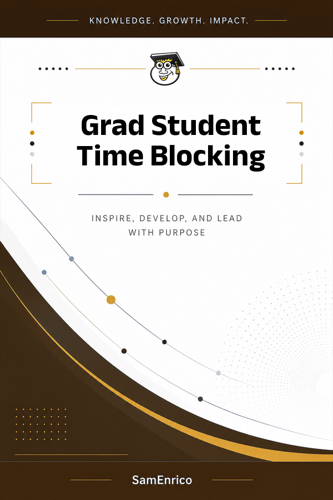
Grad Student Time Blocking eBook
Protects thesis writing from coursework and TA dut
Protects thesis writing from coursework and TA duties.
Formats
Free sample
Chapter 1: The 40-Hour Lie--–- Every September, thousands of brilliant, hardworking graduate students walk into their programs believing the same lie. They believe that because they are no longer taking fifteen credits of coursework, because they have no back-to-back lectures from nine to five, because their teaching duties occupy only ten or twelve hours per week—they therefore have forty or more hours of “free” time to dedicate to their thesis. This belief is not merely optimistic. It is not merely naive. It is the single most destructive force in graduate education, and it is the reason most Ph D students take seven years to complete a dissertation that could have been done in four.The lie feels true.
Look at your calendar. You have three hours of TA discussion section on Tuesday and Thursday mornings. You have two hours of office hours on Wednesday afternoon. You have a one-hour lab meeting on Friday. That leaves...
what? Monday all day. Tuesday afternoon. Wednesday morning. Thursday afternoon.
Friday after the meeting. The entire weekend. Add it up, and yes—there are forty, fifty, even sixty hours of unscheduled time in a typical graduate student’s week. Forty hours of thesis time. A full-time job’s worth of writing, data analysis, and reading.So why is your thesis not done?
Why are you reading this book instead of defending your dissertation? Why do you feel, deep in your gut, that you are falling behind even though you have “plenty of time”?Because the lie ignores a fundamental truth about how human beings actually work. Forty unscheduled hours are not forty hours of thesis progress. They are forty hours of paralysis, procrastination, decision fatigue, and the oppressive weight of an infinite blank slate. When everything is possible, nothing gets done.
When you could write at any time, you write at no time.This chapter dismantles the 40-Hour Lie. You will learn why most graduate students accomplish less thesis work in a sixty-hour “free” week than a well-structured professional accomplishes in ten focused hours. You will learn the difference between urgent and important—and why your TA duties will always steal your thesis time unless you build a wall around it. And you will be introduced to the single most important tool in this book: the Protected Thesis Block, or PTB.By the end of this chapter, you will never again say, “I have all week to write.” You will say, “I have a PTB on Tuesday at 8 AM, and that is where my thesis lives.”The Infinite Blank Slate Let us start with a thought experiment. Imagine you are given a blank canvas, a full set of paints, and an entire empty room.
You have no deadline. No one is watching. No one will judge you until you decide to show them your work. You have unlimited time and unlimited space. How much painting do you actually do?For most people, the answer is: very little.
The blankness is oppressive. Every choice feels consequential. Should you paint a landscape or a portrait? Should you use oil or acrylic? Should you start with the sky or the foreground?
Without constraints, the brain enters a state of analysis paralysis. The lack of urgency removes any pressure to decide. And so you clean your brushes. You organize your paints by color. You read about painting techniques.
You take a nap. You do everything except paint.This is exactly what happens to graduate students with “unlimited” thesis time. The blank slate of an unscheduled week is not freedom. It is a trap. Your brain, faced with infinite possibilities and zero external deadlines, defaults to the path of least resistance: low-stakes, high-urgency tasks that feel like progress but are not.
You check email. You read one more paper. You reformat your bibliography for the fourth time. You reorganize your data folder. You scroll Twitter “just for five minutes.” You tell yourself you are “warming up.”Five hours later, you have written zero words.
But you feel exhausted. What happened?You experienced what psychologist Roy Baumeister called decision fatigue. Every small choice—when to start, what to work on first, whether to write or read, whether to edit or draft—consumes a tiny bit of your limited cognitive fuel. By the time you actually sit down to write, you have already spent your best energy on decisions that should have been made once, in advance.The solution is not more willpower. Willpower is a finite resource, and graduate school is designed to deplete it.
The solution is structure. You cannot rely on your future self to “feel like writing” at 2 PM on a random Tuesday. Your future self will feel like taking a nap, checking Instagram, or staring blankly at the wall. You must build a system that removes decisions before they arise.The TA Drain: Urgent Versus Important If the blank slate were the only problem, you could solve it by simply scheduling blocks of thesis time. But there is a second, more insidious force at work: the constant pull of urgent-but-unimportant tasks, almost all of which come from your teaching assistant duties.In 1954, President Dwight Eisenhower articulated a decision framework that has become known as the Eisenhower Matrix.
It divides all tasks into four quadrants based on two dimensions: urgency (does this need to happen now?) and importance (does this contribute to my long-term goals?). The matrix looks like this:Quadrant I (Urgent + Important): Crises, deadlines, pressing problems. Do these immediately.Quadrant II (Not Urgent + Important): Long-term planning, deep work, relationship building, thesis writing. Schedule these intentionally.Quadrant III (Urgent + Not Important): Most emails, many phone calls, some meetings, other people’s small requests. Delegate or batch.Quadrant IV (Not Urgent + Not Important): Mindless scrolling, gossip, excessive Netflix, reorganizing your desk for the third time.
Eliminate these.Here is the brutal truth for graduate students: nearly all of your TA duties fall into Quadrant III. They are urgent—students want their papers graded now, the course coordinator needs your discussion section prep by tomorrow, an undergraduate is panicking about a deadline that is hours away. But they are not important to your long-term goal of earning a Ph D. Grading a stack of essays does not move your thesis forward. Answering the same question about citation format for the fifteenth time does not make you a better researcher.
Prepping a discussion section on a topic unrelated to your dissertation does not contribute to your literature review.Meanwhile, your thesis work—reading, data analysis, writing, revising—falls squarely into Quadrant II. It is profoundly important. Without it, you do not graduate. But it is almost never urgent. No one is standing over your shoulder demanding to see your literature review by 5 PM today.
Your advisor is not going to fire you if you push your data analysis to next week. The lack of external urgency means your thesis will always lose to the screaming urgency of your TA inbox.This is the TA Drain: the slow, steady leakage of your time and attention into tasks that feel urgent but are ultimately unimportant. A single email takes two minutes to answer. A single grading comment takes thirty seconds. But the…
This is the end of the free sample. Get the eBook to keep going. Buy now
About this book
Details
- Author
- Severson Darline
- Publisher
- SamEnrico
- Language
- English
- Genre
- Non-Fiction, Self-Help, Graduate School
- Released
- 2026-06-08
- Pages (approx.)
- 157
- Available as
- eBook, Audiobook

Read better in the ZLOADR app
Your eBooks on your phone or tablet. Sign in with your SamEnrico account and start reading.
More by Severson Darline
 Morning Hypnosis ListeningSeverson Darline$11.99
 Accident Scene Reconstruction ManualSeverson Darline$11.99
 Founder Loan AccountingSeverson Darline$11.99
 Retail Talent Flow PatternsSeverson Darline$11.99
 Imposter For EntrepreneursSeverson Darline$11.99
 Administrative Task BlockingSeverson Darline$11.99
 Deep Work Recovery PlanSeverson Darline$11.99
 The Magical Realism of Guillermo del Toro: A Director’s Vision Comes to LifeSeverson Darline$11.99
 The Drummer’s Resurrection: How a Broken Hand Sparked a Musical Revolution in 18th-Century AfricaSeverson Darline$11.99
 How to Produce Dowel Pins and RodsSeverson Darline$11.99
 Exploring Russian Art: Icons, Constructivism & SuprematismSeverson Darline$11.99
 Carob: Harvesting PodsSeverson Darline$11.99
You may also like
 Growth Mindset For PhD StudentsLagace Julian$11.99
 Graduate Student Distraction GuideFields Gustavo$11.99
 Eisenhower For Graduate StudentsKnoll Xuan$11.99
 Graduate School Stress GuideLadner Leann$11.99
 Graduate Study GuideAlvarez Marion$11.99
 NVC for Graduate StudentsUtley Isaias$11.99
 ABCDE for Graduate StudentsJacobsen Kala$11.99
 Grad Student Stress GuideKearns Annice$11.99
 Transcendental Meditation for Graduate StudentsTitus Earleen$11.99
 ABCDE for Graduate Students GuidePeachey Jeana$11.99
 PhD Imposter Syndrome GuideHenderson Seth$11.99
 Imposter Syndrome In Graduate SchoolWillson Trudi$11.99