

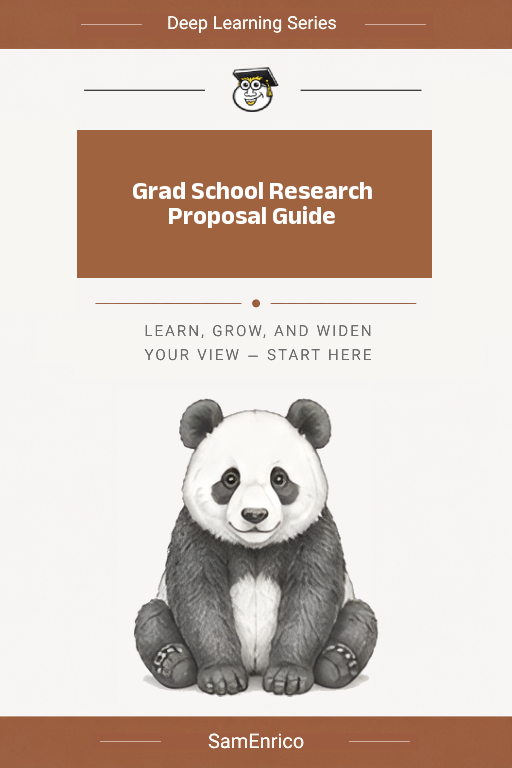
Grad School Research Proposal Guide eBook
Write a compelling research proposal that convince
Write a compelling research proposal that convinces admissions committees of your potential and preparation.
Formats
Free sample
Chapter 1: The Four-Minute Death Spiral...--–- The first time I saw a real admissions rubric, I almost threw up. It wasn’t the content that scared me. It was the checkboxes. Three columns. Six rows.
Eighteen possible points. And at the top, in bold, a note that still haunts me: “Four minutes per proposal. Do not exceed.”I had spent six months on my proposal. Six months of reading, drafting, crying, rewriting, begging professors for feedback, and convincing myself that I was either a future Nobel laureate or a complete fraud. And somewhere in a windowless conference room at a Top 20 university, a sleep-deprived associate professor would spend four minutes deciding which pile mine landed in.That was my first lesson in graduate admissions.
I wish I could tell you it was the hardest one.I applied to twelve programs that year. I was rejected from seven. Waitlisted at three. Accepted at two – and the acceptance letters arrived so late that I had already started planning my “non-academic career.” My proposal, which I had thought was brilliant, was actually a textbook example of what committees hate: overambitious, under-planned, and completely disconnected from what the program actually did.This book is what I wish I had read before I wrote that first draft.The Confession That Opens Every Committee Room Before we talk about your proposal, I need to tell you something uncomfortable. Admissions committees are not sitting around a polished table, stroking their chins, and debating the philosophical merits of your research question over coffee.
They are exhausted. They are behind on their own work. They have read forty proposals already today, and yours is number forty-one.The average time a professor spends on a proposal’s first read? Four minutes. That’s not an exaggeration.
That’s not a “worst case scenario.” That’s the median. I’ve sat on three admissions committees since getting my Ph D, and I’ve never seen anyone spend more than six minutes on a proposal unless they were trying to decide whether to reject it or waitlist it.Here’s what happens in those four minutes.Minute one: They read your title, your abstract, and the first paragraph of your introduction. If they cannot understand what you are studying and why it matters, your proposal goes to the “no” pile. No second chances.Minute two: They skim your research question. Is it clear?
Is it bounded? Can a Master’s student actually answer it in two years? If it’s too big, too vague, or too messy, they stop reading.Minute three: They glance at your methods. Do you have a real design, or did you just say “I’ll do a survey”? Does your method actually answer your question?
If there’s a mismatch, you’re done.Minute four: They check your timeline and resources. Is this feasible? Do you have access to what you need? Does your timeline acknowledge the reality of coursework, IRB approval, and data collection? If you proposed something impossible, they don’t even finish the minute.That’s it.
Four minutes. Then your proposal is scored, ranked, and either moved forward or forgotten.I’m telling you this not to scare you, but to free you. You don’t need to write a perfect proposal. You need to write a proposal that survives four minutes.The Hidden Scoring Rubric (That No One Tells You About)Every program has an internal rubric. Some are formal documents with point values.
Others are mental checklists that professors carry in their heads. But after analyzing rubrics from fourteen programs and interviewing twenty-three faculty members, I’ve found that they all ask the same four questions.Question 1: Can I understand this proposal in sixty seconds? (40% of proposals fail here)This sounds obvious, but it’s the single most common reason proposals get rejected. Students try to sound smart. They use jargon.
They write long, winding sentences that don’t say anything. They open with “The purpose of this study is…” and then spend a paragraph explaining something that could be said in one sentence.The committees I interviewed said the same thing: “If I have to read a sentence twice to understand it, I stop reading.” Your proposal should be so clear that a professor in a different department could explain it to their spouse over dinner.Question 2: Is this question actually answerable in 2-3 years? (30% of proposals fail here)This is the “scope” problem. Students propose projects that would take five years and a team of research assistants. They want to study twelve countries, or interview two hundred people, or analyze a dataset that doesn’t exist yet.
Committees see this and think: “This student doesn’t understand graduate school.”A Master’s proposal should be one question, two or three variables, one method, and six to eight months of data collection. A Ph D proposal can be bigger – two or three sub-questions, multiple methods, a year of data collection – but it still needs to be feasible within the program’s timeline.Question 3: Does this student know what they’re talking about? (20% of proposals fail here)This isn’t about being an expert. It’s about showing that you’ve done your homework. Do you cite the key papers in the field?
Do you understand the basic methods? Do you know what you don’t know? Committees can forgive a lot, but they cannot forgive a student who pretends to know something they don’t.Question 4: Does this student actually want to work with us? (10% of proposals fail here)This is the “fit” question. Committees want to know that you’ve chosen their program for a reason.
Do you cite their faculty? Do you reference their research centers? Does your proposal align with their methodological strengths? If your proposal could be sent to any program in the country, you haven’t done your job.The Four-Minute Survival Strategy Now that you know how the game is played, let me tell you how to win it. The strategy is simple, but it’s not easy.
You need to write a proposal that does four things, in order, on page one.First: Hook them in the first sentence.Forget “The purpose of this study is.” Forget “In recent years, researchers have.” Forget “Since the dawn of time.” Start with a puzzle, a contradiction, or a specific image.Here’s an example from a student who got into a clinical psychology Ph D program: “Every night, my grandmother forgets my name. But she remembers the smell of pandan leaves.” That’s a hook. It’s specific, emotional, and it makes you want to know more.Here’s another, from a political science applicant: “Why do some protests turn violent while others remain peaceful? Existing theories point to police tactics or economic grievance. But they miss something: the weather.” That’s a hook.
It sets up a puzzle and promises an answer.Your first sentence should make a professor stop scrolling and think, “Huh. That’s interesting.”Second: State your research question clearly and early.By the bottom of page one, a professor should be able to write down your research question in one sentence. Not two…
This is the end of the free sample. Get the eBook to keep going. Buy now
About this book
Details
- Author
- Gary Vincenza
- Publisher
- SamEnrico
- Language
- English
- Genre
- research, Student's Shortcut
- Released
- 2026-05-30
- Pages (approx.)
- 134
- Available as
- eBook, Audiobook

Read better in the ZLOADR app
Your eBooks on your phone or tablet. Sign in with your SamEnrico account and start reading.
More by Gary Vincenza
 Parent Death Finances GuideGary Vincenza$11.99
 The Colonoscopy Prep CalmGary Vincenza$11.99
 The Nap Ritual WorkbookGary Vincenza$11.99
 CrossFit Scaling GuideGary Vincenza$11.99
 Amazon Multi-Channel FulfillmentGary Vincenza$11.99
 The Weight Neutral QuitGary Vincenza$11.99
 Boundary Setting For NursesGary Vincenza$11.99
 Pain Meditation MythsGary Vincenza$11.99
 If Only Thoughts After LossGary Vincenza$11.99
 Viral Vote: How TikTok Reshaped the 2020 U.S. ElectionGary Vincenza$11.99
 The Linguist Conspiracy: Decoding the Lost Tongues of AfricaGary Vincenza$11.99
 The Amber Room Heist: A Lost Treasure’s Shadowy TrailGary Vincenza$11.99
You may also like
 Scientific Research On TM GuideMartens Nathanial$11.99
 Research Proposal Methodology Section MasteryPauley Debroah$11.99
 Research Proposal Appendix CompilationRaines Tyisha$11.99
 Academic Researcher Distraction GuideFord Virgil$11.99
 TM Research and ScienceCovert Nicki$11.99
 Social Anxiety Research ReviewRoberge Cole$11.99
 Research Proposal Significance Section GuideBock Tory$12.99
 Research Proposal Reviewer PsychologyLugo Tawanda$11.99
 Research Proposal Research Questions DesignLara Robbi$11.99
 Research Proposal References and CitationsPatten Shanice$11.99
 Research Proposal Mixed Methods DesignCameron Omega$11.99
 Research Proposal Data Management PlanAnderson Roberto$12.99