
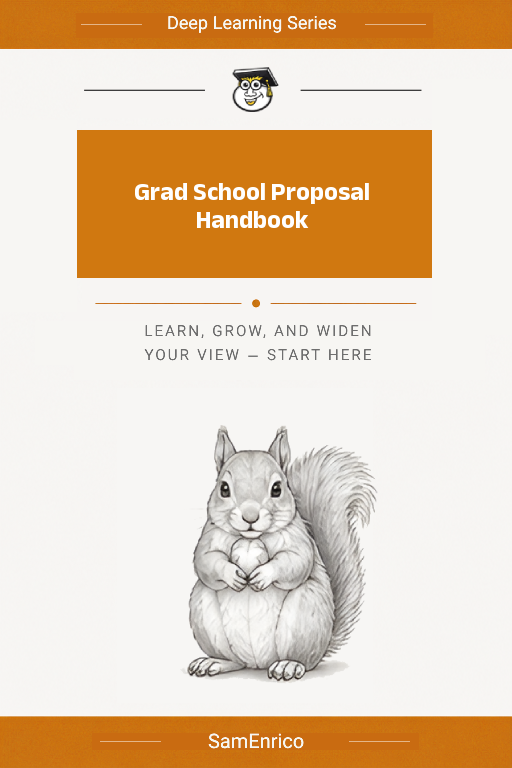
Non-FictionStudent's ShortcutGraduate Admissions
Grad School Proposal Handbook
Navigate admissions requirements for research prop
by Bales Lesa
Navigate admissions requirements for research proposals across humanities, sciences, and social sciences graduate programs.
Formats
About this book
Free sample
Chapter 1: The Tribe Fallacy--You are not bad at writing research proposals. You have simply been trying to write one for the wrong audience.This is not a metaphor. It is the single most common reason that brilliant, curious, hardworking applicants get rejected from graduate programs in the United States every single year. They write a proposal that would impress their undergraduate thesis advisor, only to discover that the admissions committee on the other end of the table evaluates proposals using an entirely different set of assumptions about what counts as knowledge, what counts as evidence, and what counts as a contribution worth funding. The gap between what you were taught in college and what graduate committees actually want is not a measure of your intelligence.
It is a measure of the hidden curriculum that no one ever explained to you.The problem is not your work ethic. The problem is not even your research idea. The problem is that you have been taught, implicitly, that good research is universal—that a well-designed study is a well-designed study, regardless of field, regardless of audience, regardless of the unspoken rules that govern academic judgment. That is a lie. It is a well-intentioned lie, perhaps, but a lie nonetheless.
And it has cost thousands of applicants their acceptance letters.Let me tell you about Sarah.Sarah was a history major at a good liberal arts college. She had a sharp eye, a deep archive, and a genuine question. She wanted to study how nineteenth-century botanical illustrators encoded colonial hierarchies in their drawings of Indian flora. She noticed that the illustrations often placed native plants alongside images of local laborers, and she suspected there was something more going on than mere documentation. Her undergraduate thesis advisor loved the project.
Sarah graduated with honors.When she decided to apply to Ph D programs, she wrote a proposal that would have made her advisor proud. She identified a gap in the literature. She proposed a mixed-methods approach combining archival analysis with quantitative counts of visual motifs. She promised her findings would have policy implications for museum decolonization…
This is the end of the free sample. Get the eBook to keep going. Buy now
Contents
- Chapter 1
- Chapter 2
- Chapter 3
- Chapter 4
- Chapter 5
- Chapter 6
- Chapter 7
- Chapter 8
- Chapter 9
- Chapter 10
- Chapter 11
- Chapter 12
Details
- Author
- Bales Lesa
- Publisher
- SamEnrico
- Language
- English
- Genre
- Non-Fiction, Student's Shortcut, Graduate Admissions
- Released
- 2026-05-30
- Pages (approx.)
- 160
- Available as
- eBook, Audiobook

Read better in the ZLOADR app
Your eBooks on your phone or tablet. Sign in with your SamEnrico account and start reading.
More by Bales Lesa
 Weekend Loneliness GuideBales Lesa$11.99
 Emotional Regulation Goal SettingBales Lesa$11.99
 Solar Temple Geneva Safe House CourseBales Lesa$11.99
 Low Testosterone Symptoms GuideBales Lesa$11.99
 Mindfulness for Fear of FlyingBales Lesa$11.99
 From Rags to Retail: The Unlikely Rise of Dollar GeneralBales Lesa$11.99
 The Phantom of the Silk RoadBales Lesa$11.99
 How to Become a Mixer Operator IBales Lesa$11.99
 Understanding Ceroid Lipofuscinois, NeuronalBales Lesa$17.99
 Dubai Student Festivals GuideBales Lesa$12.99
 Constructed Languages (Conlanging)Bales Lesa$11.99
You may also like
 Hong Kong Handover 1997Dunn Johnnie$11.99
 Zumba For Postnatal Recovery CourseNeal Christian$11.99
 Zumba for BeginnersLadner Nikia$11.99
 YouTube Comment Mining GuideHumes Pandora$12.99
 Worry Box MeditationCarlin Rudy$11.99
 Workplace Stress MeditationNguyen Lynn$11.99
 Workplace Stress and Sleep RepairHawley Ivory$11.99
 Workplace Perfectionism CureDelaney Jeffry$11.99
 Workplace Injustice Anger GuideWallen Isabelle$11.99
 Work Addiction and Burnout LinkGreenwood Ester$11.99
 Women in Yoga and WellnessBeattie Galina$11.99
 Women in Stand Up ComedyChun Evangeline$11.99