
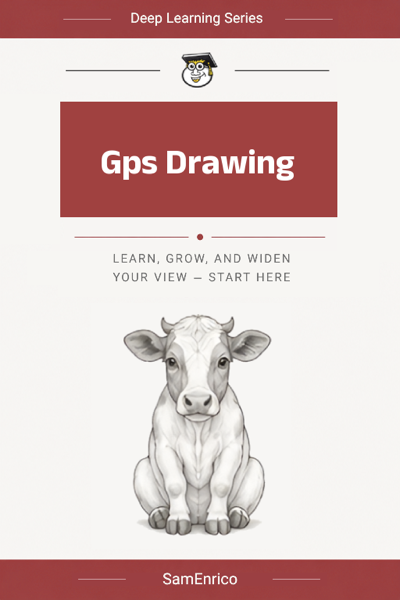
Non-FictionInformativeEducational
Gps Drawing eBook
A Coursebook on Gps Drawing
A Coursebook on Gps Drawing
Formats
Free sample
Chapter 1: The Line You Left Behind...--You have already made GPS art.This is not a metaphor, a motivational trick, or a sales pitch. It is a literal fact. Sometime in the past year—perhaps during a distracted walk to the grocery store, a meandering Sunday bike ride, or a drive home from a vacation you didn't want to end—you carried a device that recorded your path. That path, that specific sequence of latitude and longitude coordinates stamped at one-second intervals, is a drawing. You just didn't know you were making it.The satellites orbiting twelve thousand miles above your head don't care whether you intended to create art.
They log your movement regardless. Every zigzag across a parking lot, every shortcut through an alley, every wrong turn that became an adventure—all of it sits in a database somewhere, waiting to be seen. Most of these tracks will never be opened. They will expire in a phone's cache, or get overwritten by tomorrow's commute, or sit unviewed on a fitness app server until a algorithm deletes them. But a few—a very few—will be pulled onto a screen and recognized for what they are: a signature written on the surface of the earth.This book exists to help you become one of those people who recognizes the line before it disappears.
And, more importantly, to help you start drawing with intention.The Invisible Masterpiece You Already Made Let me prove it to you.Open your phone's photo gallery. Scroll back to the oldest screenshot or saved image you can find. Now—without looking at a map—try to remember a walk you took last month. Not a special walk. Just an ordinary one.
The route from your front door to the coffee shop. The loop around your neighborhood after dinner. The path you took through the park because the sidewalk was closed for construction.Do you remember the shape?Probably not. Most of us don't. We remember the destination, the weather, the person we were with, the podcast we were listening to.
But the shape of the path—the specific geometry of left turns and right turns, the little detour to avoid a puddle, the extra block you walked because you were on a phone call and not paying attention—that shape evaporates within hours. It is the most forgotten part of any journey.And yet, somewhere, that shape exists as a file. If you had Strava, Map My Run, or even Google Maps Timeline enabled, the coordinates are still there. You could, right now, export that walk and see it on a satellite image. You would see a thin, slightly wobbly line threading through streets and sidewalks—a line that looks, from above, almost exactly like a pen stroke on paper.That line is yours.
No one else walked that exact path at that exact speed with that exact combination of pauses and accelerations. It is as unique as your handwriting. And you drew it without trying.This is the first and most important truth of GPS drawing: you are already an artist. The only thing you lack is awareness.The Question Nobody Asks (Until Now)Why does this matter?Why should anyone care about a line that leaves no trace on the ground, that can only be seen from space, that exists only as a string of numbers on a server somewhere? Why would someone spend six hours walking a perfect circle in a field, or seventeen days spelling a two-letter word across an entire county, or fly across the Pacific Ocean in a zigzag pattern just to write "Marry Me" on a flight tracker?The answer is stranger and more beautiful than you might expect.GPS drawing matters because it solves a problem that art has struggled with for thirty thousand years: the problem of scale.
Cave painters could cover a wall. Renaissance painters could cover a chapel ceiling. Land artists like Robert Smithson could reshape a shoreline. But until the year 2000, no one could draw on the scale of a city—or a region, or a continent—and have that drawing be visible all at once.With GPS, you can. A single line that takes three hours to walk might span ten kilometers.
Viewed from above, that line resolves into a shape—a heart, a star, a word, an animal—that is simultaneously intimate (it was made by your body) and monumental (it covers more ground than the largest painting in history).There is another reason, too. One that has nothing to do with scale and everything to do with memory.When you draw with GPS, you are not leaving a mark on the world. You are leaving a mark on the record of the world. That drawing will outlast you. It will outlast the sidewalk you walked on, the neighborhood you walked through, perhaps even the city you walked in.
Long after the physical ground has been reshaped by construction, weather, and time, the GPX file will remain—a ghost of a journey that happened exactly once, at exactly those coordinates, on exactly that day.That is the seduction of this medium. It is drawing with immortality.The Accidental Birth of a Medium Every art form has its origin story. Photography began with a man named Niépce who spent eight hours exposing a pewter plate to light outside his window. Film began with a horse galloping past a row of cameras. GPS drawing began, improbably, with a turtle.In 1999, a sailor named Reid Stowe set out from New York Harbor on what would become a 260-day non-stop voyage across the Atlantic and back.
He was not trying to make art. He was trying to prove that a single person could live indefinitely at sea. But his boat, the Anne, was equipped with a GPS tracker that recorded every mile of his journey. When Stowe returned to port and looked at the complete track, he saw something astonishing: the line traced the rough shape of a sea turtle.Not perfectly. Not intentionally.
But recognizably. The looping path across the ocean—shaped by currents, winds, and Stowe's own decisions—had, by accident, drawn an animal. The Voyage of the Turtle became a sensation in the small community of early GPS enthusiasts, not because Stowe had planned it, but because he hadn't. The earth had collaborated with him. The ocean had become a pencil.That accidental turtle was the spark.
But the real revolution came one year later, and it came not from an artist but from the White House.On May 1, 2000, President Bill Clinton ordered the removal of Selective Availability—a deliberate error that the US military had been adding to civilian GPS signals since the system went live. Before that day, consumer GPS was accurate to only about 100 meters. You could find a city, but not a street corner. You could navigate a highway, but not a sidewalk.After that day, accuracy dropped to three to ten meters.This was the difference between drawing with a crayon held at arm's length and drawing with a fine-point pen. Suddenly, a walker could trace a single city block and see the shape of their path…
This is the end of the free sample. Get the eBook to keep going. Buy now
About this book
Details
- Author
- Blackman Tamesha
- Publisher
- SamEnrico
- Language
- English
- Genre
- Non-Fiction, Informative, Educational
- Released
- 2026-06-02
- Pages (approx.)
- 132
- Available as
- eBook, Audiobook

Read better in the ZLOADR app
Your eBooks on your phone or tablet. Sign in with your SamEnrico account and start reading.
More by Blackman Tamesha
 NVC And Neuroscience GuideBlackman Tamesha$11.99
 Social Media Self Esteem ShieldBlackman Tamesha$11.99
 The Mental Filtering Anger GuideBlackman Tamesha$11.99
 Canva Brand Identity for PlumbersBlackman Tamesha$11.99
 Operation Northwoods: The Declassified Blueprint for False FlagsBlackman Tamesha$11.99
 AI for Promotion Impact ForecastingBlackman Tamesha$12.99
 Learn to Play the Steam WhistleBlackman Tamesha$11.99
 How to Start a Clearing House (banking) Business (Beginners Guide)Blackman Tamesha$11.99
You may also like
 Hong Kong Handover 1997Dunn Johnnie$11.99
 Zumba For Postnatal Recovery CourseNeal Christian$11.99
 Zumba for BeginnersLadner Nikia$11.99
 YouTube Comment Mining GuideHumes Pandora$12.99
 Worry Box MeditationCarlin Rudy$11.99
 Workplace Stress MeditationNguyen Lynn$11.99
 Workplace Stress and Sleep RepairHawley Ivory$11.99
 Workplace Perfectionism CureDelaney Jeffry$11.99
 Workplace Injustice Anger GuideWallen Isabelle$11.99
 Work Addiction and Burnout LinkGreenwood Ester$11.99
 Women in Yoga and WellnessBeattie Galina$11.99
 Women in Stand Up ComedyChun Evangeline$11.99