
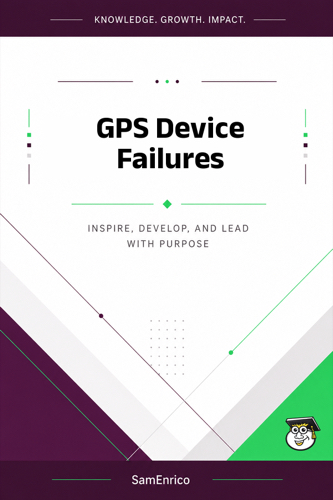
GPS Device Failures eBook
When technology fails to locate victims.
When technology fails to locate victims.
Formats
Free sample
Chapter 1: The Glass Coffin--The GPS device said “Turn right in 300 feet,” and so they did. The road, such as it was, had already narrowed from a two-lane asphalt ribbon to a gravel path, then to two dirt tire tracks, and finally to nothing at all—just sand and rocks and the kind of silence that deserts specialize in. But the machine’s female voice, which the three women had nicknamed “Nell,” sounded so certain. So confident. So unlike the gnawing doubt building in their stomachs.It was July 2009.
The temperature in Death Valley was 121 degrees Fahrenheit.Alessia, a 24-year-old from Switzerland, was behind the wheel of the rented Jeep Liberty. Beside her sat her friend, also 24, while a third woman, 27, occupied the back seat. They were educated, capable, and far from home. They had planned a scenic detour from Las Vegas to Death Valley National Park—a route that should have taken a few hours on paved roads. But Nell had other ideas.
The GPS unit, purchased cheaply from a rental car add-on, had been programmed with “shortest distance” rather than “fastest time.” In the world of navigation algorithms, shortest distance ignores road quality. It ignores bridges. It ignores the difference between a highway and a goat trail. It sees only geometry: a straight line between two points.And so Nell had guided them off the pavement and into the furnace.By the time they realized something was wrong, the Jeep was already stranded. The sandy “road” had become so soft that the tires spun uselessly.
They were 100 miles from the nearest paved road, with no cell service, one bottle of water between them, and a GPS screen that now showed nothing but a blank grid—no roads, no landmarks, no “You Are Here” dot. Nell had fallen silent. The women did what any rational person might do: they waited. They expected someone to come looking. They expected rescue.For three days, they waited.On the second day, Alessia wrote a goodbye letter to her parents.
On the third day, hallucinating from dehydration, she tore her shirt into strips and laid them on the Jeep’s roof in an SOS pattern. A passing helicopter spotted them by pure chance. They were airlifted to a hospital, barely alive. All three survived, though they would later describe the experience as “looking into the glass coffin of their own deaths.”The GPS had not malfunctioned in the technical sense. The satellites were working.
The receiver was working. The screen was working. And yet, the device had failed catastrophically—not because its circuits fried, but because it lacked something that every human navigator possesses: the ability to see a road and judge whether it is safe. The machine processed data. It did not process fear.This is the central paradox of our age of satellite navigation.
We have outsourced our sense of direction to a constellation of thirty-one aging satellites orbiting 12,500 miles above Earth. We have done so willingly, eagerly, and almost universally. The Global Positioning System—GPS for short—is arguably the most successful technology most people have never thought about. It is embedded in our phones, our cars, our watches, our delivery trucks, our airplanes, our ships, and even our livestock collars. It generates an estimated $1.4 trillion in annual economic value for the United States alone.
And it has made us, collectively, the most navigationally incompetent generation in human history.But this chapter is not about the satellites. It is about us.The Most Dangerous Word in Navigation In 2018, a 48-year-old father named Phil drove his minivan off a collapsed bridge in North Carolina. The bridge had been washed out by Hurricane Florence two weeks earlier. Yellow barricades blocked the approach. Orange signs warned “ROAD CLOSED.” A local resident had even spray-painted “BRIDGE OUT” on the pavement in six-foot letters.
Phil drove around the barricades, through the warning signs, and past the spray paint. His GPS had told him this was the fastest route to his son’s basketball game. He later told rescuers, “The GPS said to go that way.”He survived the 40-foot drop into the swollen river below. His son did not.The most dangerous word in navigation is not “error” or “failure” or even “lost.” It is the word “said.” As in, “The GPS said.” This single word represents a complete abdication of human judgment. It is the linguistic equivalent of handing the keys to your brain to a plastic box with a five-year-old processor and a screen the size of a credit card.Psychologists have a name for this phenomenon.
They call it automation bias.Automation bias is the tendency for humans to favor information generated by automated systems over information generated by our own senses, even when the automated system is clearly wrong. It is not laziness, though laziness can amplify it. It is a cognitive shortcut—a mental heuristic that evolved to help us make decisions quickly in complex environments. When the environment is simple (a clear road, a familiar neighborhood), our own judgment works fine. When the environment is complex (a foreign country, a disaster zone, an unfamiliar trail), our brains look for a decision-making crutch.
The GPS becomes that crutch.The problem is that the crutch can break. And when it breaks, we fall.A Brief History of Losing Our Way Before GPS, humans navigated using a combination of tools and intuition. Polynesian voyagers crossed thousands of miles of open ocean using wave patterns, star positions, bird flight paths, and the color of the sky. Desert nomads read sand dunes and wind direction. European explorers used compasses, sextants, and chronometers—instruments that required training, patience, and constant cross-checking.
Getting lost was expected. Getting found was celebrated.Then came the satellites.The Global Positioning System was developed by the United States Department of Defense in the 1970s and 1980s, originally for military navigation and targeting. The first GPS satellite was launched in 1978. The system achieved full operational capability in 1995, with 24 satellites in orbit—enough to ensure that any receiver on Earth could see at least four satellites at any given time. For the first decade of its existence, GPS was intentionally degraded for civilian users through a feature called Selective Availability, which introduced random errors of up to 100 meters.
In 2000, President Bill Clinton ordered Selective Availability turned off, making GPS instantly ten times more accurate for civilians.That was the moment everything changed.Within a decade, GPS receivers went from expensive, brick-sized devices used by surveyors and the military to cheap, pocket-sized chips embedded in every smartphone. Google Maps launched in 2005. The i Phone arrived in 2007 with built-in GPS and a touchscreen interface that made navigation feel like magic. By 2010, the phrase “Map Quest directions” had already become a nostalgic relic. By 2015, the idea of folding a paper map was something grandparents did.
By 2020, a significant percentage of young adults had never used a physical map to navigate anywhere.This is not a moral failing. It is technological progress. But progress always has a shadow.The Trust Trap Let me introduce a term that will appear throughout this book: The Trust Trap.The Trust Trap is the gap between what a technology promises and what it…
This is the end of the free sample. Get the eBook to keep going. Buy now
About this book
Details
- Author
- Turpin Fransisca
- Publisher
- SamEnrico
- Language
- English
- Genre
- Non-Fiction, True Crime, Tech Fail
- Released
- 2026-06-09
- Pages (approx.)
- 151
- Available as
- eBook, Audiobook

Read better in the ZLOADR app
Your eBooks on your phone or tablet. Sign in with your SamEnrico account and start reading.
More by Turpin Fransisca
 Membership Site GrowthTurpin Fransisca$11.99
 Prodigy Child Burnout RecoveryTurpin Fransisca$11.99
 The Three Question Rule ManualTurpin Fransisca$11.99
 Being Interrupted TriggerTurpin Fransisca$11.99
 Nightmare Processing For ParentsTurpin Fransisca$11.99
 Language Learning ShortcutsTurpin Fransisca$11.99
 Closing Argument StrategiesTurpin Fransisca$11.99
 Flying Fortresses: How Japan's Carrier Strike at Pearl Harbor Redefined Naval WarfareTurpin Fransisca$11.99
 John D. Rockefeller: The Titan of Industry and PhilanthropyTurpin Fransisca$11.99
 Understanding Williams SyndromeTurpin Fransisca$11.99
 How to Start a Amusement Guide Periodical Publishing Business (Beginners Guide)Turpin Fransisca$11.99
 How to Produce Sports Fan AccessoriesTurpin Fransisca$11.99