
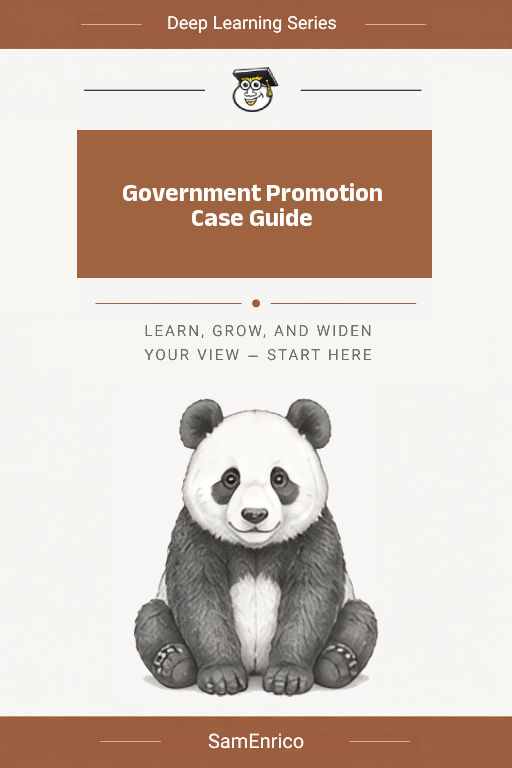
Non-FictionProfessional's Cheat SheetGovernment
Government Promotion Case Guide
Adapts business case approach for government promo
Adapts business case approach for government promotion processes, focusing on mission impact, program outcomes, compliance, and public value.
Formats
About this book
Free sample
Chapter 1: The Spreadsheet Lie--–- You have six weeks. Your boss wants a "business case." You open Excel, build a tidy model with revenues, costs, and a neat little ROI percentage at the bottom. The number comes back negative. You tweak the assumptions. Still negative.
You add "intangible benefits." The spreadsheet smiles back at you: red, unforgiving, and utterly useless.You are not selling sneakers. You are not launching a software startup. You are trying to keep homeless veterans off the street, or reduce childhood asthma in a polluted zip code, or retrain displaced factory workers for jobs that haven't been invented yet. And yet, someone handed you a template designed for a venture capitalist and said, "Make it work."This chapter is an intervention.It will show you why the private-sector business case is not just unhelpful in government – it is actively dangerous. It will introduce a new framework, the Public Value Scorecard, that replaces ROI with three dimensions that actually matter: Mission Impact, Political Legitimacy, and Fiscal Compliance.
And it will give you permission to stop apologizing for the fact that your program does not generate profit.By the end of this chapter, you will never look at a spreadsheet the same way again.The Day the Math Stopped Working Let us start with a story. Not a hypothetical. A real one.In 2016, a mid-sized city's housing department received a 4milliongranttoreducechronichomelessness.Theprogramwassimple:rentalsubsidiespluscasemanagementforthe200mostmedicallyvulnerableindividualslivingonthestreets.Thecity′sowndatashowedthatthese200peoplecollectivelycosttheemergencyroom,thejail,andthesheltersystemapproximately4 million grant to reduce chronic homelessness. The program was simple: rental subsidies plus case management for the 200 most medically vulnerable individuals living on the streets. The city's own data showed that these 200 people collectively cost the emergency room, the jail, and the shelter system approximately 4milliongranttoreducechronichomelessness.Theprogramwassimple:rentalsubsidiespluscasemanagementforthe200mostmedicallyvulnerableindividualslivingonthestreets.Thecity′sowndatashowedthatthese200peoplecollectivelycosttheemergencyroom,thejail,andthesheltersystemapproximately8 million per year in crisis services.The program director, a earnest policy analyst named Maria, built a business case.
She calculated the cost of the program: 4million.Shecalculatedtheexpectedreductionincrisiscosts:roughly4 million. She calculated the expected reduction in crisis costs: roughly 4million.Shecalculatedtheexpectedreductionincrisiscosts:roughly5 million per year, assuming 60 percent success. That produced a net benefit of $1 million in year…
This is the end of the free sample. Get the eBook to keep going. Buy now
Contents
- Chapter 1
- Chapter 2
- Chapter 3
- Chapter 4
- Chapter 5
- Chapter 6
- Chapter 7
- Chapter 8
- Chapter 9
- Chapter 10
- Chapter 11
- Chapter 12
Details
- Author
- Hassell Keshia
- Publisher
- SamEnrico
- Language
- English
- Genre
- Non-Fiction, Professional's Cheat Sheet, Government
- Released
- 2026-06-01
- Pages (approx.)
- 149
- Available as
- eBook, Audiobook

Read better in the ZLOADR app
Your eBooks on your phone or tablet. Sign in with your SamEnrico account and start reading.
More by Hassell Keshia
 Financial Stress While Studying HandbookHassell Keshia$11.99
 Stretching for Musicians GuideHassell Keshia$11.99
 The Miscarriage Grief Support WorkbookHassell Keshia$11.99
 Metta for Foster Care ExperienceHassell Keshia$11.99
 Economics Exam Excel GuideHassell Keshia$12.99
 Understanding Natal Teeth Intestinal Pseudoobstruction Patent DuctusHassell Keshia$17.99
 How to Start a Perishable Prepared Salads; Mixed Salads Business (Beginners Guide)Hassell Keshia$11.99
 Etching (Semiconductor)Hassell Keshia$11.99
You may also like
 Hong Kong Handover 1997Dunn Johnnie$11.99
 Zumba For Postnatal Recovery CourseNeal Christian$11.99
 Zumba for BeginnersLadner Nikia$11.99
 YouTube Comment Mining GuideHumes Pandora$12.99
 Worry Box MeditationCarlin Rudy$11.99
 Workplace Stress MeditationNguyen Lynn$11.99
 Workplace Stress and Sleep RepairHawley Ivory$11.99
 Workplace Perfectionism CureDelaney Jeffry$11.99
 Workplace Injustice Anger GuideWallen Isabelle$11.99
 Work Addiction and Burnout LinkGreenwood Ester$11.99
 Women in Yoga and WellnessBeattie Galina$11.99
 Women in Stand Up ComedyChun Evangeline$11.99