
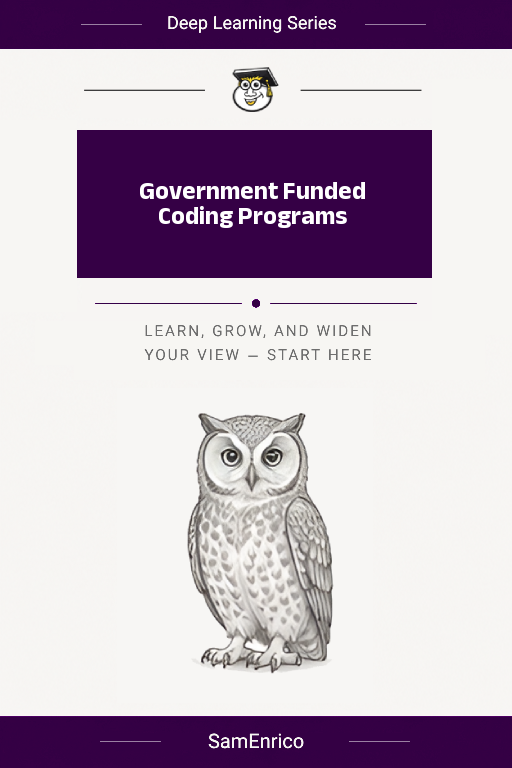
Non-FictionStudent's ShortcutGovernment ProgramsSubsidized Training
Government Funded Coding Programs eBook
Access free or subsidized coding education through
Access free or subsidized coding education through government initiatives in Singapore France and Saudi Arabia.
Formats
Free sample
Chapter 1: The Thirty-Thousand-Dollar Question--I want you to imagine something for a moment.You are sitting at your kitchen table. It is a Tuesday evening, probably around 8:30 PM. You have just finished dinner, or maybe you skipped dinner because you were too tired to cook. You have a laptop in front of you – not a new one, maybe something from three or four years ago, with a battery that no longer holds a charge unless the cord is positioned at exactly the right angle.You are searching for something. You are not sure what, exactly.
But you know you are stuck.You type into Google: "How to learn coding for free."Three million results appear. You scroll past the ads for bootcamps that cost fifteen thousand dollars. You scroll past the You Tube videos promising "Learn Python in 4 Hours!" with smiling thumbnails. You scroll past the Reddit threads where people argue about whether Java Script is a real programming language. And somewhere, buried on page four, you see something unexpected.A government website.It says something like: "Skills Future Career Transition Programme – Up to 95% subsidy for Singapore citizens and PRs."Or: "Compte Personnel de Formation – €5,000 available for coding training."Or: "Tuwaiq Academy – Fully funded bootcamps for Saudi citizens and eligible residents."And you stop scrolling.Because this does not look like a scam.
It has a .gov domain. It has official logos. It has application deadlines and eligibility requirements and PDF forms. This looks real. This looks like someone – some government, somewhere – is willing to pay for you to learn to code.But then you ask the question that everyone asks.What is the catch?The Question That Stops Everyone That question – "What is the catch?" – has killed more careers than bad code ever will.I have watched hundreds of people discover government-funded coding programs.
I have watched their eyes light up when they see the subsidy amounts. I have watched them calculate how much money they could save. And then I have watched them freeze.Because they assume there must be something hidden. Something terrible. Military service, perhaps.
Or forced labor in some government office for five years. Or a clawback clause that demands repayment with interest if you ever leave the country. They have been burned before – by student loans, by expensive bootcamps that overpromised, by employers who reneged on tuition reimbursement. They have learned to distrust anything that seems too good to be true.So they close the browser tab. They go back to scrolling.
They tell themselves they will research it later.And later never comes.This chapter exists to answer that question once and for all. Not with vague assurances. Not with marketing language. But with the actual terms, conditions, and legal obligations written into the funding agreements of Singapore, France, and Saudi Arabia.By the time you finish this chapter, you will know exactly what these governments demand in exchange for their money. You will know which obligations are real and which are rumors.
And you will know whether you are willing to accept those terms.Let us start with the most important truth.The Real Catch – And Why Most People Get It Wrong The real catch is almost boring.In all three countries, the core obligation is the same: after completing a government-funded coding program, you must make a good-faith effort to seek local employment for a specified period – typically six to twelve months.That is it.No military service. No forced relocation. No repayment of tuition unless you actively defraud the program. No lifetime commitment to government work. No blacklist that follows you across borders.Just a requirement that you try to get a job in the country that paid for your training.Let me break down exactly what this means for each country.The Singapore Obligation – T-Prov and Skills Future Singapore's Skills Future Career Transition Programme (SCTP) includes a provision called "T-Prov" – short for Training-Provision.
If you receive a 95 percent subsidy, you are required to seek full-time employment in Singapore for six months after graduation.What does "seek" mean? It means you must register with the program's placement team. It means you must attend at least three interviews that they arrange for you. It means you must accept a bona fide offer that meets the minimum salary threshold for your visa class (if you are a foreigner) or a reasonable market rate (if you are a citizen or permanent resident).What does it not mean? It does not mean you have to accept the first offer.
If the salary is below market, you can decline. If the role is not a coding role – if they try to place you in technical support or quality assurance – you can decline. If the company has a reputation for exploiting junior developers, you can decline.The only way you face consequences is if you refuse every offer without reasonable cause. And even then, the consequence is not financial. You do not owe money.
You are simply blacklisted from future Skills Future programs. You cannot apply for another subsidized bootcamp later.That is the catch for Singapore. Try to find a job for six months. If you fail, you lose access to future funding. That is all.The France Obligation – Alternance and POECFrance has two main funding mechanisms, and each has slightly different obligations.The first is the Contrat de Professionalisation (Professionalization Contract).
This is an apprenticeship model. You sign a contract with a company before you start training. The company pays you 60 to 80 percent of the minimum wage while you study two days per week. The state pays the school.The obligation here is clear: you must stay with that company for twelve months after completing your training. If you leave earlier – either by quitting or by being fired for misconduct – you may be required to repay a portion of the training costs.
The exact amount depends on your contract, but it is typically prorated: leave after six months, repay half; leave after ten months, repay one-sixth.The second mechanism is POEC (Préparation Opérationnelle à l'Emploi Collective). This is for job seekers, including refugees and people receiving unemployment benefits. The state pays 100 percent of tuition – not a loan, not a subsidy, but a direct payment to the training provider. In exchange, you must complete the program and then actively seek employment for six months.But here is the crucial detail that almost no one knows: POEC funding does not require you to stay in France. If you complete the program and then receive a job offer in Germany or Belgium or Canada, you can take it.
The French state does not claw back the money. Their goal is to get you employed anywhere, not to trap you in France.The Saudi Arabia Obligation – HRDF and Employer Sponsorship Saudi Arabia's funding model is the most employer-centric of the three. The Human Resources Development Fund (HRDF) pays for training, but almost always through an employer sponsor. You do not apply directly as an individual unless you are a citizen. Instead, your employer nominates you for a seat at Tuwaiq Academy or the Saudi Digital Academy.The obligation, therefore, is tied to your employer.
If you accept a sponsored training seat, you are typically required to remain with that employer for twelve to twenty-four…
This is the end of the free sample. Get the eBook to keep going. Buy now
About this book
Details
- Author
- Obryan Melony
- Publisher
- SamEnrico
- Language
- English
- Genre
- Non-Fiction, Student's Shortcut, Government Programs, Subsidized Training
- Released
- 2026-05-30
- Pages (approx.)
- 140
- Available as
- eBook, Audiobook

Read better in the ZLOADR app
Your eBooks on your phone or tablet. Sign in with your SamEnrico account and start reading.
More by Obryan Melony
 Emotion Regulation for Panic Attacks HandbookObryan Melony$11.99
 Vendor Negotiation Presentation NervesObryan Melony$11.99
 Self Hypnosis Morning RoutineObryan Melony$11.99
 Panic Disorder Depersonalization GuideObryan Melony$11.99
 AI Thumbnail Generation for YouTubeObryan Melony$11.99
 The Snowden Files: The Untold Backstory of a Digital ExodusObryan Melony$11.99
 The Last Heist: The Untold Tale of the 1987 Great Train RobberyObryan Melony$11.99
 Understanding BradykinesiaObryan Melony$17.99
 Ecommerce Logistics Automation OutlookObryan Melony$12.99
 HousepersonObryan Melony$11.99
 10 Ways to Use Coffee (Recipe Book)Obryan Melony$11.99
You may also like
 Hong Kong Handover 1997Dunn Johnnie$11.99
 Zumba For Postnatal Recovery CourseNeal Christian$11.99
 Zumba for BeginnersLadner Nikia$11.99
 YouTube Comment Mining GuideHumes Pandora$12.99
 Worry Box MeditationCarlin Rudy$11.99
 Workplace Stress MeditationNguyen Lynn$11.99
 Workplace Stress and Sleep RepairHawley Ivory$11.99
 Workplace Perfectionism CureDelaney Jeffry$11.99
 Workplace Injustice Anger GuideWallen Isabelle$11.99
 Work Addiction and Burnout LinkGreenwood Ester$11.99
 Women in Yoga and WellnessBeattie Galina$11.99
 Women in Stand Up ComedyChun Evangeline$11.99