
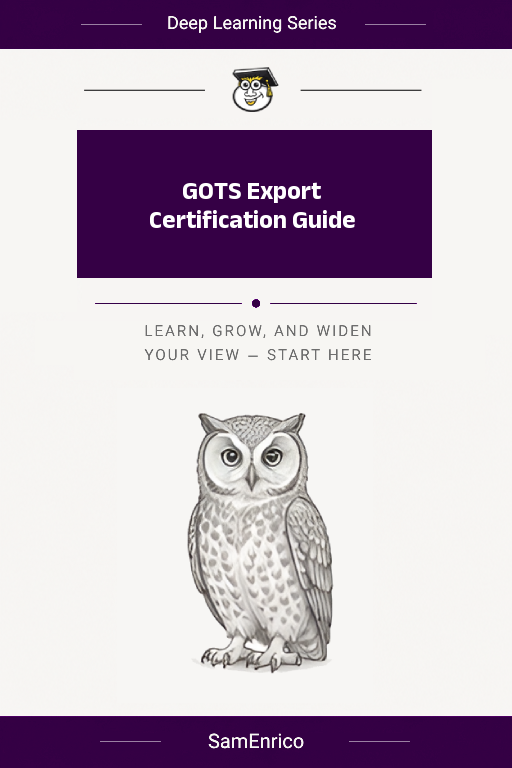
GOTS Export Certification Guide eBook
Get Global Organic Textile Standard for sustainabl
Get Global Organic Textile Standard for sustainable textile and apparel exports.
Formats
Free sample
Chapter 1: The $500,000 Container--–- The集装箱 sat in Rotterdam harbor for 23 days. Not because of customs, not because of a strike, not because of a paperwork error in the usual sense. The container held 12,000 units of premium organic cotton t-shirts, beautifully finished, perfectly folded, packed with care by a factory that had done everything right—or so they thought. The buyer, a mid-sized German sustainable fashion brand, had already paid 50% upfront. The factory in Tirupur, India, was counting on the remaining $250,000 to cover their next cotton purchase, their workers' bonuses for Diwali, and their certification renewal fee due in six weeks.But the container sat.The buyer's procurement manager, a harried woman named Klara in Berlin, had sent an email on day three: "We need your GOTS Transaction Certificate for this shipment.
Our compliance team flagged that the document you provided has a discrepancy in Box 7. Please correct within 48 hours or we cannot release payment."The factory's export manager, Rajesh, had responded within an hour: "What discrepancy? The TC matches our invoice exactly."Klara's reply: "Box 7 says '100% Organic Cotton TShirt' with no space. Our purchase order says '100% Organic Cotton T-Shirt' with a hyphen. The compliance system reads them as different products.
We cannot accept."Rajesh had laughed at first. A hyphen? They were going to hold up a quarter-million dollars over a hyphen? He called his Certification Body in Mumbai, explained the situation, and requested a corrected TC. "Standard processing time is ten business days," the CB representative said.
"We can expedite for an additional fee of $500, but we still need to verify the upstream TCs from your spinner and knitter, which takes time."Ten business days. Two weeks. The container sat. Storage fees accrued: €150 per day. Demurrage charges: another €200 per day.
By day 23, the fees exceeded €8,000. The buyer, tired of waiting, finally accepted a corrected TC on day 24. But by then, the factory's reputation had suffered. Klara later admitted that her compliance team had flagged the factory as "high risk for documentation errors," a note that would appear in every future RFP review.Rajesh's factory lost the next season's contract. The buyer went to a competitor in Bangladesh who had "cleaner TCs," as Klara put it.
The total cost to the factory: 500,000inlostrevenue,plus€8,000inportfees,plusthe500,000 in lost revenue, plus €8,000 in port fees, plus the 500,000inlostrevenue,plus€8,000inportfees,plusthe500 expedite fee, plus the intangible cost of a damaged relationship that had taken three years to build.This is not a cautionary tale about attention to detail. This is a story about a fundamental shift in global trade. The container didn't sit because of a typo. The container sat because the factory failed to understand that the Transaction Certificate is not a piece of paper—it is your product's passport, and in the new era of supply chain regulation, a passport with a typo is no passport at all.This book exists because that shift is already happening, and most textile exporters are not ready.The New Reality: Sustainability is No Longer Voluntary For the past twenty years, sustainability certifications like GOTS, OEKO-TEX, Fair Trade, and BCI were marketing tools. You pursued them if you wanted a premium price.
You ignored them if you competed on cost alone. They were nice-to-have, not must-have.That era is over.The European Union's Corporate Sustainability Due Diligence Directive (CSDDD), adopted in 2024 and rolling out between 2025 and 2027, fundamentally rewrites the rules of trade. Under CSDDD, any company selling into the EU with more than 1,000 employees and €450 million in global revenue is required to conduct mandatory human rights and environmental due diligence across their entire supply chain—including their suppliers' suppliers. Non-compliance carries fines of up to 5% of global revenue and, in extreme cases, exclusion from the EU market.But here's what most exporters don't understand: the CSDDD does not name GOTS. It does not require GOTS certification.
However, in practice, GOTS is becoming the de facto compliance standard because it provides exactly what the CSDDD demands: verifiable, auditable, third-party-certified evidence of due diligence.A German buyer facing CSDDD penalties for importing goods made with forced labor or banned chemicals has two choices. Option one: hire their own team to audit every supplier in their supply chain, a process that would cost millions and take years. Option two: require all their suppliers to hold GOTS certification, which already includes forced labor prohibitions, chemical bans, and annual independent audits. The choice is obvious.This is why major brands—H&M, C&A, Patagonia, Inditex (Zara), and dozens of others—have already announced that GOTS certification is either mandatory or heavily preferred for their organic cotton sourcing. It's why the number of GOTS-certified facilities grew 35% between 2020 and 2024, from fewer than 10,000 to over 13,000.
It's why the global organic textile market is projected to reach $30 billion by 2030.And yet, most textile exporters are flying blind. They pursue GOTS certification because a buyer demanded it, not because they understand the system. They hire consultants to prepare for audits without knowing what auditors actually look for. They treat TCs as administrative paperwork rather than the legal documents they have become. They fail audits that could have been passed with basic preparation.
They lose contracts to competitors who understand that GOTS is not a certificate to hang on the wall—it is a management system that, when implemented correctly, becomes a competitive moat.Who This Book Is For This book is written for three distinct audiences, and the Reader Roadmap in the front matter will guide each to the chapters most relevant to them.The first audience is export managers and compliance officers in textile and apparel factories that are already GOTS-certified but struggling with audits, TCs, or buyer requirements. You already know the basics. You need advanced tactics: how to write a Corrective Action Plan that closes in 14 days instead of 90, how to verify a subcontractor's certificate in five minutes, how to respond to a buyer's CSDDD data request without panicking. Your path through this book is Chapters 6, 7, 9, 11, and 12.The second audience is factory owners and CEOs who have decided to pursue GOTS certification but don't know where to start. You need the big picture: what it costs, how long it takes, whether the ROI justifies the investment, and how to avoid the most expensive mistakes.
Your path is Chapters 1 through 5, then Chapter 8, then Chapter 10.The third audience is sustainability consultants, auditors, and students who need a comprehensive reference. You need everything: the technical details, the regulatory context, the audit protocols, and the future direction of the standard. Read the entire book sequentially, but pay special attention to the war stories and case studies that illustrate how theory fails in practice.One note on language: this book uses "factory" and "facility" interchangeably to mean any entity seeking GOTS certification: a gin, a spinner, a knitter, a weaver, a dye house, a garment factory, or a finished goods manufacturer. The principles are the same regardless of where you sit in the supply chain.What This Book Is Not Let me be clear about what you will not find in these pages.This is not an official GOTS document. Global Standard g Gmb H, the Berlin-based non-profit that owns and maintains the…
This is the end of the free sample. Get the eBook to keep going. Buy now
About this book
Details
- Author
- Mullins Angel
- Publisher
- SamEnrico
- Language
- English
- Genre
- Non-Fiction, Business Brief, Textile Certification
- Released
- 2026-05-30
- Pages (approx.)
- 150
- Available as
- eBook, Audiobook

Read better in the ZLOADR app
Your eBooks on your phone or tablet. Sign in with your SamEnrico account and start reading.
More by Mullins Angel
 Black Women Breast Health GuideMullins Angel$11.99
 Stress and Cardiovascular DiseaseMullins Angel$11.99
 Divorce in Community PropertyMullins Angel$11.99
 Warm Bath MeditationMullins Angel$11.99
 Team Creativity for Product ManagersMullins Angel$11.99
 Severance Negotiation GuideMullins Angel$11.99
 Persuasion for Military LeadersMullins Angel$11.99
 The Golden Grain: Canada’s Wheat Empire and the Birth of a NationMullins Angel$11.99
 The Mind of a Warrior: Li Na's Battle for Tennis Glory in ChinaMullins Angel$11.99
 How to Produce Paintball and Airsoft PadsMullins Angel$11.99
 A Collector's Handbook to the Triumph Spitfire IiiMullins Angel$11.99
 Fintech Lending Against Export ReceivablesMullins Angel$12.99