
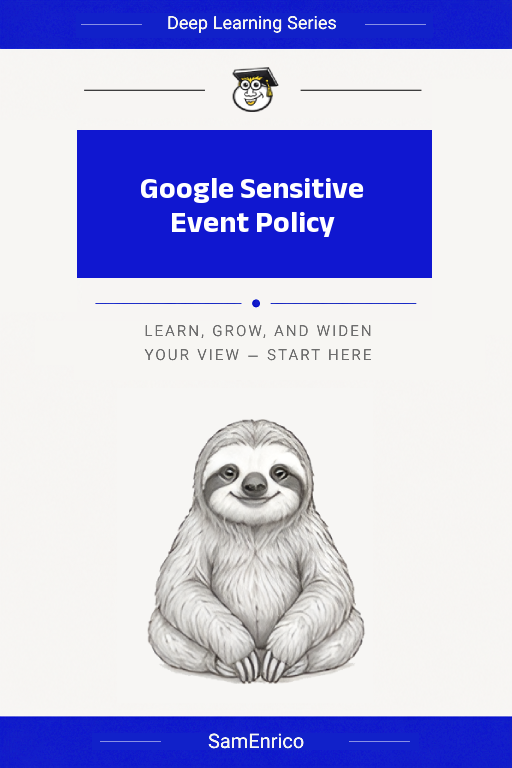
Google Sensitive Event Policy eBook
Navigate Google's sensitive event policy that rest
Navigate Google's sensitive event policy that restricts ads during crises, tragedies, and major global events.
Formats
Free sample
Chapter 1: The Day the Ads Stopped--The alert arrived at 5:47 AM Eastern Time on February 24, 2022. For most of the world, it was the first news that Russia had launched a full-scale invasion of Ukraine. For the 5.6 million advertisers who woke up to suspended Google Ads accounts over the following seventy-two hours, it was the beginning of a very different nightmare.Within three days, Google had blocked 8 million advertisements related to the war. Some of those ads were obvious violations—merchants selling “I Survived the Kyiv Bombing” t-shirts, cryptocurrency scams pretending to raise funds for Ukrainian refugees, and drop shippers marking up tourniquets by 1,400 percent. But many of the suspended accounts belonged to legitimate businesses that had done nothing wrong except run ads containing words like “crisis,” “emergency,” or “Ukraine.” A hardware store in Ohio that had been advertising “emergency generators” for three years suddenly found its account frozen.
A mental health nonprofit’s fundraising campaign for “war trauma counseling” was flagged as exploitative. A European airline that continued running its standard “fly to Warsaw” ads was suspended for misdirected traffic.None of them received a phone call. None of them received a personalized email. They received automated notifications with generic language: “Your account has been suspended for violating our Sensitive Event policy.” For most, the appeal process took two to three weeks. Some never got their accounts back.This chapter introduces the core mechanism of Google’s Sensitive Event policy, the single most misunderstood and dangerous policy in digital advertising.
It is not a punishment for bad actors, though it certainly catches them. It is an algorithmic tripwire designed to protect Google’s advertising business from reputational catastrophe during moments of global crisis. Understanding how this tripwire works—and why it was created—is the difference between keeping your business online and watching your revenue vanish overnight.The Birth of the Sensitive Event Policy To understand where we are, you must understand where Google has been. For the first fifteen years of Google Ads (formerly Ad Words), the company operated on a relatively simple brand safety model: don’t serve ads next to porn, don’t serve ads next to hate speech, and don’t serve ads for illegal products. Advertisers had enormous latitude to bid on keywords related to news events, tragedies, and crises.
If a plane crashed, you could bid on “plane crash.” If a hurricane made landfall, you could bid on “hurricane supplies.” If a mass shooting occurred, you could bid on “memorial donations.” Google’s only requirement was that your landing page actually delivered what your ad promised.That era ended in 2017.The catalyst was the “You Tube Brand Safety Crisis” of March 2017, when The Times of London published an investigation revealing that major brands—including Pepsi, Walmart, and Mc Donald’s—had their ads running alongside videos promoting terrorism, white nationalism, and anti-Semitism. The fallout was immediate and brutal. Major advertisers pulled hundreds of millions of dollars from Google. The company’s stock dropped 3 percent in a single day. You Tube’s chief business officer, Robert Kyncl, issued a public apology and promised “tougher controls.”But the real shift was internal.
Google realized that its previous brand safety model—reacting to violations after they occurred—was insufficient. In a world of real-time bidding and programmatic advertising, a single offensive ad placement could trigger a global boycott within hours. The company needed to predict violations before they happened, not just clean them up afterward. This led to the first version of what would eventually become the Sensitive Event policy, initially called the “Tragedy and Conflict” policy.The 2017 version was narrow. It applied only to “deaths, natural disasters, and civil emergencies.” It prohibited ads that “exploit or lack reasonable sensitivity” toward these events.
But the definition of “exploit” was vague, and enforcement was inconsistent. Some advertisers received warnings; others received immediate suspensions. There was no published list of prohibited keywords. There was no public appeals data. The policy existed as a black box, and advertisers learned its boundaries only when they crossed them.The 2020 COVID Trigger The Sensitive Event policy remained a relatively obscure corner of Google’s terms of service until March 2020, when the World Health Organization declared COVID-19 a pandemic.
Overnight, the entire global economy became a Sensitive Event.Every advertiser selling masks, sanitizer, gloves, or thermometers suddenly found themselves in the crosshairs. Google’s algorithms, trained to detect price gouging and exploitation during localized disasters like hurricanes or wildfires, were suddenly processing global data. The result was chaos. Legitimate medical suppliers were suspended alongside profiteers. Pharmacies that had sold masks for years were flagged for “insufficient demand” signals—a new algorithmic category that nobody outside Google had heard of.
The appeals backlog grew to six weeks.But something else happened during COVID that fundamentally changed how Google thought about the Sensitive Event policy. The company realized that the old model of defining a Sensitive Event as a “tragedy or conflict” was too narrow. COVID wasn’t a single event; it was a sustained global condition that lasted years. Google needed a policy that could handle both acute crises (a building collapse, a mass shooting, a volcanic eruption) and chronic conditions (a pandemic, a climate-driven famine, an ongoing war). This led to the first major policy expansion in 2021, which introduced the concept of “public health emergencies” as a separate category.By the end of 2021, Google had blocked over 100 million COVID-related ads and suspended more than 2 million advertiser accounts.
The Sensitive Event policy was no longer a niche concern for disaster relief charities and news organizations. It was a core risk factor for every business on the platform.The 2024 Pivot: From Vague to Explicit The current version of the Sensitive Event policy—the one you must understand to protect your business—was released in March 2024. It represents a fundamental shift in both scope and enforcement.The 2024 update did three things. First, it expanded the definition of a Sensitive Event to include “political unrest, coups, military coups, and civil unrest” as separate categories from “terrorism and mass violence.” This closed a loophole where advertisers could bid on keywords related to protests or uprisings as long as they avoided the word “terrorism.”Second, it introduced the concept of “ground truth” as the organizing principle of the policy. Google now defines a Sensitive Event as any unforeseen occurrence that creates a risk to “ground truth”—meaning the factual, verifiable reality of what is happening on the ground.
This language comes directly from Google’s internal policy documents, which state: “Advertisers may not use our platforms to distort, deny, or exploit the ground truth of a Sensitive Event.” In practice, this means that even if your ad copy is technically accurate, if it is structured to profit from confusion or misrepresentation of an event, it violates the policy.Third, and most importantly, the 2024 update moved from vague descriptions to explicit prohibitions with named categories and examples. The new policy lists prohibited practices including:Misdirected traffic: Using crisis keywords to drive users to products or services that do not directly address the stated crisis (e.g., advertising camping gear during a hurricane under the keyword “emergency shelter”).Price gouging: Advertising vital supplies at prices significantly above…
This is the end of the free sample. Get the eBook to keep going. Buy now
About this book
Details
- Author
- Heck Bridgette
- Publisher
- SamEnrico
- Language
- English
- Genre
- Non-Fiction, Annual Checkup, Sensitive Events, Crisis
- Released
- 2026-06-01
- Pages (approx.)
- 138
- Available as
- eBook, Audiobook

Read better in the ZLOADR app
Your eBooks on your phone or tablet. Sign in with your SamEnrico account and start reading.
More by Heck Bridgette
 Senator Recess Engagement GuideHeck Bridgette$11.99
 Essential Oil Inhaler GuideHeck Bridgette$11.99
 Self Hypnosis Jaw Pain TMJHeck Bridgette$11.99
 Meth Recovery Dental Care GuideHeck Bridgette$11.99
 Duty Suspension Program GuideHeck Bridgette$11.99
 The Silent Betrayal: How the CIA Sabotaged the Iran Hostage RescueHeck Bridgette$11.99
 The Alchemist of Cusco: How a Forgotten Laboratory Changed MedicineHeck Bridgette$11.99
 Wellness CoordinatorHeck Bridgette$11.99
 Understanding Continuous Muscle Fiber Activity HereditaryHeck Bridgette$17.99
 Pre Revenue Venture DebtHeck Bridgette$12.99
 How to Become a Mottle-lay-up OperatorHeck Bridgette$11.99