
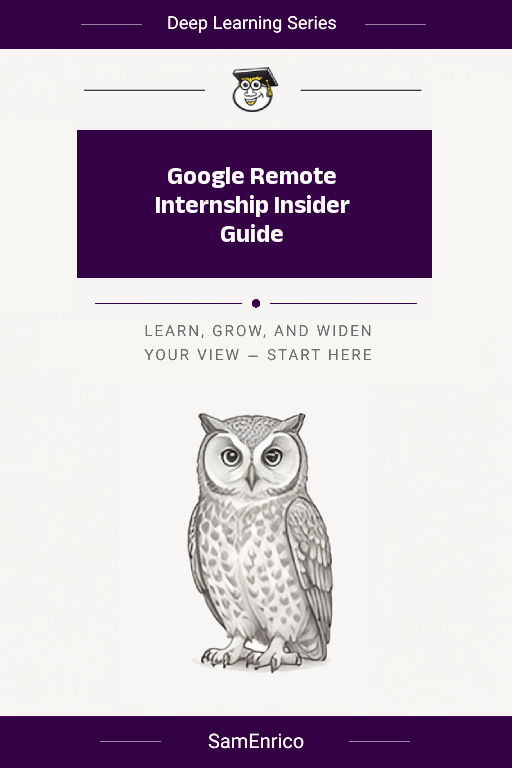
Non-FictionStudent's ShortcutTech InternshipGoogle Career
Google Remote Internship Insider Guide eBook
Land a virtual internship at Google with applicati
by Trout Evita
Land a virtual internship at Google with application strategies interview prep and project tips from former remote interns.
Formats
Free sample
Chapter 1: The Invisible Internship--The most common question I get from students isn't about coding challenges or resume keywords. It's a quiet, almost embarrassed whisper: "Is a remote internship at Google even a real internship?"Behind that question hides a deeper fear. You're imagining your friends at other companies posting photos of free cafeterias, nap pods, and late-night hackathons with pizza boxes stacked to the ceiling. You're imagining yourself alone in your childhood bedroom, wearing headphones, staring at a screen while your parents watch television in the next room. You're wondering if you'll miss the "real" experience—the mentorship, the spontaneous learning, the inside jokes, the feeling of being part of something bigger than your laptop.I understand that fear because I felt it too.
But I'm going to tell you something that sounds like heresy in most career advice books: The remote Google internship isn't a consolation prize. It's actually better.Not easier. Not more comfortable. Better.Here's why. When you intern remotely at Google, you cannot hide.
In a physical office, it's possible to look busy without being productive. You can wander to the coffee machine, hover near a senior engineer's desk, nod along in meetings, and leave at 5 PM with everyone else. Your presence alone creates the illusion of contribution. Remote work strips away that illusion completely. Every line of code, every comment in a design doc, every thoughtful question in a recorded meeting—that's your only evidence.
You learn faster because you have to. You communicate more clearly because vague messages get ignored. You document everything because nobody can tap you on the shoulder.This chapter dismantles the romanticized image of the traditional internship and builds a new framework for understanding what success looks like when your office is a Zoom window. You will learn why digital presence matters more than physical proximity, how Google's "Digital First" culture actually works (not the PR version), and why the skills you build as a remote intern will serve you better in the future of work than any in-person experience could.But first, let's clear up the biggest lie.The Free Food Fallacy Google's physical campuses are engineered for serendipity. The microkitchens stocked with kombucha, the shuttle systems connecting buildings, the open floor plans—all of it is designed to increase the probability of random collisions between people who wouldn't normally talk to each other.
A designer bumps into an engineer. A product manager shares an elevator with a researcher. A summer intern grabs a salad next to a senior vice president.These collisions produce value. That's not a secret. But here's what no one tells you: serendipity is a tax, not a gift.When you rely on physical proximity to learn, you're outsourcing your growth to randomness.
You're hoping the right person sits next to you. You're hoping they're in a good mood. You're hoping they have time. The remote internship forces you to replace hope with intention. You cannot stumble into a mentor.
You must find one, message them, schedule time on their calendar, and show up with specific questions that respect their limited attention.I interviewed a former remote intern—let's call her Priya—who worked on the Google Pay team from her apartment in Austin while her host was in Mountain View and her co-host was in Zurich. She never met either of them in person. On her first day, she felt invisible. Then she made a decision: she would treat every interaction as if it were being recorded for her performance review. Not from fear, but from clarity.
She wrote down every question before asking it. She summarized every meeting in a shared doc. She sent weekly updates even when no one asked for them.By week three, her host told her something remarkable: "You're the easiest intern I've ever managed. I always know what you're doing, even when I'm offline."That's the power of remote. You become unignorable.The Communication Matrix: When to Write, When to Speak One of the biggest contradictions in remote work advice is the tension between "over-communicate in writing" and "be articulate in interviews." Which one is it?
Does Google want writers or speakers?The answer is both, but in different contexts. This confusion led to the creation of the Communication Matrix, a framework you'll use throughout this book. It has four quadrants, each suited to a specific situation:Quadrant 1: Async Written Examples: Design docs, email updates, bug reports, code comments, weekly status summaries When to use: Planning, documenting decisions, sharing status, anything that needs to be referenced later Google tool: Google Docs, internal wikis (g3doc), email, Buganizer Quadrant 2: Sync Written Examples: Chat messages, Slack DMs, instant messages When to use: Quick clarifications, urgent but simple questions, coordinating a live meeting time Google tool: Google Chat, internal instant messaging Warning: Never use sync written for complex decisions. If a conversation goes beyond three back-and-forth messages, escalate to a call or a doc.Quadrant 3: Sync Spoken Examples: Technical interviews, stand-up meetings, pair programming, host calls, exit reviews When to use: Real-time problem-solving, building rapport, negotiating, anything with emotional stakes Google tool: Google Meet, phone Note: This is where your spoken communication skills matter most Quadrant 4: Async Spoken Examples: Recorded Loom videos, voicemail, narrated slide decks When to use: Explaining something complex to a team in different time zones, providing feedback that might be misinterpreted in writing, demonstrating a process Google tool: Google Meet recordings, Loom (external), internal video tools Here's the rule that will save you months of frustration: Default to Quadrant 1 (Async Written) for everything except live interviews and urgent problems. When in doubt, write it down.
When someone asks you a question in a meeting, follow up with a written summary. When you make a decision, document it. The written artifact is the unit of work at Google.But during your technical interview (Chapter 6) and your behavioral interview (Chapter 7), you must switch to Quadrant 3 (Sync Spoken). The interviewer cannot read your mind. They cannot see your Portfolio Doc unless you share it—and even then, they probably won't.
They need to hear you think.This tension is not a bug. It's a feature. Google is testing your ability to navigate different communication modes. The candidate who writes beautifully but stumbles through a live explanation is incomplete. The candidate who speaks fluently but never documents anything is equally incomplete.Digital First, Not Remote Only Google's internal culture is officially called "Digital First," not "Remote Only." The distinction matters.
Digital First means that digital collaboration is the default, not the backup. Before the pandemic, most teams defaulted to in-person meetings and used digital tools when someone was traveling or sick. Now, the opposite is true. You start with a design doc. You add comments.
You escalate to a recorded video. You only schedule a live meeting when the async conversation has reached an impasse.This shift has profound implications for interns. In the old model, you learned by osmosis—sitting near experienced engineers, overhearing their debugging sessions, noticing which documentation they consulted. In the Digital First model, you learn by reading the artifacts those engineers left behind. Every design doc, every code review comment, every archived mailing list thread is a teaching…
This is the end of the free sample. Get the eBook to keep going. Buy now
About this book
Details
- Author
- Trout Evita
- Publisher
- SamEnrico
- Language
- English
- Genre
- Non-Fiction, Student's Shortcut, Tech Internship, Google Career
- Released
- 2026-06-01
- Pages (approx.)
- 155
- Available as
- eBook, Audiobook

Read better in the ZLOADR app
Your eBooks on your phone or tablet. Sign in with your SamEnrico account and start reading.
More by Trout Evita
 Rabbi Nachman KrochmalTrout Evita$11.99
 Prioritization for Military PersonnelTrout Evita$11.99
 Problem Solving Chain Analysis GuideTrout Evita$11.99
 Murdoch Wall Street Journal LegacyTrout Evita$11.99
 Fatherhood Rage Quieting GuideTrout Evita$11.99
 The Vanishing of the Boy in Blue: The Unsolved Mystery of Bobby DunbarTrout Evita$11.99
 The Oracle of Delphi and the Earth's Hidden Fury: Ancient Seismology in the Shadow of the GodsTrout Evita$11.99
 10 Ways to Use Crab Boil (Recipe Book)Trout Evita$11.99
 Polish Remote Contractor TerminationTrout Evita$12.99
 Understanding Bone NeoplasmsTrout Evita$17.99
 AI Writing and Research with ChatGPTTrout Evita$11.99
You may also like
 Hong Kong Handover 1997Dunn Johnnie$11.99
 Zumba For Postnatal Recovery CourseNeal Christian$11.99
 Zumba for BeginnersLadner Nikia$11.99
 YouTube Comment Mining GuideHumes Pandora$12.99
 Worry Box MeditationCarlin Rudy$11.99
 Workplace Stress MeditationNguyen Lynn$11.99
 Workplace Stress and Sleep RepairHawley Ivory$11.99
 Workplace Perfectionism CureDelaney Jeffry$11.99
 Workplace Injustice Anger GuideWallen Isabelle$11.99
 Work Addiction and Burnout LinkGreenwood Ester$11.99
 Women in Yoga and WellnessBeattie Galina$11.99
 Women in Stand Up ComedyChun Evangeline$11.99