
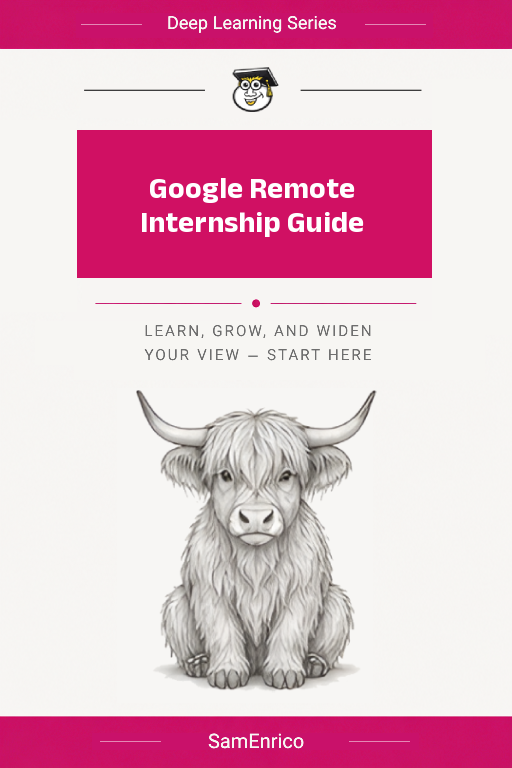
Google Remote Internship Guide eBook
Learn how to land a virtual internship at Google w
Learn how to land a virtual internship at Google with portfolio tips and async interview strategies. Covers project showcases and cross-time-zone collaboration skills.
Formats
Free sample
Chapter 1: The Geography of Opportunity...--The email arrived at 11:47 PM on a Tuesday. Sarah, a junior at a small liberal arts college in rural Kansas—three hundred miles from the nearest tech hub—had been staring at her laptop for six hours. She had rewritten her cover letter seventeen times. She had watched four You Tube videos about “Google interview tips.” She had even practiced her handshake in the bathroom mirror, because every career guide she had ever read told her that the handshake mattered.But Sarah was applying for a remote internship. There would be no handshake.
There would be no tour of Building 43. There would be no awkward small talk by the espresso machine. And yet, she was preparing for a world that no longer existed.Sarah’s story is not unique. Every year, hundreds of thousands of students—many of them brilliant, capable, and exactly what Google is looking for—filter themselves out of the application process before they even begin. Why?
Because they believe a lie. The lie is this: you need to be near a Google campus to be a competitive candidate.This chapter exists to kill that lie.The Myth of Geographic Proximity Let’s start with a simple question: When was the last time you shook hands with someone over a video call? When was the last time your GPA mattered more than your Git Hub commit history? When was the last time a recruiter asked you what you were wearing, rather than what you had shipped?The answer is never. Because the rules of remote recruiting are not the rules of office recruiting.
They are different. Fundamentally, structurally, psychologically different.Google’s transition to remote-first work did not begin with the pandemic. It began years earlier, with distributed teams in Zurich, Sydney, and Mountain View collaborating across sixteen time zones. The pandemic simply accelerated what was already inevitable. By 2023, over 60% of Google’s intern roles were remote or hybrid.
By 2026, that number will exceed 70%. The company has invested billions in asynchronous collaboration tools, internal wikis, and virtual onboarding systems. They have hired remote-first managers who have never managed a physical team. They have built career ladders for people who will never set foot in a Google office.And yet, the average student still applies like it is 2019.Consider this: In 2024, Google received over 3 million applications for approximately 2,000 intern positions. That is a 0.07% acceptance rate.
But here is the statistic that matters more: of those 3 million applicants, fewer than 10% had a public Git Hub repository with meaningful contribution history. Fewer than 5% had ever collaborated on an open-source project. Fewer than 2% had written an asynchronous update template.The students who get offers are not the ones with the highest GPAs. They are not the ones who attended the most prestigious universities. They are the ones who have figured out that remote work is a different game, with different rules, and they have learned to play it.This chapter is your rulebook.The Remote Opportunity Landscape Before you can land a remote internship at Google, you need to understand what “remote” actually means in Google’s ecosystem.
It is not a single category. It is a spectrum.Remote-First Roles These are roles where the entire team is distributed. There is no “home office.” Your manager might be in Dublin. Your mentor might be in Singapore. Your daily standup might be an asynchronous thread in Slack.
These roles are the truest expression of remote work, and they are growing faster than any other category.Examples:Software Engineering Intern (distributed teams in Google Cloud)Technical Program Manager Intern (global supply chain)UX Research Intern (remote-first product teams)Key characteristic: You will never be required to relocate. Your “office” is your home, a coffee shop, or a co-working space. Your success depends entirely on your ability to communicate asynchronously and manage your own schedule.Location-Specific Remote Roles These roles are tied to a specific geographic region—usually for legal, tax, or time-zone alignment reasons—but you perform the work remotely. You might need to live in a particular state or country, but you will not commute to an office.Examples:Student Researcher (Ph D roles tied to US time zones)Google Cloud Digital Leader (region-specific remote)Legal Intern (country-specific due to compliance)Key characteristic: You must be authorized to work in that location, but you can work from anywhere within that jurisdiction. These roles often have hybrid expectations (e.g., quarterly in-person gatherings).Virtual Programs and Portfolios These are not traditional internships, but they serve as powerful on-ramps.
Google Summer of Code (GSo C) is the most famous example. You contribute to open-source projects, receive a stipend, and build a portfolio that recruiters actively search. Important distinction (see Chapter 10 for full details): GSo C is not a Google internship. You are not a Google employee. But it is the single best portfolio-builder for a future Google application.Examples:Google Summer of Code (open-source contribution)Google Open Source Peer Bonus Google Season of Docs (technical writing)Key characteristic: These programs are fully remote, globally accessible, and require no prior Google affiliation.
They are designed specifically for students who do not live near tech hubs.The Decision Matrix How do you know which category applies to you? Use this simple matrix:Your Situation Best Fit Action Step Live in US, EU, or APAC, authorized to work Remote-first or location-specific Apply directly via Google Careers Live outside major tech hubs, strong open-source portfolio Virtual programs (GSo C)Build contributions first (Chapter 10)Ph D or Master's student, research-focused Student Researcher Network with research teams via cold email Non-technical (PM, marketing, policy)Remote-first (many roles)Focus on portfolio showcase (Chapter 5)The key insight is this: Your location is almost never the disqualifying factor. Your ability to demonstrate remote readiness is the only factor that matters.The Remote Readiness Score Before you submit a single application, you need to know where you stand. The Remote Readiness Score is a 10-point self-audit that measures your preparedness for Google’s remote-first environment. Be honest.
No one sees this but you.Section A: Technical Setup (2 points)1 point: You have a reliable internet connection (minimum 25 Mbps download, 5 Mbps upload)1 point: You have a dedicated workspace with neutral background and decent lighting Section B: Asynchronous Communication (3 points)1 point: You have written a public async update (blog post, newsletter, or documented project)1 point: You have used Slack or Discord for remote collaboration (not just casual chat)1 point: You can articulate the difference between “urgent” and “important” in writing Section C: Portfolio Publicness (3 points)1 point: Your Git Hub (or portfolio site) has a README explaining who you are and what you build1 point: You have at least one project with meaningful commit history (not a single massive push)1 point: Your portfolio includes measurable outcomes (e.g., “reduced latency by 15%”)Section D: Time-Zone Literacy (2 points)1 point: You understand the difference between UTC-5, UTC+0, and UTC+81 point: You have scheduled a meeting across at least three time zones without a scheduling tool Scoring:9-10: You are ready to apply now. Skip to Chapter 6 for interview prep.6-8: You need targeted work. Identify your lowest section and read the corresponding chapter.0-5…
This is the end of the free sample. Get the eBook to keep going. Buy now
About this book
Details
- Author
- Maurer Krysten
- Publisher
- SamEnrico
- Language
- English
- Genre
- Non-Fiction, Student's Shortcut, Virtual Work Experience, Tech Career Guide
- Released
- 2026-06-01
- Pages (approx.)
- 131
- Available as
- eBook, Audiobook

Read better in the ZLOADR app
Your eBooks on your phone or tablet. Sign in with your SamEnrico account and start reading.
More by Maurer Krysten
 Tabriz Uprising 1978Maurer Krysten$11.99
 GAD Values Based ActionMaurer Krysten$11.99
 PMDD Symptom Management WorkbookMaurer Krysten$11.99
 Nightmare Cessation Techniques GuideMaurer Krysten$11.99
 The Sitting Meditation MBSRMaurer Krysten$11.99
 The Riddle of the Red Dust: The Discovery of Cobalt in the CongoMaurer Krysten$11.99
 Xipe Totec: The Flayed God's Living MaskMaurer Krysten$11.99
 Understanding Hand–schüller–Christian DiseaseMaurer Krysten$17.99
 How to Start a Hobby in Off Road DrivingMaurer Krysten$11.99
 Artificial Intelligence Supply Chain OutlookMaurer Krysten$12.99
 Aircraft Engine MechanicMaurer Krysten$11.99