
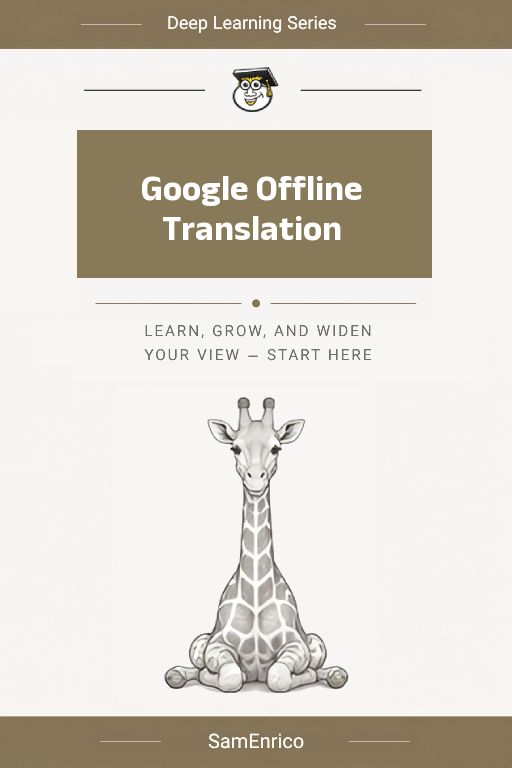
Google Offline Translation
Build voice-to-text AI for local languages where k
by Quiroz Rona
Build voice-to-text AI for local languages where keyboard usage is low.
Formats
About this book
Free sample
Chapter 1: The Silent Majority...--There is a farmer in rural Kenya named Wanjiku. She wakes at 5:00 AM, tends to her cows, walks three kilometers to the nearest market town, and sells her produce using a smartphone that cost her $40. She has never owned a laptop. She has never typed an email. When she wants to send a message to her cooperative, she presses a button on her phone and speaks.
The phone transcribes her words into text. That text becomes a message. That message reaches buyers fifty kilometers away.Wanjiku is not a tech enthusiast. She does not know what ASR stands for. But she is part of the largest unaddressed market in the history of computing: the 2.8 billion people who cannot type effectively.This book is about building voice-to-text systems for people like Wanjiku.
Not as an afterthought. Not as a "nice to have" accessibility feature. As the primary interface.The QWERTY Deception The keyboard you are likely not using right now—because you are reading, not typing—was designed in 1873 for a mechanical typewriter. Christopher Latham Sholes arranged the letters in a specific order to solve a mechanical problem: adjacent keys, when struck in rapid succession, would jam. QWERTY was not designed for speed, comfort, or learnability.
It was designed to slow typists down just enough to prevent mechanical failure.That compromise has now persisted for 150 years. It has been ported to every smartphone, every tablet, every smartwatch. It has been imposed on languages that do not use Latin scripts. It has become the default interface for billions of people who never asked for it.The deception is this: we assume typing is natural. It is not.
Typing is a learned skill that requires months or years of practice to master. In countries with universal primary education and abundant access to computers, that practice is baked into childhood. In countries where a smartphone is the first—and often only—computing device, that practice never happens.Consider the cognitive load of typing on a touchscreen. A user must:Remember the location of 26+ letters on a virtual keyboard that provides no tactile feedback…
This is the end of the free sample. Get the eBook to keep going. Buy now
Contents
- Chapter 1
- Chapter 2
- Chapter 3
- Chapter 4
- Chapter 5
- Chapter 6
- Chapter 7
- Chapter 8
- Chapter 9
- Chapter 10
- Chapter 11
- Chapter 12
Details
- Author
- Quiroz Rona
- Publisher
- SamEnrico
- Language
- English
- Genre
- Non-Fiction, Startup Guide, AI Models, Voice Interface
- Released
- 2026-05-30
- Pages (approx.)
- 158
- Available as
- eBook, Audiobook

Read better in the ZLOADR app
Your eBooks on your phone or tablet. Sign in with your SamEnrico account and start reading.
More by Quiroz Rona
 RLS And Antihistamine Warning GuideQuiroz Rona$11.99
 Technical Role Confidence BuildingQuiroz Rona$11.99
 The Koresh FBI FilesQuiroz Rona$11.99
 Almodovar Color WorldQuiroz Rona$11.99
 Macmillan HaroldQuiroz Rona$11.99
 Cleopatra's Military Logistics ManualQuiroz Rona$11.99
 Parenting Anger Cognitive ToolsQuiroz Rona$11.99
 Emergency Radio and CommunicationQuiroz Rona$11.99
 Cash Flow for CateringQuiroz Rona$11.99
 The Ballad of the Black Cowboy: Nat Love's Untold FrontierQuiroz Rona$11.99
 Frozen Secrets: The First Antarctic Climate Pioneers (1838-1843)Quiroz Rona$11.99
 Bottled Time: The 100-Year-Old Mystery of the Lost Champagne CellarsQuiroz Rona$11.99