
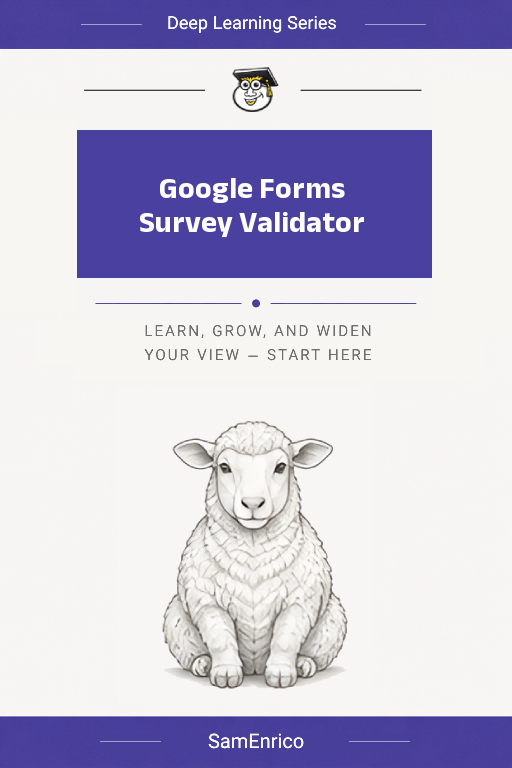
Non-FictionStartup GuideSurveyGoogle Tools
Google Forms Survey Validator eBook
Design free Google Forms survey with net promoter
by Culp Akiko
Design free Google Forms survey with net promoter score questions to measure potential customer interest.
Formats
Free sample
Chapter 1: The Polite Lie...--–- Every entrepreneur has heard it. You show your idea to a friend, a family member, or a potential customer. You lean in with nervous excitement and ask, "What do you think?" They smile. They nod. They say, "That's a great idea.
I would definitely buy that."Then you build it. And no one buys it.This chapter opens with a brutal truth that most business books dance around: people lie about their interest in new products. Not because they are malicious, but because they are polite. They want to spare your feelings. They want to end the conversation quickly.
They want to feel helpful without any commitment. The result is a catastrophic data problem that has sunk more startups than bad execution, lack of funding, or incompetent teams combined.According to CB Insights, 42 percent of startups fail because there is no market need for their product. That is not a failure of building. That is a failure of listening. Or more precisely, a failure of asking the right question in the right way using the right tools.This book exists because the gap between "I would buy that" and "I am buying that" is where good intentions go to die.
And the bridge across that gap is something most survey creators ignore entirely: validation.Welcome to The Validated Survey. This is not a beginner's guide to clicking buttons in Google Forms. You can find that on You Tube for free. This is an advanced playbook for entrepreneurs, product managers, researchers, and marketers who need trustworthy data from a free tool—and who understand that garbage in equals garbage out.In this first chapter, you will learn why most product ideas fail because of measurement error, not product quality. You will discover the Net Promoter Score and why a single question on a 0-to-10 scale is the most researched and validated predictor of customer behavior in existence.
You will understand why free tools like Google Forms get a bad reputation—and how the hidden feature of Response Validation transforms a simple pollster into a rigorous research instrument. And you will walk away with a clear roadmap for the twelve chapters ahead, each designed to strip away the polite lies and reveal the unvarnished truth about whether your idea deserves to exist.The stakes are simple. Every hour you spend building a product nobody wants is an hour you cannot recover. Every dollar you spend marketing to people who will never buy is a dollar stolen from your next idea. Every survey you field that collects junk data is a step closer to a decision you will regret.Validation is the vaccine against these failures.
And it starts with understanding the enemy: the polite lie.The Graveyard of Good Ideas Let me tell you about Sarah. Sarah was a first-time founder with a brilliant concept: a subscription box for artisanal coffee beans sourced from small-batch roasters. She had taste-tested forty-seven coffees. She had designed beautiful packaging. She had secured letters of intent from twelve roasters.Before building her website or ordering inventory, she did what every responsible entrepreneur should do.
She asked people if they would buy it.She created a survey using a free tool. She asked questions like "Would you be interested in a coffee subscription box?" and "How much would you pay for premium beans delivered monthly?" She shared the link on social media, in Facebook groups, and with her personal network.Within two weeks, she had 847 responses. Eighty-three percent said they were "very interested." Seventy-one percent said they would pay forty dollars per month. The data looked incredible.Sarah raised thirty thousand dollars from friends and family. She built a custom website.
She ordered three months of inventory. She launched with a marketing budget of ten thousand dollars.In the first thirty days, she sold seventeen subscriptions.Seventeen. Not 847. Not 83 percent of 847. Seventeen.The polite lie had cost her forty thousand dollars and six months of her life.What happened?
Did her respondents intentionally deceive her? Almost certainly not. They believed they were interested. They believed they would pay. But belief is not behavior.
Intention is not action. And a survey without validation is just a collection of well-meaning falsehoods.Sarah made three fatal errors that this book will teach you to avoid.First, she asked about interest rather than behavior. "Would you be interested?" is a dangerous question because there is no cost to saying yes. It costs zero dollars to click a button that says "very interested." A better question—one we will spend significant time on in this book—asks about likelihood to recommend because that correlates with actual purchasing behavior in ways that "interest" never will.Second, she collected responses from the wrong people. Her social media followers and friends were predisposed to support her.
They wanted her to succeed. That social pressure produced inflated scores. You need strangers. You need skeptics. You need people who have no emotional investment in your feelings.Third, and most critically, she had no validation rules on her survey.
Anyone could submit anything. Bots could have inflated her numbers. But more likely, real humans clicked through her survey without thinking, selecting "very interested" because it was the path of least resistance. There was no friction. No forced reflection.
No requirement to explain why they were interested or what specifically would motivate them to open their wallets.Sarah is not an outlier. She is the rule. And her story is included here because it is also my story. I have made every mistake this book will help you avoid. I have launched products that failed.
I have trusted surveys that lied. I have wasted years on ideas that should have died in a spreadsheet.The difference now is that I learned to validate. And you will too.The Question That Changed Everything In 2003, a researcher named Fred Reichheld published an article in the Harvard Business Review titled "The One Number You Need to Grow." In it, he argued that companies were asking too many questions. They were drowning in customer satisfaction metrics, loyalty scores, and retention models. But most of those metrics predicted nothing.Reichheld had a radical idea.
What if you asked customers just one question? And what if that single question could predict future growth better than any complex model?The question was this: "On a scale of 0 to 10, how likely are you to recommend our company to a friend or colleague?"He called it the Net Promoter Score, or NPS. And over the next two decades, it became the most widely used customer loyalty metric in the world. Companies like Apple, Amazon, Tesla, and thousands of others adopted it. Academic researchers published hundreds of peer-reviewed studies validating its predictive power.Here is what the research shows.
Customers who score 9 or 10—called Promoters—are five times more likely to repurchase than Passives. They are three times more likely to forgive a mistake. And they generate 80 to 90 percent of all word-of-mouth referrals. Customers who score 0 through 6—called Detractors—are more likely to churn, more likely to complain publicly, and more likely to damage your brand reputation.The middle scores—7 and 8—are…
This is the end of the free sample. Get the eBook to keep going. Buy now
About this book
Details
- Author
- Culp Akiko
- Publisher
- SamEnrico
- Language
- English
- Genre
- Non-Fiction, Startup Guide, Survey, Google Tools
- Released
- 2026-06-01
- Pages (approx.)
- 137
- Available as
- eBook, Audiobook

Read better in the ZLOADR app
Your eBooks on your phone or tablet. Sign in with your SamEnrico account and start reading.
More by Culp Akiko
 Conflict Resolution In Creative Teams GuideCulp Akiko$11.99
 Nordic Talent Attraction PatternsCulp Akiko$11.99
 Bodyweight Senior CalisthenicsCulp Akiko$11.99
 The Grandparent Sleep Advice GuideCulp Akiko$11.99
 Stress Management for Administrative AssistantsCulp Akiko$11.99
 The Art of the Steal: How a Master Forger Laundered Millions Through the Art WorldCulp Akiko$11.99
 The Bone Setters of Baghdad: 19th-Century Surgical Pioneers in the Heart of the Ottoman EmpireCulp Akiko$11.99
 How to Become a Cable Assembler And SwagerCulp Akiko$11.99
 Understanding Chromosome 3, Monosomy 3pCulp Akiko$17.99
 Journeyman Automotive TechnicianCulp Akiko$11.99
 First Customer Acquisition PlanCulp Akiko$12.99
You may also like
 Hong Kong Handover 1997Dunn Johnnie$11.99
 Zumba For Postnatal Recovery CourseNeal Christian$11.99
 Zumba for BeginnersLadner Nikia$11.99
 YouTube Comment Mining GuideHumes Pandora$12.99
 Worry Box MeditationCarlin Rudy$11.99
 Workplace Stress MeditationNguyen Lynn$11.99
 Workplace Stress and Sleep RepairHawley Ivory$11.99
 Workplace Perfectionism CureDelaney Jeffry$11.99
 Workplace Injustice Anger GuideWallen Isabelle$11.99
 Work Addiction and Burnout LinkGreenwood Ester$11.99
 Women in Yoga and WellnessBeattie Galina$11.99
 Women in Stand Up ComedyChun Evangeline$11.99