
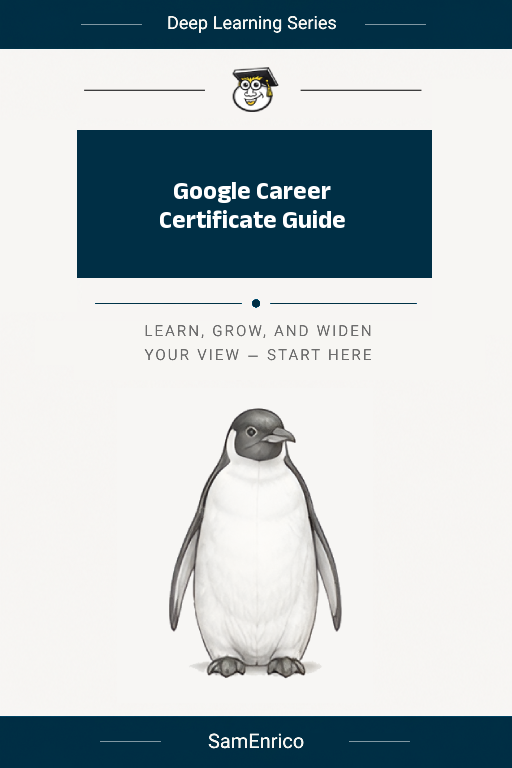
Non-FictionStudent's ShortcutGoogle Certifications
Google Career Certificate Guide eBook
Earn Google Career Certificates in IT, UX, Data, o
by Peck Dennise
Earn Google Career Certificates in IT, UX, Data, or Project Management that employers actively recruit for.
Formats
Free sample
Chapter 1: The $39 Bet--Maria’s alarm went off at 4:47 AM. Not because she had somewhere to be — but because that was the only hour of the day she could guarantee two hours of uninterrupted quiet. Her son, Leo, would sleep until 7:00. Her shift at the hotel front desk started at 8:00. Between those two immovable walls of responsibility, she had exactly 133 minutes to teach herself data analytics.Six months earlier, Maria had never written a line of SQL.
She had never heard of Tableau. The word “pivot table” sounded like something in a carnival ride. She had a high school diploma, a seven-year-old who asked her every week why other moms had “office jobs,” and a growing certainty that the hospitality industry was going to automate her position before Leo started middle school.She had $39 in her checking account on the day she enrolled. That was not an exaggeration. She chose the Google Data Analytics Certificate because Coursera offered a seven-day free trial, and she needed seven days to decide if this was delusion or destiny.This book exists because Maria now manages a team of six analysts at T-Mobile, makes 89,000peryear,andworksfromthesamelivingroomwhere Leodoeshismathhomework.Thetotaltimefromherfirstpanicked“WHEREDOICLICK?”tohersignedofferletterwastwelvemonths.Thetotalcostwas89,000 per year, and works from the same living room where Leo does his math homework.
The total time from her first panicked “WHERE DO I CLICK?” to her signed offer letter was twelve months. The total cost was 89,000peryear,andworksfromthesamelivingroomwhere Leodoeshismathhomework.Thetotaltimefromherfirstpanicked“WHEREDOICLICK?”tohersignedofferletterwastwelvemonths.Thetotalcostwas479. The return on that investment, in her first year alone, was 18,578 percent.This is not a miracle story. It is a roadmap. And you are holding the only guide that will walk you through every single step — not just the coursework, but the psychological warfare of job hunting without a degree, the hidden job boards that ninety percent of certificate graduates never find, and the exact scripts Maria used to answer the question “Why aren’t you in college?” without sounding defensive or embarrassed.Before we go any further, let us address the voice in your head that is already whispering objections.
You are not too old. Maria was thirty-four. You are not too young. Nineteen-year-olds have completed this path. You do not need to be good at math.
You need to be good at knowing when to Google something you do not understand. You do not need to quit your job. Maria never missed a single hotel shift. You do not need a laptop from this decade. She completed her coursework on a refurbished Chromebook with a cracked screen.The only thing you need is the willingness to bet $39 on yourself for thirty days and see what happens.The Million-Dollar Misunderstanding Let us name the elephant in the room immediately.
You have been told, probably by well-meaning parents, guidance counselors, or society at large, that the only reliable path to a middle-class or upper-middle-class career runs through a four-year university. This belief is so deeply embedded in American culture that questioning it feels almost blasphemous. We have entire industries built around this assumption: student loan servicers, campus housing developers, textbook publishers, accreditation bodies, and a thousand other institutions that profit from the status quo.Here is what those institutions do not want you to know. According to the Federal Reserve Bank of New York, forty-one percent of recent college graduates are underemployed — meaning they hold jobs that do not require a bachelor’s degree. They are waiting tables, stocking shelves, and answering phones while carrying an average student loan balance of $37,000.
Meanwhile, according to Google’s own program data, over one million people have completed their Career Certificates, and seventy percent report a positive career outcome — new job, promotion, or raise — within six months of finishing. A footnote is necessary here, because precision matters: that seventy percent figure applies to the six-month period after you complete the certificate, not six months from the day you start. Most students take three to six months to finish the coursework first. Maria took four months while working full-time. The twelve-month timeline from start to hire is realistic, honest, and achievable.Let us put these numbers side by side.
A four-year degree costs an average of 108,584includingtuition,fees,room,andboard,accordingtothe National Centerfor Education Statistics.Thatfigureassumesyougraduateinfouryears,whichonlyforty−onepercentofstudentsactuallydo.The Google Career Certificatecosts108,584 including tuition, fees, room, and board, according to the National Center for Education Statistics. That figure assumes you graduate in four years, which only forty-one percent of students actually do. The Google Career Certificate costs 108,584includingtuition,fees,room,andboard,accordingtothe National Centerfor Education Statistics.Thatfigureassumesyougraduateinfouryears,whichonlyforty−onepercentofstudentsactuallydo.The Google Career Certificatecosts39 per month on Coursera. The average student completes the program in four months, for a total tuition cost of 156.Addincidentals—maybeadecentmouse,asecondmonitorifyouarefeelingfancy,andthe156. Add incidentals — maybe a decent mouse, a second monitor if you are feeling fancy, and the 156.Addincidentals—maybeadecentmouse,asecondmonitorifyouarefeelingfancy,andthe24.99 for this book — and your all-in investment lands somewhere between 200and200 and 200and500.The average starting salary for certificate graduates varies by track.
IT Support specialists start around 55,000.Project Coordinatorsaverage55,000. Project Coordinators average 55,000.Project Coordinatorsaverage67,000. UX Designers come in at 77,000.Data Analystsleadthepackat77,000. Data Analysts lead the pack at 77,000.Data Analystsleadthepackat86,000. These are national averages; a disclaimer is warranted because salaries vary significantly by city.
An IT Support role in Austin, Texas, might pay 48,000,whilethesamerolein San Franciscocouldbe48,000, while the same role in San Francisco could be 48,000,whilethesamerolein San Franciscocouldbe68,000. Chapter 2 provides detailed city-by-city tables. For now, understand that your earning potential after completing this program is roughly equivalent to or better than the average starting salary of a four-year degree graduate — without the decade of debt repayment.Maria’s break-even calculation is instructive. She spent 479totalonthecertificate,thisbook,andausedmonitorfrom Facebook Marketplace.Herfirst−yearsalaryat T−Mobilewas479 total on the certificate, this book, and a used monitor from Facebook Marketplace. Her first-year salary at T-Mobile was 479totalonthecertificate,thisbook,andausedmonitorfrom Facebook Marketplace.Herfirst−yearsalaryat T−Mobilewas89,000.
Her first month of salary paid for her entire educational investment approximately fifteen times over. Her student loan–burdened friends, the ones with degrees from respectable state universities, will be making payments until their forties.The Employer Consortium: Your Backstage Pass You might be thinking, “This sounds too good to be true. If certificates are so valuable, why isn’t everyone doing this? Why do employers still ask for degrees?”These are fair questions. Here is the honest answer.
Most employers do still ask for degrees. The typical job posting for an entry-level analyst position includes a line that says “Bachelor’s degree required.” You are going to see that line hundreds of times during your job search. It will make you feel invisible, unqualified, and angry.But here is what those job postings do not say. Over one hundred and fifty companies — including Deloitte, Siemens, T-Mobile, Wells Fargo, Walmart, Best Buy, Infosys, and Google itself — have signed formal agreements with Google to actively recruit certificate graduates. The word “actively” is doing important work here.
These companies have not simply agreed to “consider” certificate holders alongside degree holders. They have built dedicated recruiting pipelines. They have trained their hiring managers to recognize the credential. They have created exclusive job boards that only certificate graduates can access. Some of them, like Deloitte, have publicly stated that…
This is the end of the free sample. Get the eBook to keep going. Buy now
About this book
Details
- Author
- Peck Dennise
- Publisher
- SamEnrico
- Language
- English
- Genre
- Non-Fiction, Student's Shortcut, Google Certifications
- Released
- 2026-05-30
- Pages (approx.)
- 151
- Available as
- eBook, Audiobook

Read better in the ZLOADR app
Your eBooks on your phone or tablet. Sign in with your SamEnrico account and start reading.
More by Peck Dennise
 Beginner Fitness for MenPeck Dennise$11.99
 Retail Insurance Broker DirectoryPeck Dennise$11.99
 Metta for Teens CoursePeck Dennise$11.99
 Anger Outburst Couples WorkbookPeck Dennise$11.99
 Antwerp Diamond Heist Mastermind RevealedPeck Dennise$11.99
 The Last Great Crossing: Explorers Conquer the Australian OutbackPeck Dennise$11.99
 The Diamond Heist That Shook a KingdomPeck Dennise$11.99
 Understanding Dentinogenesis ImperfectaPeck Dennise$17.99
 How to Become a Scientific LinguistPeck Dennise$11.99
 Credit Repair Organizations ActPeck Dennise$12.99
 Quality Control TechnicianPeck Dennise$11.99Quality Control TechnicianPeck Dennise$11.99
You may also like
 Hong Kong Handover 1997Dunn Johnnie$11.99
 Zumba For Postnatal Recovery CourseNeal Christian$11.99
 Zumba for BeginnersLadner Nikia$11.99
 YouTube Comment Mining GuideHumes Pandora$12.99
 Worry Box MeditationCarlin Rudy$11.99
 Workplace Stress MeditationNguyen Lynn$11.99
 Workplace Stress and Sleep RepairHawley Ivory$11.99
 Workplace Perfectionism CureDelaney Jeffry$11.99
 Workplace Injustice Anger GuideWallen Isabelle$11.99
 Work Addiction and Burnout LinkGreenwood Ester$11.99
 Women in Yoga and WellnessBeattie Galina$11.99
 Women in Stand Up ComedyChun Evangeline$11.99