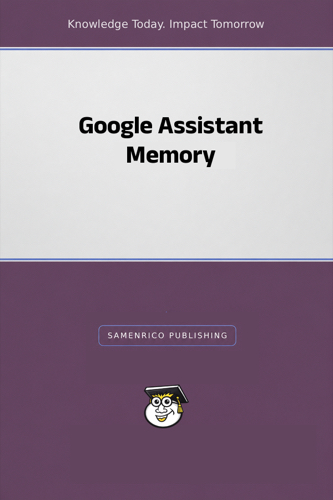
Google Assistant Memory eBook
undefined
by Khan Awilda
undefined
Formats
Free sample
Chapter 1: The Leaky Sieve...--–- Every morning, millions of people ask their Google Assistant the same question: “Hey Google, what’s on my calendar today?” The Assistant answers correctly, listing appointments, meetings, and reminders. Then, five minutes later, the same person asks: “Hey Google, what was that second meeting again?” And the Assistant has already forgotten. Not because the data is gone—it’s still right there on the calendar—but because the Assistant treated the first conversation as a closed session, wiped its short-term memory, and started fresh.This tiny, daily frustration reveals a much larger truth about how digital assistants actually work. Most users assume that once they tell Google Assistant something—an address, a preference, a passcode—it will remember forever. They assume the Assistant builds a growing, permanent understanding of their life, like a trusted personal secretary who learns over years of service.
But that assumption is wrong. Or rather, it’s partially wrong, and the difference between what users assume and what the Assistant actually does is the source of nearly every complaint, confusion, and missed opportunity in the Google ecosystem.The reality is far more nuanced. Google Assistant does remember things, but not everything. It remembers some things for seconds, others for years. It remembers some things you explicitly tell it, and other things you never intended to share.
It remembers across some devices but not others, in some contexts but not others, and sometimes it appears to remember when it’s actually just guessing based on patterns. Understanding these different layers of memory—what they are, how they work, and why they fail—is the difference between treating your Assistant as a frustrating toy and wielding it as a genuine cognitive extension.This chapter introduces the three-layer model of Google Assistant memory, a framework that will underpin every technique, trick, and troubleshooting step in this book. By the end of this chapter, you will understand exactly why your Assistant forgets your parking spot but remembers your mother’s birthday, why a command that worked perfectly on your phone fails on your smart speaker, and why the arrival of Gemini AI changes everything about what “memory” even means for a digital assistant.The Three-Layer Model: RAM, Hard Drive, and Archive Every digital memory system—from a calculator storing the last number you typed to a supercomputer running complex simulations—operates on a fundamental trade-off between speed, capacity, and persistence. Google Assistant is no different. To understand what your Assistant remembers and why, you need to visualize three distinct storage layers, each with its own purpose, limitations, and failure modes.Layer One: Session Memory (The Leaky Sieve)Session memory is the Assistant’s working memory.
It holds information for the duration of a single conversation or interaction sequence, typically lasting anywhere from thirty seconds to about two minutes. This is the layer that remembers “Italian restaurants” when you follow up with “the ones with outdoor seating.” It’s the layer that holds onto “my wife’s name is Sarah” for the rest of that conversation, only to forget it entirely once you say “Hey Google, stop.”Think of session memory as a whiteboard that gets wiped clean every time you finish a command. It’s fast, it’s responsive, and it’s essential for natural conversation. Without session memory, you would have to repeat all relevant context in every single command: “Hey Google, find Italian restaurants that have outdoor seating and are within two miles and are open now and have a four-star rating or higher.” With session memory, you can break that into a natural back-and-forth.But session memory has severe limitations. It does not persist across conversations.
It does not sync between devices. And it degrades rapidly with time—leave your Assistant idle for more than two minutes, and the whiteboard is wiped. This is by design. Holding onto session memory indefinitely would consume resources and create confusion (imagine your Assistant still thinking you wanted Italian food three hours later when you ask for movie times).Session memory is also surprisingly fragile. Interruptions—a phone call, a second person speaking, even background noise—can clear it.
Switching apps or devices definitely clears it. And most frustratingly for users, session memory sometimes clears without any obvious trigger, simply because the Assistant’s internal timeout expired. This is not a bug. It is a feature of how conversational AI manages context, but it feels like a bug when you’re in the middle of a complex task.Layer Two: Long-Term Context (The Personal Database)Long-term context is what most people mean when they say “memory.” This is the layer that stores facts, preferences, and learned patterns across days, weeks, and years. When your Assistant knows that your work address is 123 Main Street, that you prefer Celsius over Fahrenheit, and that your spouse’s name is Jamie, that information lives in long-term context.But here is where the model gets more complex—and where most guides get it wrong.
Long-term context actually contains two distinct subtypes of memory, stored differently, retrieved differently, and subject to different rules. Understanding this distinction is the single most important insight in this book.Subtype A: Factual Memory (Explicitly Taught)Factual memory consists of information you deliberately tell the Assistant to remember. The syntax is almost always the “remember” command: “Hey Google, remember that my garage code is 1873.” “Hey Google, remember that I’m allergic to penicillin.” “Hey Google, remember that my daughter prefers vanilla ice cream.”Factual memory is precise, permanent (until you delete it), and device-agnostic. When you store a fact using the “remember” command, that fact is saved to your Google account’s knowledge graph—a structured database of facts associated with your identity. Any device signed into that account can retrieve that fact, provided the device supports long-term memory (most do) and you haven’t disabled personal results in shared device settings.Factual memory is also limited in scope.
It stores discrete facts, not narratives. It can remember that you like medium-rare steak, but it cannot remember the story of the first time you ordered medium-rare and the waiter brought it well-done. It can remember your mother’s birthday, but not the conversation you had about her birthday party plans. This limitation becomes crucial when we discuss generative AI in Chapter 8.Subtype B: Behavioral Memory (Implicitly Learned)Behavioral memory consists of patterns the Assistant infers from your repeated actions, without you ever explicitly saying “remember this.” Your Assistant notices that you listen to NPR every morning at 7 AM, so it starts suggesting NPR when you say “play the news.” It observes that you call your brother every Friday evening, so it begins pre-loading his contact information at that time. It tracks that you navigate to the same coffee shop every weekday around 8:15 AM, so it starts showing you traffic to that location before you ask.Behavioral memory is powerful because it requires no effort.
You don’t have to teach it; you just live your life, and the Assistant learns. But behavioral memory is also imprecise, sometimes incorrect, and deeply privacy-sensitive. The Assistant might misinterpret a one-time action as a pattern, or it might fail to recognize…
This is the end of the free sample. Get the eBook to keep going. Buy now
About this book
Details
- Author
- Khan Awilda
- Publisher
- SamEnrico
- Language
- English
- Genre
- Non-Fiction, Self-Help / Google
- Released
- 2026-06-08
- Pages (approx.)
- 153
- Available as
- eBook, Audiobook

Read better in the ZLOADR app
Your eBooks on your phone or tablet. Sign in with your SamEnrico account and start reading.
More by Khan Awilda
 Conversation Starters for Social AnxietyKhan Awilda$11.99
 Bipolar Exercise PrescriptionKhan Awilda$11.99
 Spin Sprint IntervalsKhan Awilda$11.99
 Napping for Military PersonnelKhan Awilda$11.99
 The Truck Stop RunawayKhan Awilda$11.99
 Accidental Child DeathKhan Awilda$11.99
 Cornell Note TakingKhan Awilda$11.99
 Boundary Setting For Foster ParentsKhan Awilda$11.99
 The Last Stand of the 1975 Contract: How a Forgotten Deal Changed Music ForeverKhan Awilda$11.99
 Threads of the Unseen: The Enigmatic Life of Marco Polo’s Forgotten NavigatorKhan Awilda$11.99
 The Healers of Kadesh: Egypt's Forgotten Medics in the Battle of the DeltaKhan Awilda$11.99
 The Mineral Guide to JadariteKhan Awilda$11.99