
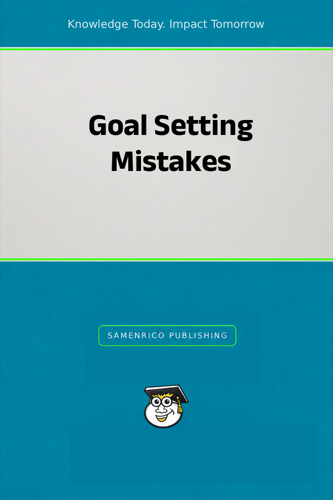
Free sample
Chapter 1: The Vagueness Mortgage--The year you finally set the right goal—the one that was going to change everything—was also the year you secretly stopped believing in yourself.Not because you lacked talent. Not because you were lazy. Not because the universe conspired against you. But because you made a mistake so common, so invisible, and so socially acceptable that no one ever called you on it. You took out a vagueness mortgage.Here is what a vagueness mortgage sounds like: "I want to get in shape." "I need to save more money." "I should write a book someday." "I want to be more present with my family." "I need to grow my business."These statements feel good to say.
They feel responsible, aspirational, and safe. They earn nods of approval from friends and colleagues. They allow you to claim the identity of someone who cares about fitness, finance, creativity, family, or entrepreneurship—without ever having to actually do the uncomfortable work of becoming that person.But here is the truth that no one tells you: a vague goal is not a goal. It is a wish dressed in work clothes. And a wish, no matter how sincerely felt, has never built a business, lost a pound, or written a single page of a book.The vagueness mortgage is the first and most destructive mistake in goal setting because it operates silently.
You do not realize you have made it until months have passed, until the calendar has flipped, until you are standing exactly where you started, wondering what went wrong. Nothing went wrong. You just never actually started. And you never started because you never knew what "start" meant.This chapter is not about motivation. It is about engineering.
It is about taking the fuzzy, feel-good fog of aspiration and compressing it into something hard, sharp, and actionable. By the time you finish these pages, you will never again mistake a wish for a goal. And more importantly, you will have a tool so simple and so brutal that it will reveal, in seconds, whether you are serious or just performing seriousness.The Comfort of the Unsaid Let us begin with an uncomfortable question. Think of the goal you have been carrying around the longest—the one you tell yourself you are "working on" but have made no measurable progress on in the last six months. Write it down in your mind.
Now read it back.Does it contain a number? Does it contain a deadline? Does it contain a concrete, observable outcome that someone else could verify without asking you?If the answer to any of those questions is no, you are not in a goal. You are in a relationship with an idea. And relationships with ideas are famously non-monogamous; you can maintain ten of them simultaneously without ever being faithful to any.The reason we love vague goals is simple: they are impossible to fail at.
If you never define what "fit" means, you can never be definitively unfit. If you never specify how much money you need to save, you can always claim you are "working on it." Vague goals are the emotional equivalent of a mattress warranty—they sound reassuring until you actually try to use them.But there is a deeper psychology at play here, and it is one that the best goal-setting research has mapped with startling clarity. We do not choose vagueness because we are lazy. We choose vagueness because we are afraid.The Neurology of Ambiguity Dr. Edwin Locke and Dr.
Gary Latham spent decades studying what separates people who achieve their goals from people who do not. Their conclusion, now replicated in hundreds of studies across industries and cultures, is almost insulting in its simplicity: specific, difficult goals produce consistently higher performance than vague, easy goals.The word "specific" is doing all the work here. When Locke and Latham asked participants to "do their best" on a task, performance was reliably lower than when they asked participants to achieve a specific number. "Do your best" sounds motivating, but it is actually demobilizing. The brain hears "do your best" and translates it as "do enough to feel okay about yourself." There is no finish line.
There is no external standard. There is only your own fluctuating self-assessment, which is always generous.Vague goals also trigger a neurological phenomenon called choice paralysis. When your brain receives an ambiguous instruction—"get healthier"—it must first interpret what that means. Does it mean run? Lift weights?
Eat vegetables? Sleep more? Meditate? The brain, confronted with too many possible interpretations, defaults to the path of least resistance: nothing. Ambiguity creates cognitive friction, and cognitive friction creates procrastination.This is not a character flaw.
This is how the mammalian brain evolved. Certainty is expensive; the brain conserves energy by avoiding decisions that lack clear payoff structures. A vague goal offers no clear payoff structure. So the brain does nothing. And then you feel guilty.
And guilt, contrary to popular belief, is not a motivator—it is an anesthetic. Guilt numbs you into accepting the vagueness mortgage for another month.The Social Reward of False Precision Here is where the trap gets truly insidious. Vague goals are not only safe from failure; they are actively socially rewarded. Tell a colleague "I'm going to get in shape this year," and they will nod approvingly. Tell a friend "I'm going to deadlift 225 pounds by December 1st," and they might look at you strangely.
The first statement sounds healthy and balanced. The second sounds obsessive.But the first statement is a lie disguised as wisdom. The second statement is an uncomfortable truth disguised as obsession. And this is the fundamental trade-off: you can have social approval, or you can have results. You cannot have both from the same sentence.The reason we choose vague language in our goals is the same reason we choose vague language in our relationships, our reviews, and our commitments to ourselves.
Specificity invites scrutiny. Specificity creates the possibility of public failure. Specificity means that on December 2nd, someone could look at your gym log and see the truth. Vague goals allow you to keep your failures private.But privacy is not protection. It is a prison.
The same walls that keep others from seeing your failure also keep you from seeing your own stagnation. You float in a comfortable fog of "trying," mistaking activity for progress, effort for results. And the years pass.The Cost of the Unmeasured Life Let us quantify what vagueness actually costs you. Imagine two people on January 1st.Person A sets a vague goal: "I want to save more money this year." Person B sets a specific goal: "I will save $6,000 this year by automatically transferring $500 from each paycheck into a separate account, tracked monthly in a spreadsheet."On March 1st, Person A has saved nothing. But they feel fine about it because "more money" is undefined.
They might have saved $50 and call it progress. They might have saved nothing and call it a slow start. There is no way to measure failure, so there is no way to trigger a corrective response.Person B, on March 1st…
This is the end of the free sample. Get the eBook to keep going. Buy now
About this book
Details
- Author
- Lemieux Arnetta
- Publisher
- SamEnrico
- Language
- English
- Genre
- Non-Fiction, Self-Help / Mistakes
- Released
- 2026-06-06
- Pages (approx.)
- 135
- Available as
- eBook, Audiobook

Read better in the ZLOADR app
Your eBooks on your phone or tablet. Sign in with your SamEnrico account and start reading.
More by Lemieux Arnetta
 Boundary Setting Self TalkLemieux Arnetta$11.99
 Step Ten Continuing Personal Inventory GuideLemieux Arnetta$11.99
 Stress Digestive System DamageLemieux Arnetta$11.99
 Goal Setting for MusicLemieux Arnetta$11.99
 Adam Savage BioLemieux Arnetta$11.99
 Stock Options ExplainedLemieux Arnetta$11.99
 Police and Coroner After SuicideLemieux Arnetta$11.99
 The Djinn of the Empty Quarter: Whispers from the SandsLemieux Arnetta$11.99
 The Druids of the Iron Age: Celtic Wisdom and the Birth of Western ThoughtLemieux Arnetta$11.99
 How to Produce Writing InstrumentsLemieux Arnetta$11.99
 How to Produce Microscope Objective LensesLemieux Arnetta$11.99
 Ransomware Customer Notification TemplatesLemieux Arnetta$12.99
You may also like
 Hong Kong Handover 1997Dunn Johnnie$11.99
 Zumba For Postnatal Recovery CourseNeal Christian$11.99
 Zumba for BeginnersLadner Nikia$11.99
 YouTube Comment Mining GuideHumes Pandora$12.99
 Worry Box MeditationCarlin Rudy$11.99
 Workplace Stress MeditationNguyen Lynn$11.99
 Workplace Stress and Sleep RepairHawley Ivory$11.99
 Workplace Perfectionism CureDelaney Jeffry$11.99
 Workplace Injustice Anger GuideWallen Isabelle$11.99
 Work Addiction and Burnout LinkGreenwood Ester$11.99
 Women in Yoga and WellnessBeattie Galina$11.99
 Women in Stand Up ComedyChun Evangeline$11.99