
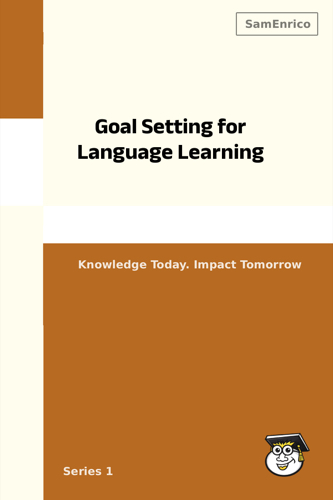
Goal Setting for Language Learning eBook
Set vocabulary and conversation milestones.
by Getz Yolonda
Set vocabulary and conversation milestones.
Formats
Free sample
Chapter 1: The Vocabulary Trap--–- Ana had spent 847 days learning Spanish. That was the first thing she told me when we sat down in the cramped Madrid café. She knew the number because her language app had a "streak counter" – a digital badge of honor that glowed green every time she completed her daily flashcards. Eight hundred and forty-seven consecutive days. Nearly two and a half years.
She had learned 2,341 words, according to the app's vocabulary tracker. She had listened to 147 hours of grammar explanations. She had achieved a "Fluent" rating on every progress quiz.And then the waiter arrived."¿Qué te pongo, cariño?" he asked – "What can I get you, dear?"Ana froze. Her eyes darted to me, then to the menu, then back to the waiter. She understood every word in that sentence.
She knew "qué" meant "what." She knew "te pongo" was a colloquial way of saying "I put for you." She knew "cariño" meant "dear" or "sweetheart." She had reviewed those words dozens of times. Her app said she had mastered them.But when the waiter smiled and waited for her response, her mind went white. The words were there – somewhere – but they wouldn't come out. She could feel them trapped behind her teeth, like a sneeze that wouldn't arrive. Three seconds passed.
Five. Ten. The waiter's smile began to falter."I'll have... uh... coffee," she finally said in English, her face flushing red.
The waiter nodded and walked away. Ana turned to me and whispered the sentence that would become the inspiration for this book:"I know the words. I just can't speak."She is not alone.The Great Deception of Modern Language Learning Every day, millions of language learners around the world open their phones and tap through cheerful flashcards. They match words to pictures. They select the correct translation from multiple choices.
They watch their "words learned" counter tick upward – 500, 1,000, 2,000 words – and feel a genuine sense of progress. The apps tell them they are "fluent" or "proficient" or "ready for conversation."And then a waiter asks them a simple question. And they freeze.This is not a failure of effort. It is not a failure of intelligence. It is a failure of design – specifically, the design of most language learning methods, which prioritize one thing above all others: acquisition.Acquisition is the process of taking in new information.
It is passive. It is recognition. It is the feeling of "oh yes, I've seen that word before" when you read a sentence. Acquisition is easy to measure – apps can count how many cards you've flipped – and easy to scale. You can acquire 50 new words in an hour by tapping through a deck.But acquisition is not activation.Activation is the process of retrieving a word from your memory and deploying it in real time, under pressure, with a human being looking at you and waiting for a response.
Activation is active. It is production. It is the difference between circling "manzana" on a multiple-choice quiz and saying "¿Me das una manzana, por favor?" to a vendor who is already reaching for the oranges.Here is the brutal truth that no app will tell you: You can acquire 2,000 words and activate only 200.The other 1,800 words exist in your passive vocabulary – the part of your brain that recognizes words when you hear or read them. But they never make the journey to your active vocabulary – the part of your brain that produces words when you speak. They are like books in a library that you have cataloged but never read.
You know they exist. You know where they are. But when someone asks you to quote a passage, you cannot.Ana had acquired 2,341 words. She had activated perhaps 300 of them. The rest were trapped in her passive vocabulary, perfectly recognized but utterly unusable.This book exists to close that gap.The 800-Word Secret If acquisition is easy and activation is hard, the natural question is: How many words do you actually need to activate to have a real conversation?The answer, drawn from decades of corpus linguistics research, is surprisingly small.In the 1930s, linguist C.K.
Ogden proposed a language called "Basic English" consisting of only 850 words. He claimed – and subsequent research has largely confirmed – that 850 words could handle the vast majority of everyday communication. Modern corpus studies have refined this number. Researchers have analyzed millions of conversations, transcripts, and written texts to determine which words appear most frequently.The finding is remarkably consistent across languages: The 800 most common words account for approximately 75% of all daily conversation.This is the Pareto Principle – the 80/20 rule – applied to language. Eighty percent of your daily communication will use only twenty percent of the words in the dictionary.
For most people, that twenty percent is around 800 words.Consider your own speech for a moment. Think about the last conversation you had with a friend, a coworker, or a family member. How many rare or unusual words did you use? Did you say "ubiquitous" or "melancholy" or "ephemeral"? Probably not.
You said "the," "and," "to," "of," "a," "I," "you," "it," "we," "they." You used common verbs like "go," "come," "see," "want," "need," "like." You used basic adjectives like "good," "bad," "big," "small," "hot," "cold." You used conjunctions like "because," "so," "but," "and."These 800 words are the skeleton key to everyday conversation. Master them – not just recognize them, but activate them – and you can navigate restaurants, shops, taxis, hotels, casual conversations, work meetings, and social gatherings. You will not be poetic. You will not be eloquent. But you will be functional.
And for most learners, functional is the goal.The problem is that most learners spend their time on the wrong words. They learn "elephant" before "because." They learn "umbrella" before "need." They learn "library" before "where." They are building a vocabulary that is wide but shallow – lots of rare words, few of the common ones. It is like a carpenter who owns a lathe and a router but has forgotten to buy a hammer and a saw.The Two Tiers of the First 800The 800 words that unlock daily conversation are not all equally important. They break cleanly into two tiers, each with a distinct function and a different learning strategy.Tier 1: The Survival Pack (0–250 words)These are the words you need to stay alive, get fed, find a bathroom, and communicate your most basic physical and emotional states. They include:Greetings and farewells (hello, goodbye, please, thank you, sorry)Numbers 1–100 (one, two, three...)Food and drink (water, bread, coffee, chicken, fish, rice)Immediate physical needs (bathroom, tired, sick, hot, cold, hungry, thirsty)Common locations (hotel, airport, train station, pharmacy, hospital, bank)Basic directions (left, right, straight, near, far, here, there)Pronouns (I, you, he, she, we, they, me, him, her, us, them)With Tier 1 words alone, you can accomplish the following: find food and water, locate a bathroom, ask for help, express pain or illness, understand basic prices, follow simple directions, and introduce yourself.
You cannot have a real conversation – but you can survive. More importantly, Tier 1 gives you the confidence to try.Tier 2: The Connectors (251–800 words)These are the words that turn isolated nouns and…
This is the end of the free sample. Get the eBook to keep going. Buy now
About this book
Details
- Author
- Getz Yolonda
- Publisher
- SamEnrico
- Language
- English
- Genre
- Non-Fiction, Self-Help, Language
- Released
- 2026-06-09
- Pages (approx.)
- 141
- Available as
- eBook, Audiobook

Read better in the ZLOADR app
Your eBooks on your phone or tablet. Sign in with your SamEnrico account and start reading.
More by Getz Yolonda
 People Pleasing Recovery AffirmationsGetz Yolonda$11.99
 Stress Brain Shrinkage GuideGetz Yolonda$11.99
 Step Eleven Prayer And Meditation HandbookGetz Yolonda$11.99
 Parent Loss First AnniversaryGetz Yolonda$11.99
 RSU Negotiation GuideGetz Yolonda$11.99
 Jamie Hyneman BioGetz Yolonda$11.99
 Suicide Funeral PlanningGetz Yolonda$11.99
 Phantom of the Nile: The Last Hunt for the Beast of KhartoumGetz Yolonda$11.99
 The Siege of Chittorgarh: Rajput Blood and Fire Against the SultanateGetz Yolonda$11.99
 How to Produce Writing PencilsGetz Yolonda$11.99
 How to Start a Aniline Dye Business (Beginners Guide)Getz Yolonda$11.99
 A Collector's Handbook to the Peugeot 402dsGetz Yolonda$11.99
You may also like
 The Power Of Yet Mindset GuideGamble Breanna$11.99
 The Verbal Aggression DetectorForsyth Corene$11.99
 The Growth Mindset for Language LearningRowland Alyse$11.99
 Growth Mindset Language ShiftGilson Dara$11.99
 Active Listening For ESL SpeakersHoppe Jackeline$11.99
 The Power of YetAustin Carol$11.99
 Embedded Commands in ScriptsWhiting Mavis$11.99
 Vocabulary Memorization GuideGoss Phoebe$11.99
 The Emotional Vocabulary BuilderCausey Janiece$11.99
 Word Finding Difficulty GuideBrumfield Chanda$11.99
 The Multilingual Speaker GuideOdonnell Bertie$11.99
 The Blame Free Vocabulary GuideConnell Agripina$11.99