

Non-FictionSelf-HelpDepression
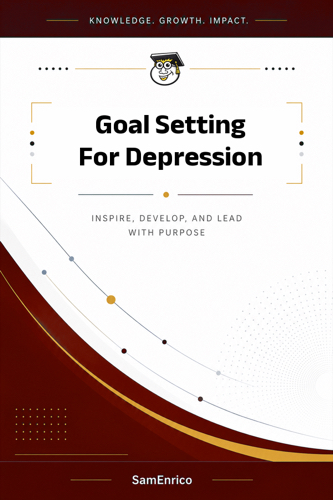
Goal Setting For Depression eBook
Tiny achievable wins for mood lift.
Tiny achievable wins for mood lift.
Formats
Free sample
Chapter 1: The Dopamine Trap--–- The morning light sliced through the blinds like an accusation. You knew you should get up. You listed the reasons: work, responsibilities, the growing text thread you’d been avoiding for three days. But your body felt like it was filled with wet cement. So you lay there, watching the dust motes spin, and for the ninetieth minute in a row, you asked yourself the question that has no answer: What is wrong with me?Nothing is wrong with you that hasn’t been wrong with millions of people before.
You are not lazy. You are not broken. You are not lacking willpower or moral fiber. You are, however, trapped in a neurological paradox that most goal-setting books refuse to acknowledge: your brain’s reward system is on strike.This chapter is not about motivation. It’s not about finding your “why” or visualizing success.
It’s about understanding why those strategies fail when you’re depressed, and why the tiniest, most ridiculous action—worse than ridiculous, almost insultingly small—is actually your only real way out.The Great Motivation Myth Let’s start with a lie you’ve been told your entire life. The lie is this: motivation comes first, then action. You’ve heard it a thousand ways. “You have to want it.” “Find your passion.” “When you’re ready, you’ll know.” Advertisers sell it. Self-help gurus package it.
Even well-meaning therapists sometimes imply it.For a brain that isn’t depressed, this works. A non-depressed person feels a flicker of desire—say, to exercise—and that flicker generates enough dopamine to fuel the action. They put on their shoes. They go for a run. They feel good afterward, which reinforces the loop.
Motivation → Action → Reward → More Motivation. It’s a beautiful, self-sustaining cycle.Depression doesn’t just break this cycle. It saws the wires, sets the factory on fire, and then blames you for the smoke.Here’s what actually happens in the depressed brain. The anticipation of reward—that little hit of “this will feel good”—requires dopamine. But depression is associated with dysregulated dopamine pathways.
In simple terms: your brain struggles to register the promise of future pleasure. Anhedonia, the clinical term, means exactly that: without pleasure. Not “less pleasure.” Without. Activities that used to feel good—eating, seeing a friend, finishing a project—now feel like nothing. Or worse, like effort with no payoff.So when you lie in bed and think, “I should get up and take a shower,” your brain runs a cost-benefit analysis.
The cost is high: getting up, feeling the cold air, standing, the sensory overwhelm of water. The benefit? Your brain returns a blank receipt. No reward detected. The logical conclusion is: why bother?And then comes the shame, because you’ve been taught that wanting should be enough.
“If I really wanted to get better, I would have showered.” That thought is not wisdom. It is the depression talking through your own voice.Why Willpower Is a Bank Account You Can’t Access Every self-help book ever written eventually tells you to try harder. “Discipline is freedom.” “No excuses.” “Grind.” These phrases are designed for people whose neurological systems are functioning. They assume a baseline of available energy, working dopamine receptors, and a reward system that will, eventually, pay out.Depression is a willpower thief. It doesn’t just make you tired.
It makes the cost of every decision astronomically high.Let me explain with something called decision fatigue. In a healthy brain, making a choice—what to eat, whether to get up, which shirt to wear—consumes a small amount of glucose and cognitive bandwidth. You can make hundreds of choices a day without collapsing. In a depressed brain, every single choice feels like lifting a barbell. Should I open my eyes?
That’s a choice. Should I check my phone? That’s another choice. Should I move my left leg? That’s a third choice.
By the time you’ve been awake for ten minutes, you’ve made dozens of microscopic decisions, and each one has cost you more energy than it should have.This is why you can lie in bed for three hours, exhausted, having done nothing. You haven’t been resting. You’ve been making decisions in quicksand.Traditional goal-setting makes this worse. SMART goals (Specific, Measurable, Achievable, Relevant, Time-bound) assume that “Achievable” means something like “run a 5K in three months.” For a depressed person, “Achievable” might mean “lift my head off the pillow for two seconds.” The gap between what the books ask for and what you can actually do is not a character flaw. It is a mismatch between the tool and the job.The Upward Spiral (Yes, It’s Real)Now for the good news.
If depression creates a downward spiral—low energy leads to less action leads to more shame leads to even lower energy—then the reverse is also true. Small actions, even absurdly small ones, can slowly, haltingly, start to turn the spiral upward.This is not positive thinking. This is behavioral activation, one of the most scientifically validated treatments for depression. The insight is almost embarrassingly simple: action comes before motivation, not after.You cannot wait until you feel like doing something. That day may never come.
But you can do something so small that your brain doesn’t bother to resist. And when you do that something, two things happen. First, you have evidence that you are capable of action, which weakens the shame spiral. Second, the action itself—any action—sends a tiny signal to your reward system that something happened. It’s not pleasure.
It’s not joy. It’s just… data. But data is the beginning of learning.Let me give you an example from the research. In a famous study on behavioral activation, participants with severe depression were asked to do one thing each day: get out of bed, walk to the window, and look outside for ten seconds. That’s it.
No shower. No breakfast. No conversation. Just stand and look. After one week, many reported a slight decrease in the feeling of “heaviness.” After two weeks, some spontaneously added a second action.
After a month, a subset had built enough momentum to resume basic self-care.The mechanism here is not magic. It’s neuroplasticity. Every time you repeat an action, the neural pathway for that action gets stronger. But when you’re depressed, the pathways for initiating action are what have weakened. You don’t need to strengthen “showering.” You need to strengthen “starting.” And starting is a separate skill.The 5% Shift: A New Definition Throughout this book, you will encounter a concept called the 5% Shift.
Let me define it clearly now, because confusion here has derailed many well-intentioned readers.A 5% Shift is any action that requires 5% or less of your current available energy. Not 5% of your “ideal self” energy. Not 5% of what you “should” be able to do. Five percent of right now, this minute, as you are.Here’s why this matters. On a good day, 5% of your energy might be enough to brush your teeth, make a…
This is the end of the free sample. Get the eBook to keep going. Buy now
About this book
Details
- Author
- Mattison Sallie
- Publisher
- SamEnrico
- Language
- English
- Genre
- Non-Fiction, Self-Help, Depression
- Released
- 2026-06-05
- Pages (approx.)
- 114
- Available as
- eBook, Audiobook

Read better in the ZLOADR app
Your eBooks on your phone or tablet. Sign in with your SamEnrico account and start reading.
More by Mattison Sallie
 Pre Reading Strategies for TextbooksMattison Sallie$11.99
 March On Washington PlanningMattison Sallie$11.99
 Sheppard Defense Attorney BellamyMattison Sallie$11.99
 Money and Debt TalksMattison Sallie$11.99
 The Study ChallengeMattison Sallie$11.99
 Bird Loss GriefMattison Sallie$11.99
 Morning Routine JournalMattison Sallie$11.99
 The Plague Fighters: Tycho Brahe and the Birth of EpidemiologyMattison Sallie$11.99
 The Great Canadian Whiskey Heist: The Ransomware of the Prohibition EraMattison Sallie$11.99
 Service Providers Guide to Advertising AgenciesMattison Sallie$11.99
 How to Produce Kite AccessoriesMattison Sallie$11.99
 How to Start a Cooker (oil) Business (Beginners Guide)Mattison Sallie$11.99
You may also like
 Hong Kong Handover 1997Dunn Johnnie$11.99
 Zumba For Postnatal Recovery CourseNeal Christian$11.99
 Zumba for BeginnersLadner Nikia$11.99
 YouTube Comment Mining GuideHumes Pandora$12.99
 Worry Box MeditationCarlin Rudy$11.99
 Workplace Stress MeditationNguyen Lynn$11.99
 Workplace Stress and Sleep RepairHawley Ivory$11.99
 Workplace Perfectionism CureDelaney Jeffry$11.99
 Workplace Injustice Anger GuideWallen Isabelle$11.99
 Work Addiction and Burnout LinkGreenwood Ester$11.99
 Women in Yoga and WellnessBeattie Galina$11.99
 Women in Stand Up ComedyChun Evangeline$11.99