
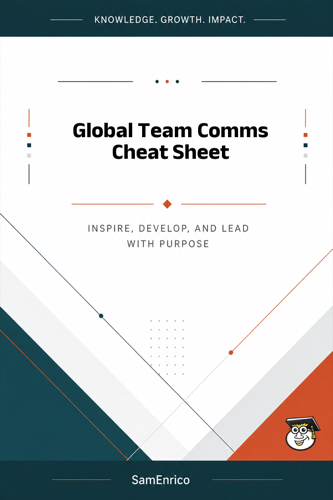
Non-FictionProfessional's Cheat SheetBusiness Communication
Global Team Comms Cheat Sheet eBook
Access quick reference templates for cross cultura
Access quick reference templates for cross cultural email and Slack communication.
Formats
Free sample
Chapter 1: The Four Filters--–- The Slack message arrived at 9:03 AM Singapore time. It was written by a senior product manager named Mei, who had spent fifteen minutes carefully crafting it. She had used clear English, broken her request into bullet points, and even added a smiling emoji at the end to signal good intent. She clicked send, leaned back in her chair, and felt the quiet satisfaction of a job done right.Twelve hours later, at 9:03 PM Mexico City time, a developer named Carlos opened the same message on his phone while eating dinner with his family. He skimmed the bullet points, noticed a phrase that seemed ambiguous – "we should probably revisit the architecture" – and interpreted it as an urgent instruction to rewrite the backend overnight.
He excused himself from the table, opened his laptop, and worked until 4 AM. By morning, he had completed the wrong task. Twelve hours of work were wasted. Mei was confused. Carlos was exhausted and resentful.
Neither person had made a grammatical error. Neither had been rude. Neither had intended any harm.This is not a story about bad people. It is a story about invisible risk.Every time you type a message to a colleague in another country, you are sending that message through four invisible filters. These filters bend meaning, amplify ambiguity, and silently rewrite your intent before it arrives on the other person's screen.
Most people do not even know the filters exist. That is why global teams waste an estimated 20 percent of their time on communication repair – re-explaining, clarifying, apologizing, and redoing work that was misunderstood the first time.This chapter introduces the Four Filters. Think of them as a pre-flight checklist for every email, Slack message, or meeting request you send across cultures. Running the Four Filters takes fifteen seconds. Skipping them costs hours.The Four Filters are:Language Proficiency – Is everyone a native speaker of the language you are using?
If not, what are the odds your idioms, jokes, or complex sentences will be misunderstood?Cultural Context – Is the person on the other end from a high-context culture (where meaning is inferred from relationships, hierarchy, and what is not said) or a low-context culture (where meaning must be spelled out in explicit words)?Power Distance – How does hierarchy affect how your message will be received and replied to? In some cultures, a junior employee will never question a vague instruction. In others, they will push back immediately.Time Zone Urgency – When will this message actually be read? What will have changed between send and receive? Who is asleep right now?By the end of this chapter, you will have a laminated checklist you can glance at before every important message.
You will also have a Team Communication Contract – a one-page agreement your team can sign (with emoji reactions) to align on the rules of engagement before the next miscommunication blows up your week.Let us start with the first filter – the one that causes the most daily friction and the fewest dramatic explosions.Filter One: Language Proficiency – The Silent Misunderstanding English is the lingua franca of global business. Approximately 1.5 billion people speak English worldwide. Only about 375 million of them are native speakers. That means nearly seventy-five percent of your global team is communicating in a language they learned after childhood.Here is what that means in practice. When a native English speaker writes "That's an interesting idea, let's circle back on that," they often mean "I don't like this and I hope you forget about it." When a non-native speaker reads the same sentence, they hear "My idea is interesting and we will discuss it again later." The native speaker is being polite.
The non-native speaker is being accurate to the dictionary definition. Both walk away with different realities.Language proficiency is not binary. It is a spectrum. The four levels that matter for global teams are:Level 1 – Native or near-native. The person understands idioms, sarcasm, and cultural references.
They can write complex emails and follow fast group conversations. Less than twenty percent of the global workforce operates at this level.Level 2 – Professional working proficiency. The person can handle most business conversations but struggles with idioms, humor, and very fast speech. They may need written follow-up after calls. This is the largest group in most global teams, representing perhaps sixty percent of knowledge workers.Level 3 – Basic proficiency.
The person can understand simple instructions and write short messages but cannot follow complex arguments or nuanced negotiation. They rely heavily on written confirmation.Level 4 – Minimal proficiency. The person uses translation tools or a colleague to interpret. They should rarely, if ever, be expected to communicate independently in high-stakes situations.The single biggest mistake global teams make is assuming everyone is at Level 1. They are not.
The second biggest mistake is treating Level 2 and Level 3 speakers as if they are broken versions of Level 1 – slower, less articulate, somehow deficient. They are not. They are operating in their second or third language, which is something most native English speakers never attempt.The Idiom Trap Idioms are the most dangerous form of language proficiency risk because they are invisible to native speakers. You do not know you are using an idiom until someone looks at you blankly.Consider these real examples from global team Slack channels:"Let's not boil the ocean" – A perfectly sensible phrase to an American. Nonsense to a German who has never heard it."We need to get our ducks in a row" – Charming imagery for a Brit.
A confusing reference to waterfowl for a Brazilian."I'm going to take a shotgun approach" – A strategic method for one person. A violent threat to another."Spill the beans" – Reveal a secret. Or destroy legumes. Context does not help.The solution is not to eliminate all idioms. That is impossible.
The solution is to recognize that every idiom is a test. If the person on the other end passes the test (they understand), fine. If they fail, they will not tell you they failed. They will smile, nod, and guess. And they will often guess wrong.The Proficiency Protocol Before you send any message to anyone you have not worked with extensively, ask yourself one question: What level is this person at?If you do not know, assume Level 2 – professional working proficiency.
Then write accordingly:Use short sentences. Fifteen words maximum.Use common vocabulary. If a word has more than three syllables, question it.Use one idea per sentence. Do not nest clauses.Specify dates, times, and time zones explicitly. "Friday" is meaningless.
"Friday, October 12, by 5 PM GMT" is clear.Avoid idioms. If you cannot resist, bracket them with an explanation: "Let's not boil the ocean (meaning: let's not try to solve everything at once)."If you are writing to someone you know is Level 3 (basic proficiency), add one more rule: Write as if you are writing a text message to a tired friend. Short words. Short sentences. Bullet points.
And always, always offer a confirmation echo: "Please reply 'GOT IT' so I know you received this."The goal is not to patronize. The goal is to be understood. Clarity is kindness.Filter Two: Cultural Context – The Hidden Architecture of Meaning In the…
This is the end of the free sample. Get the eBook to keep going. Buy now
About this book
Details
- Author
- Fournier Dorie
- Publisher
- SamEnrico
- Language
- English
- Genre
- Non-Fiction, Professional's Cheat Sheet, Business Communication
- Released
- 2026-06-10
- Pages (approx.)
- 147
- Available as
- eBook, Audiobook

Read better in the ZLOADR app
Your eBooks on your phone or tablet. Sign in with your SamEnrico account and start reading.
More by Fournier Dorie
 The Elderly Self Compassion GuideFournier Dorie$11.99
 LBO IT Due DiligenceFournier Dorie$11.99
 Metta For Narcissistic AbuseFournier Dorie$11.99
 The Breath Awareness for StudentsFournier Dorie$11.99
 The Queen of the Bootleggers: The Untold Story of Helen WilsonFournier Dorie$11.99
 Price Sensitivity InflationFournier Dorie$12.99
 Understanding Sommer–rathbun–battles SyndromeFournier Dorie$17.99
 How to Start a Accounts Payable Business (Beginners Guide)Fournier Dorie$11.99
 Tephroite MiningFournier Dorie$11.99
You may also like
 Hong Kong Handover 1997Dunn Johnnie$11.99
 Zumba For Postnatal Recovery CourseNeal Christian$11.99
 Zumba for BeginnersLadner Nikia$11.99
 YouTube Comment Mining GuideHumes Pandora$12.99
 Worry Box MeditationCarlin Rudy$11.99
 Workplace Stress MeditationNguyen Lynn$11.99
 Workplace Stress and Sleep RepairHawley Ivory$11.99
 Workplace Perfectionism CureDelaney Jeffry$11.99
 Workplace Injustice Anger GuideWallen Isabelle$11.99
 Work Addiction and Burnout LinkGreenwood Ester$11.99
 Women in Yoga and WellnessBeattie Galina$11.99
 Women in Stand Up ComedyChun Evangeline$11.99