
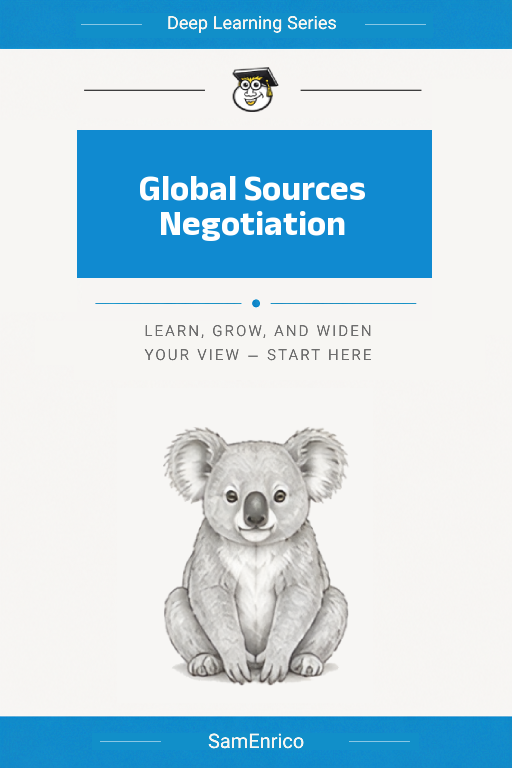
Non-FictionBusiness BriefCross-Cultural Procurement
Global Sources Negotiation eBook
Negotiate with suppliers from Global Sources. Trad
by Holguin Mee
Negotiate with suppliers from Global Sources. Trade shows and verified manufacturers.
Formats
Free sample
Chapter 1: The Price Trap--–- In a fluorescent-lit conference room at the Asia World-Expo in Hong Kong, a first-time buyer named Sarah had just received what she believed was the deal of a lifetime. A verified Global Sources supplier had offered her 10,000 Bluetooth speakers for 4.20perunit—nearlyadollarlessthanhertargetprice.Sheshookhands,celebratedwithcolleagues,andreturnedhometoplacetheorder.Eightweekslater,ashippingcontainerarrivedatherwarehousein Los Angeles.Insidewere10,000speakersthatsmelledofburntplastic,playedaudioathalftheexpectedvolume,andcarrieda ULcertificationmarkthatturnedouttobecounterfeit.Thesupplier,averifiedcompanywithapristineprofile,hadvanishedfromtheplatform.Sarahlost4.20 per unit—nearly a dollar less than her target price. She shook hands, celebrated with colleagues, and returned home to place the order. Eight weeks later, a shipping container arrived at her warehouse in Los Angeles. Inside were 10,000 speakers that smelled of burnt plastic, played audio at half the expected volume, and carried a UL certification mark that turned out to be counterfeit.
The supplier, a verified company with a pristine profile, had vanished from the platform. Sarah lost 4.20perunit—nearlyadollarlessthanhertargetprice.Sheshookhands,celebratedwithcolleagues,andreturnedhometoplacetheorder.Eightweekslater,ashippingcontainerarrivedatherwarehousein Los Angeles.Insidewere10,000speakersthatsmelledofburntplastic,playedaudioathalftheexpectedvolume,andcarrieda ULcertificationmarkthatturnedouttobecounterfeit.Thesupplier,averifiedcompanywithapristineprofile,hadvanishedfromtheplatform.Sarahlost42,000 on the product, another $15,000 on return shipping, and her relationship with her largest retail client. She had negotiated the price perfectly. She had lost everything else.This is the great paradox of Global Sources negotiation. The buyers who focus obsessively on unit price are often the ones who lose the most money.
The buyers who understand total cost of ownership build supply chains that last for decades. The difference between these two outcomes is not luck, not experience, and not relationships alone. It is a fundamental shift in mindset—moving from a "price war" mentality to a "value and risk reduction" framework.If you picked up this book expecting to learn how to grind suppliers down to their absolute lowest penny, close the book now and give it to someone else. That approach works beautifully until it doesn't. And when it fails, it fails catastrophically, as Sarah discovered.
This chapter is about something far more valuable than getting the lowest price. It is about understanding the unique ecosystem of Global Sources—a platform that operates very differently from Alibaba, Made-in-China, or any other B2B marketplace—and learning how to negotiate for total cost of ownership, not unit price.The buyers who master this distinction consistently achieve three outcomes that price-focused buyers never do. First, they pay slightly more per unit but dramatically less per year because they avoid catastrophic failures. Second, they receive preferential treatment during capacity crunches because suppliers prioritize their long-term partners. Third, they gain access to new products and technologies before competitors because trusted buyers see prototypes first.
This chapter will teach you why Global Sources is different, what the "Verified Supplier" badge actually means (and does not mean), and how to calculate the true cost of any sourcing decision before you shake hands.The History That Shapes Everything Global Sources was not born as an internet company. It began in 1971 as a trade magazine publisher called Asian Sources, founded by Merle Hinrichs, an American entrepreneur who saw a gap in the market. At the time, Western buyers had almost no reliable way to find manufacturers in Asia. Trade missions were expensive, word-of-mouth was unreliable, and the risk of fraud was enormous. Asian Sources filled this gap by sending editorial teams to factories across Hong Kong, Taiwan, and later mainland China.
These teams did not simply collect advertisements. They visited facilities, verified basic existence, and published directories that became bibles for global purchasing managers.This editorial DNA never left the company. When Global Sources launched its website in the 1990s and evolved into a digital platform, it retained the gatekeeper mentality. Unlike Alibaba, which grew as an open marketplace where anyone could pay for a listing, Global Sources maintained a verification process. This is not charity or altruism.
It is a business model. Global Sources charges suppliers more for verification and trade show participation, but in return, buyers receive a reduced risk of complete fraud. You will still receive defective goods. You will still face delays. You will still encounter suppliers who exaggerate their capabilities.
But you are far less likely to send money to a company that does not exist at all.The practical implication for negotiation is profound. On Alibaba, your primary leverage is the threat of switching to another supplier because there are thousands of unverified options. On Global Sources, your primary leverage is different. The platform has already done some vetting for you, but that verification also reduces the supplier pool. In many product categories, especially electronics, there may only be a handful of truly verified suppliers.
Your negotiation strategy, therefore, cannot rely on infinite alternatives. It must rely on becoming a customer that suppliers want to keep.The "Verified Supplier" Badge: What It Actually Means One of the most common mistakes new buyers make is treating the Global Sources "Verified Supplier" badge as a guarantee of quality. It is not. It never has been. Understanding exactly what verification does and does not cover is essential to negotiating realistically.The verification process is conducted by third-party auditors, most commonly Bureau Veritas, SGS, and TÜV Rheinland.
These auditors check five specific categories. Legal registration is first: the supplier must provide a valid business license, tax identification number, and import/export license. This confirms the company is legally registered to operate in its jurisdiction. Factory size is second: auditors measure or confirm the square footage of the facility and the number of permanent employees. This is intended to ensure the supplier has the physical capacity to produce at claimed volumes.
Production equipment is third: auditors document specific machine types and quantities, such as injection molding machines, SMT lines for electronics, or sewing stations for apparel. Export history is fourth: the supplier must provide shipping records from the past twelve months, demonstrating that they have actually exported goods to other countries. Certifications are fifth: if the supplier claims ISO 9001, BSCI, Sedex, or other credentials, auditors check the documentation.None of these five categories tests product quality. None tests whether the supplier will deliver on time. None tests whether the supplier will honor warranty claims.
Verification is a check on existence and basic capability, not reliability or integrity. A verified supplier can still produce garbage. A verified supplier can still lie about lead times. A verified supplier can still disappear after a single order. The badge simply reduces the probability that you are sending money to a complete phantom.For negotiators, this knowledge is power.
When a supplier quotes a price, you should not assume that the verification badge means you can relax your due diligence. Instead, you should recognize that the supplier has paid for verification—typically several thousand dollars annually—and therefore has more invested in maintaining a good standing on the platform. Your negotiation can reference this: "You have invested in verification, and I respect that. I am also a serious buyer who will place repeat orders if you perform. Let us agree on terms that protect both of us."Vertical Specialization: Where Global Sources Wins and Where It Does Not Global Sources does not dominate every product category.
Understanding where the platform excels and where it struggles will determine how aggressively you can negotiate and how many alternative suppliers you have.The…
This is the end of the free sample. Get the eBook to keep going. Buy now
About this book
Details
- Author
- Holguin Mee
- Publisher
- SamEnrico
- Language
- English
- Genre
- Non-Fiction, Business Brief, Cross-Cultural Procurement
- Released
- 2026-06-01
- Pages (approx.)
- 120
- Available as
- eBook, Audiobook

Read better in the ZLOADR app
Your eBooks on your phone or tablet. Sign in with your SamEnrico account and start reading.
More by Holguin Mee
 Talent Acquisition in RetailHolguin Mee$11.99
 Napoleon's Coronation As Emperor CourseHolguin Mee$11.99
 The Divorce and Children GuideHolguin Mee$11.99
 The Assertive Complaint GuideHolguin Mee$11.99
 DBT For Rejection SensitivityHolguin Mee$11.99
 The Pillars of Power: The Architects of Imperial RomeHolguin Mee$11.99
 Research Proposal for PhD AdmissionHolguin Mee$12.99
 Understanding Syncopal Paroxysmal TachycardiaHolguin Mee$17.99
 Financial CoachHolguin Mee$11.99Financial CoachHolguin Mee$11.99
 How to Start a Mustard Seed Growing Business (Beginners Guide)Holguin Mee$11.99
You may also like
 Hong Kong Handover 1997Dunn Johnnie$11.99
 Zumba For Postnatal Recovery CourseNeal Christian$11.99
 Zumba for BeginnersLadner Nikia$11.99
 YouTube Comment Mining GuideHumes Pandora$12.99
 Worry Box MeditationCarlin Rudy$11.99
 Workplace Stress MeditationNguyen Lynn$11.99
 Workplace Stress and Sleep RepairHawley Ivory$11.99
 Workplace Perfectionism CureDelaney Jeffry$11.99
 Workplace Injustice Anger GuideWallen Isabelle$11.99
 Work Addiction and Burnout LinkGreenwood Ester$11.99
 Women in Yoga and WellnessBeattie Galina$11.99
 Women in Stand Up ComedyChun Evangeline$11.99