
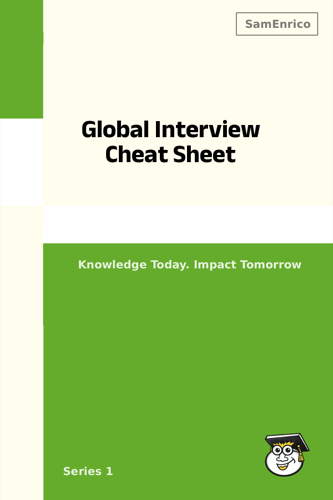
Non-FictionProfessional's Cheat SheetComparative
Global Interview Cheat Sheet eBook
Quick reference tables for France, UAE, and Mexico
by Falk Kacey
Quick reference tables for France, UAE, and Mexico key differences.
Formats
Free sample
Chapter 1: The Three Pillars--–- The email arrived at 11:47 PM on a Tuesday. Alex had been awake for nineteen hours, having just landed from a red-eye from Chicago to Paris. The subject line read: "Entretien – Mercredi 10h00." Interview – Wednesday 10:00 AM. That was in thirty-four hours. Alex had prepared for this role for months: a senior strategy position at a French multinational with a global remit.
The resume was flawless. The Linked In profile was optimized. The STAR method answers were rehearsed until they felt like second nature. Alex had even watched You Tube videos on "how to answer behavioral questions." There was just one problem. Alex had never interviewed in France.
And everything Alex thought about how to impress an interviewer was about to be wrong.This book is for every Alex who has ever walked into an interview room in a foreign country, confident in their qualifications, only to walk out an hour later wondering what the hell just happened. You prepared the right answers. You dressed professionally. You showed up on time. And yet something was off.
The interviewer seemed cold. Or too familiar. Or they asked about your age. Or they kept you waiting for forty-five minutes without apology. Or they seemed offended when you talked about your individual achievements.
You didn't get the job. And you never understood why.The answer is not that you are unqualified. The answer is not that you are bad at interviewing. The answer is that you were playing the wrong game by the wrong rules on the wrong field. Every country has its own unwritten rules of interviewing—rules that no one tells you because everyone who grew up there absorbs them through cultural osmosis.
As a foreign candidate, you are expected to know these rules. But no one will teach them to you. Until now.This chapter destroys the single most dangerous myth in global interviewing: the myth of the universally perfect interview. That myth says that if you are confident, articulate, well-prepared, and honest, you will succeed anywhere. It is a lie.
A confident, self-promoting American candidate who uses the STAR method perfectly will appear arrogant in Paris, disrespectful in Dubai, and clueless in Mexico City. The same candidate who uses a soft, humble, relationship-first approach that works in Tokyo will appear weak and indecisive in Berlin. There is no one-size-fits-all. There is only effective-for-the-culture and ineffective-for-the-culture.We begin with three nations that could not be more different in their interview expectations: France, the United Arab Emirates, and Mexico. Throughout this book, these three will serve as our anchor points—the Franco-UAE-Mexico Lens.
Each represents a distinct cluster of cultural values that recur across other countries. France represents the intellectual, high-context but logic-driven culture. The UAE represents the hierarchical, relationship-obsessed, indirect high-context culture. Mexico represents the personal, family-first, trust-before-transaction high-context culture. Master these three, and you will have a framework for understanding nearly any other country you encounter.But first, we must unlearn something.
We must unlearn the assumption that our own cultural way of interviewing is the "right" way and all others are strange variations. This book is not about right versus wrong. It is about effective versus ineffective. A behavior that is effective in one country can be a career-ending mistake in another. Neither behavior is morally superior.
Both are simply adaptations to different social environments. The goal of this book is not to change who you are. It is to give you a second set of tools—a cultural cheat sheet—that you can deploy when you cross borders.Let us begin with the single most important framework for understanding cultural differences in any professional setting: high-context versus low-context communication. This framework, first developed by anthropologist Edward Hall in 1976, remains the single best predictor of how an interview will unfold in any given country.The Great Divide: High-Context vs. Low-Context Communication In low-context cultures, communication is explicit, direct, and written.
What you say is what you mean. Contracts are detailed because words are expected to be honored precisely. In high-context cultures, communication is implicit, indirect, and relational. Much of the meaning is not in the words but in the context: the relationship between the speakers, their status relative to each other, the setting, the non-verbal cues, and what is left unsaid. In high-context cultures, a simple "yes" can mean yes, maybe, or no, depending on how it is said, who is saying it, and what was discussed before.The United States, Germany, Switzerland, and Scandinavia are classic low-context cultures.
Japan, China, the Arab Gulf states, Mexico, and much of Latin America and Africa are classic high-context cultures. France is the fascinating exception: it is high-context in its emphasis on intellectual subtlety and indirect expression, but low-context in its demand for logical rigor and explicit argumentation. We will explore this nuance in depth.Here is why this matters for interviews. In a low-context interview (say, the United States or Germany), the interviewer expects you to state your qualifications directly, give concrete examples of your achievements, and explicitly connect your skills to the job requirements. Silence is uncomfortable.
Direct disagreement is acceptable if professionally framed. The STAR method works beautifully. In a high-context interview (say, Japan or the UAE), the interviewer expects you to demonstrate your fit through relationships, humility, and reading between the lines. Direct self-praise is rude. Silence is meaningful and often respectful.
Disagreement is never direct. The STAR method, delivered with American-style enthusiasm, will make you seem arrogant and clueless.Most cross-cultural training stops here. But we need to go deeper. Because high-context is not a single category. There are at least three distinct flavors of high-context culture, and each demands a completely different interview strategy.
These three flavors are embodied by our anchor countries: France, the UAE, and Mexico.France: The Intellectual High-Context Culture France is high-context but not in the way Japan or the UAE is high-context. In Japan, much of the meaning comes from hierarchy, group harmony, and what is left unsaid to protect relationships. In France, much of the meaning comes from intellectual subtlety, wit, and the ability to argue with precision and style. The French value clarity of thought, but they distrust overt emotional expression. They value logic above all, but they also value the elegance with which that logic is presented.In a French interview, you are not selling your achievements.
You are selling your mind. The interviewer wants to know: can you think? Can you analyze? Can you defend a position under pressure? Can you critique a flawed argument—including your own—without taking it personally?
The French educational system, with its emphasis on the baccalaureate and the Grandes Écoles, trains students to write dissertations that require thesis, antithesis, and synthesis. The interview is a verbal dissertation. Your resume got you in the door. Now the interviewer wants to see how you think.This creates a paradox that confuses many non-French candidates. On one hand, France is high-context, meaning you are expected to read subtle cues and understand that not everything will be said explicitly.
On the other hand, France demands explicit logical argumentation. The resolution is this: in France, the high-context element lies in what kind…
This is the end of the free sample. Get the eBook to keep going. Buy now
About this book
Details
- Author
- Falk Kacey
- Publisher
- SamEnrico
- Language
- English
- Genre
- Non-Fiction, Professional's Cheat Sheet, Comparative
- Released
- 2026-06-07
- Pages (approx.)
- 148
- Available as
- eBook, Audiobook

Read better in the ZLOADR app
Your eBooks on your phone or tablet. Sign in with your SamEnrico account and start reading.
More by Falk Kacey
 Self Hypnosis for Neuropathic PainFalk Kacey$11.99
 Self Esteem for Women at WorkFalk Kacey$11.99
 Small Talk for Celebrity EncountersFalk Kacey$11.99
 Remote Work Legal GuideFalk Kacey$11.99
 Creative Problem Solving CPSFalk Kacey$11.99
 Parental Anger After Childs DeathFalk Kacey$11.99
 Ideation for InnovationFalk Kacey$11.99
 Silk and Splendor: The Byzantine Silk Road EntrepreneursFalk Kacey$11.99
 The Clockwork Detective: Solving the Enigma of the Antikythera MechanismFalk Kacey$11.99
 How to Become a Mat TesterFalk Kacey$11.99
 A Collector's Handbook to the Standard Vanguard Phase Ii DieselFalk Kacey$11.99
 Window Cleaner (high-rise)Falk Kacey$11.99
You may also like
 Hong Kong Handover 1997Dunn Johnnie$11.99
 Zumba For Postnatal Recovery CourseNeal Christian$11.99
 Zumba for BeginnersLadner Nikia$11.99
 YouTube Comment Mining GuideHumes Pandora$12.99
 Worry Box MeditationCarlin Rudy$11.99
 Workplace Stress MeditationNguyen Lynn$11.99
 Workplace Stress and Sleep RepairHawley Ivory$11.99
 Workplace Perfectionism CureDelaney Jeffry$11.99
 Workplace Injustice Anger GuideWallen Isabelle$11.99
 Work Addiction and Burnout LinkGreenwood Ester$11.99
 Women in Yoga and WellnessBeattie Galina$11.99
 Women in Stand Up ComedyChun Evangeline$11.99