
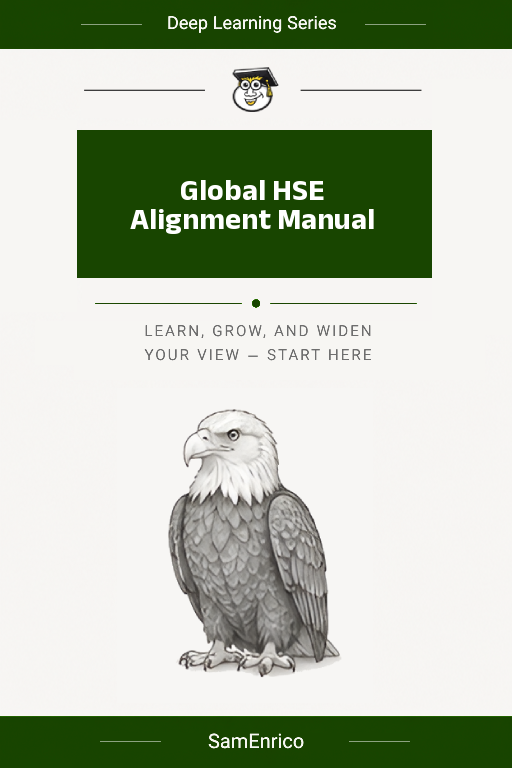
Non-FictionAnnual CheckupOSHA & GlobalGlobal Guide
Global HSE Alignment Manual eBook
Compare 2025 US OSHA updates with ISO 45001, UK HS
Compare 2025 US OSHA updates with ISO 45001, UK HSE, EU-OSHA, and ILO standards. Covers cross-border requirements for multinationals, reporting harmonization, and best practice frameworks.
Formats
Free sample
Chapter 1: The $47 Million Blindspot--–- The email arrived at 6:47 PM on a Friday, which is how you know it’s bad news. Good news arrives on Tuesday at 10:00 AM. Bad news arrives when the lawyers have had all week to build a file and want you to sit with it over the weekend.–- Alex Chen, Global HSE Director for a mid-sized industrial manufacturer with forty-seven facilities across fourteen countries, opened the email from the company’s German legal counsel. The subject line read: “Urgent – Enforcement Action – Hamburg Plant.”–- The fine was €3.2 million. Approximately $3.47 million USD at current exchange rates.
For a stress risk assessment that did not exist.–- Alex’s US plants had perfect OSHA logs. Zero willful violations in the past five years. The company’s ISO 45001 certificate was current and proudly displayed in every lobby. The Hamburg facility had passed its internal audit with flying colors just six months earlier. And yet, the German labor inspectorate had determined that the company had violated the German Occupational Safety and Health Act (Arbeitsschutzgesetz) by failing to conduct a mandatory risk assessment of psychosocial hazards — workloads, shift patterns, harassment risks, and job strain.–- The fine was not for a guard missing from a machine.
No one had fallen from a ladder. No chemical exposure had exceeded legal limits. The penalty was for not having paperwork that proved the company had asked its workers about stress.–- Alex’s first reaction was disbelief. Then anger. Then a cold, creeping realization that the problem was not the Hamburg plant.
The problem was the entire way the company thought about safety.–- This book is about that problem and how to solve it.The Three Frameworks That Don’t Speak to Each Other–- To understand why a company with perfect US compliance can be fined millions in Europe, you have to understand the fundamental differences between the three major frameworks that govern workplace safety for multinationals. They are not merely different versions of the same thing. They are different species of regulation, each evolved in a distinct legal and cultural environment.US OSHA (2025): The Selective Prescriptivist–- The Occupational Safety and Health Administration, created in 1970, operates under the Occupational Safety and Health Act. Its approach is best described as selectively prescriptive. On certain topics, OSHA tells you exactly what to do with micrometer precision.
On other topics — including some that other jurisdictions consider fundamental — OSHA is completely silent.–- Consider the 2025 updates that frame this book. The Hazard Communication Standard (HCS) now aligns with the tenth revision of the Globally Harmonized System (GHS). This is a rule about labels and safety data sheets. It tells you exactly what pictogram goes where, what font size to use, and what language must appear. Similarly, the Lockout/Tagout (LOTO) standard modernization specifies procedures for energy control with diagrams and step-by-step requirements.
The new Emergency Response rules, driven by wildfire and active shooter risks in the US, prescribe training frequencies and equipment requirements.–- This is OSHA at its most characteristic: detailed, engineering-focused, and backed by severe civil penalties. A single willful violation can exceed $150,000. Repeat violations multiply. Litigation risk is real and substantial.–- But here is what OSHA in 2025 does not require: any specific attention to psychosocial hazards (stress, workload, harassment), any mandated worker participation structure beyond a non-binding safety committee, and any systematic requirement for prevention through design (eliminating hazards at the design stage rather than guarding against them).–- This is not a criticism of OSHA’s approach; it is a description of its scope. OSHA was designed for a US legal and labor context.
It works well within that context. But when a US company expands to the EU, it must recognize that OSHA’s silence on certain topics is not permission to ignore those topics. Local law fills the gap.ISO 45001: The Management System Standard–- The International Organization for Standardization’s 45001 standard (first published 2018, replacing OHSAS 18001) is not a regulation at all. It is a voluntary management system standard. No one fines you for violating ISO 45001 because it has no legal force.
But many multinationals adopt it because customers require it, because it integrates with ISO 9001 (quality) and ISO 14001 (environmental), and because it provides a systematic framework for continuous improvement.–- ISO 45001 is built around the Plan-Do-Check-Act (PDCA) cycle. It asks questions about process rather than dictating prescriptions. Instead of “guard shall be 3/8 inch,” ISO 45001 asks: “Have you determined the effectiveness of your guards?” Instead of “maintain a log of all recordable injuries,” it asks: “Does your incident investigation process lead to corrective actions?”–- This difference is not merely semantic. An OSHA inspector will measure your guard with a caliper. An ISO auditor will ask to see your guard inspection records, your corrective action log, and evidence that a worker participated in the guard design review.
The auditor will not measure anything. The two standards ask completely different questions.–- The problem for multinationals is that ISO 45001 certification is often mistaken for compliance. Alex’s company had an ISO 45001 certificate. The Hamburg plant had passed its surveillance audit. But the ISO audit had not checked for compliance with German psychosocial risk assessment requirements because that is not what ISO 45001 audits do.
The auditor looked for evidence of a process, not compliance with a specific national legal obligation.EU-OSHA and the Social Pillar–- The European Agency for Safety and Health at Work (EU-OSHA) does not directly enforce laws; it sets frameworks through directives that member states implement into national law. The foundational directive is 89/391/EEC, the “Framework Directive” on occupational safety and health.–- This directive is philosophically different from OSHA in two fundamental ways. First, it mandates prevention through design — hazards must be eliminated at the source, not merely guarded against. Second, it requires worker participation as a legal right, not an advisory courtesy. Articles 10 and 11 explicitly require consultation and participation of workers in matters of safety and health.–- The German Arbeitsschutzgesetz (Occupational Safety and Health Act), which is the German implementation of 89/391/EEC, requires employers to conduct a “Gefährdungsbeurteilung” — a risk assessment — that explicitly includes psychosocial hazards.
The assessment must consider workloads, shift patterns, harassment risks, and job strain. And it must be conducted with the participation of the works council, a legally separate worker representation body with co-determination rights.–- Alex’s company had not conducted such an assessment. The ISO 45001-certified risk assessment covered physical hazards: chemical exposure, machine guarding, fall protection. It did not cover the fact that the Hamburg plant’s shift schedule had workers rotating every three days, a pattern that occupational health research has linked to increased fatigue and stress. The works council had not been consulted because the company’s US-based HSE team did not know that consultation was a legal requirement.–- The €3.2 million fine was not for failing ISO 45001.
It was for violating German law. But the ISO certificate made it worse: the court noted that the company had claimed to have a participatory management system, yet had never actually participated with workers on the legally required topics.The Failure of the Lowest Common Denominator–- Many multinationals, when faced with the complexity of…
This is the end of the free sample. Get the eBook to keep going. Buy now
About this book
Details
- Author
- Marlowe Miguelina
- Publisher
- SamEnrico
- Language
- English
- Genre
- Non-Fiction, Annual Checkup, OSHA & Global, Global Guide
- Released
- 2026-05-29
- Pages (approx.)
- 156
- Available as
- eBook, Audiobook

Read better in the ZLOADR app
Your eBooks on your phone or tablet. Sign in with your SamEnrico account and start reading.
More by Marlowe Miguelina
 Operation Car Wash Forensic AccountingMarlowe Miguelina$11.99
 Filmbooth Localized Video GuideMarlowe Miguelina$11.99
 Cocaine Family Intervention GuideMarlowe Miguelina$11.99
 OKRs for Retirement PreparationMarlowe Miguelina$11.99
 The Recovery Friendly Employer HandbookMarlowe Miguelina$11.99
 The Asura's Last Stand: Ravana's Fall from GraceMarlowe Miguelina$11.99
 Steatite (Talc) MiningMarlowe Miguelina$11.99
 Mycoprotein Production GuideMarlowe Miguelina$12.99
 Ultimate Handbook Guide to Tskhinvali : (South Ossetia) Travel GuideMarlowe Miguelina$11.99
 Understanding Imaizumi–kuroki SyndromeMarlowe Miguelina$17.99
You may also like
 Hong Kong Handover 1997Dunn Johnnie$11.99
 Zumba For Postnatal Recovery CourseNeal Christian$11.99
 Zumba for BeginnersLadner Nikia$11.99
 YouTube Comment Mining GuideHumes Pandora$12.99
 Worry Box MeditationCarlin Rudy$11.99
 Workplace Stress MeditationNguyen Lynn$11.99
 Workplace Stress and Sleep RepairHawley Ivory$11.99
 Workplace Perfectionism CureDelaney Jeffry$11.99
 Workplace Injustice Anger GuideWallen Isabelle$11.99
 Work Addiction and Burnout LinkGreenwood Ester$11.99
 Women in Yoga and WellnessBeattie Galina$11.99
 Women in Stand Up ComedyChun Evangeline$11.99