
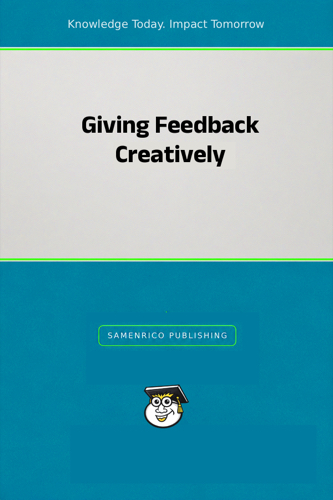
Giving Feedback Creatively eBook
Critique ideas not people constructively.
Critique ideas not people constructively.
Formats
Free sample
Chapter 1: The Identity Trap--–- Sarah had just spent eleven days on a pitch deck. Not full days—she had a toddler at home—but late nights after bedtime, early mornings before daycare, and every stolen hour on weekends. The deck was beautiful. The research was immaculate. She had interviewed seven customers, run two rounds of user testing, and aligned every slide with the client's stated objectives.Her manager, Derek, walked into the conference room, flipped to page four without reading page one, and said, "This feels off.
I don't like the orange."Sarah felt something collapse in her chest. Not because the orange mattered—it was a tertiary accent color on three of forty-two slides. She felt it because eleven days of her life had just been reduced to a gut reaction about a color. She didn't hear "I don't like the orange." She heard "I don't trust you. I don't see your effort.
You are wrong."She didn't say anything. She nodded, wrote "fix orange" in her notebook, and spent the next three hours silently resentful. That night, she cried in the shower. The next morning, she updated her resume.Derek never knew any of this happened. He thought he was giving feedback.The Problem That No One Talks About This is not a book about how to give better feedback because feedback is "nice" or "productive" or "what good managers do." This is a book about how to give better feedback because the way most people give feedback right now is quietly destroying teams, killing creativity, and driving talented people out of organizations.The data is staggering.
A Gallup study of over seven thousand managers found that only twenty-six percent of employees strongly agree that the feedback they receive improves their work. The other seventy-four percent either ignore feedback, resent it, or actively disengage. But here is the more disturbing finding: when researchers asked those same managers how they thought their feedback landed, eighty percent said "well" or "very well."There is a hole in the universe between what feedback givers think they are doing and what feedback receivers actually experience. That hole is the subject of this book.And it starts with a single psychological trap that explains almost every failed feedback conversation you have ever had or witnessed.The Identity Trap Defined Here is the trap: human beings do not distinguish between their ideas and themselves.When you say "this idea is weak," a rational computer would process that as a statement about an artifact. A human brain processes it as "I am weak." When you say "this section is confusing," the creator hears "I am confusing." When you say "you should have done this differently," the creator hears "I should have been different."This is not weakness or oversensitivity.
This is how the human brain is wired.Neuroscience research using functional MRI scans shows that social rejection—including criticism of one's work—activates the same neural regions as physical pain. The anterior cingulate cortex, the insula, and the dorsal anterior cingulate all light up whether you are being punched in the arm or told that your presentation "missed the mark." Your brain literally cannot tell the difference between a threat to your body and a threat to your idea.This is called ego-threat response, and it evolved for good reason. In tribal human history, being rejected by the group meant death. Social standing was survival. So your brain developed an early-warning system: any attack on your output is a potential attack on your belonging, and any attack on your belonging is a potential attack on your life.That system never got the memo that you are now sitting in a conference room reviewing a spreadsheet.The Identity Trap, then, is the automatic, unconscious conflation of what you make with who you are.
Every feedback conversation is therefore not a conversation about work. It is, neurologically, a conversation about survival.Taste Versus Value If the Identity Trap is the disease, the distinction between taste and value is the first step toward the cure.Taste is subjective, emotional, personal, and unactionable. "I like blue." "This feels fun." "It needs more energy." "I don't know—it just doesn't sing to me." Taste statements are about the receiver's internal state. They reveal nothing about the work and everything about the person speaking. They are also, for the purposes of creative feedback, almost completely useless.Value is objective, measurable, shared, and actionable.
"This design serves the goal of increasing click-through rate by fifteen percent." "This paragraph contradicts the claim made in section two." "This user flow takes an average of forty-seven seconds, but our target is thirty seconds or less." Value statements are about the work's relationship to a goal. They can be debated, measured, and improved.Here is the radical claim of this book: Taste should never appear in feedback. Ever. Not in small doses. Not as a "soft opener." Not as an honest opinion shared among friends.
Taste is the Trojan horse of the Identity Trap. The moment you say "I like" or "I don't like" or "this feels off" or "this is great," you have made the conversation about you, not about the work. And once the conversation is about you, the receiver's brain has no choice but to defend against you.The designer who hears "I don't like the orange" cannot improve the orange. They can only wonder why you don't like orange. Is it personal?
Do you have something against warm colors? Are you generally displeased with them? Is this about the orange or about their entire approach? The question has no answer because the feedback has no objective anchor.The Translation Principle This does not mean gut reactions are worthless. Gut reactions are data.
They are just raw, unprocessed data. Your job as a feedback giver is to translate your reaction from taste to value.Translation is the act of asking yourself: "What about the objective does my reaction point to?"Let us walk through the example from the opening of this chapter. Derek said, "This feels off. I don't like the orange." Derek had a genuine reaction. He was not lying.
Something about the deck bothered him. But he stopped at the reaction. He never asked himself the translation question.What if he had?Reaction: "This feels off."Translation question: "What objective is being violated?"Possible answer: "The client said their brand is 'trustworthy and conservative.' The orange is playful and energetic. It might contradict the brand alignment objective."Translated feedback: "I am concerned that the orange contradicts the client's stated brand of 'trustworthy and conservative.' Can we test this against their brand guidelines?"Suddenly, the feedback is actionable. Sarah can do something with it.
She can pull the brand guidelines. She can test the orange against them. She can argue that the client's product is actually for children, so playful is appropriate. The conversation becomes a collaborative investigation rather than a defense of her worth.The Translation Principle, which will appear throughout this book, is this: Every reaction is a question in disguise. Your job is to find the question."This is confusing" translates to "What was the primary task the…
This is the end of the free sample. Get the eBook to keep going. Buy now
About this book
Details
- Author
- Briscoe Devon
- Publisher
- SamEnrico
- Language
- English
- Genre
- Non-Fiction, Self-Help, Feedback
- Released
- 2026-06-09
- Pages (approx.)
- 145
- Available as
- eBook, Audiobook

Read better in the ZLOADR app
Your eBooks on your phone or tablet. Sign in with your SamEnrico account and start reading.
More by Briscoe Devon
 Pandemic Job Loss RecoveryBriscoe Devon$11.99
 Self Hypnosis for Crohn's PainBriscoe Devon$11.99
 Gratitude Journal CourseBriscoe Devon$11.99
 X2 Short Term Visa ProcessBriscoe Devon$11.99
 Self Esteem for Nonprofit WorkersBriscoe Devon$11.99
 Chicago Velma And RoxieBriscoe Devon$11.99
 Design Thinking for DataBriscoe Devon$11.99
 The Last Stand at Dien Bien Phu: How a Jungle Fortress FellBriscoe Devon$11.99
 The Great Unraveling: How a 19th-Century Political Scandal Split a NationBriscoe Devon$11.99
 How to Produce Origami PaperBriscoe Devon$11.99
 How to Produce Collectible GunsBriscoe Devon$11.99
 African Wild Dogs: Painted WolfBriscoe Devon$11.99
You may also like
 Hong Kong Handover 1997Dunn Johnnie$11.99
 Zumba For Postnatal Recovery CourseNeal Christian$11.99
 Zumba for BeginnersLadner Nikia$11.99
 YouTube Comment Mining GuideHumes Pandora$12.99
 Worry Box MeditationCarlin Rudy$11.99
 Workplace Stress MeditationNguyen Lynn$11.99
 Workplace Stress and Sleep RepairHawley Ivory$11.99
 Workplace Perfectionism CureDelaney Jeffry$11.99
 Workplace Injustice Anger GuideWallen Isabelle$11.99
 Work Addiction and Burnout LinkGreenwood Ester$11.99
 Women in Yoga and WellnessBeattie Galina$11.99
 Women in Stand Up ComedyChun Evangeline$11.99