
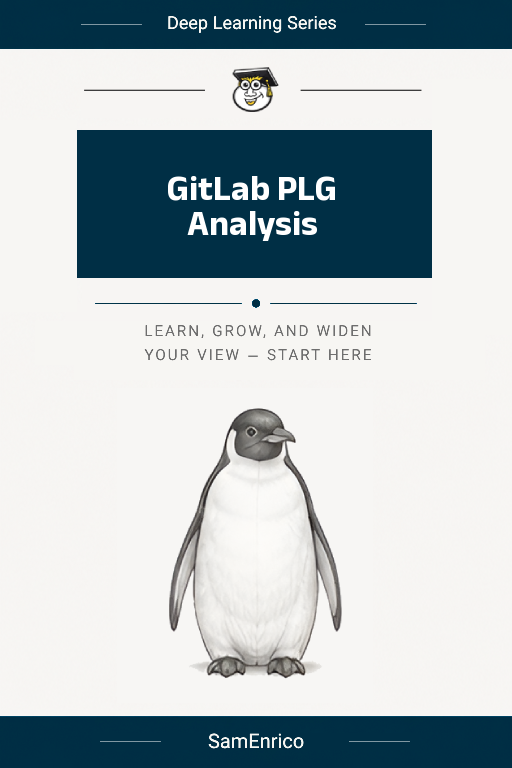
GitLab PLG Analysis eBook
Explore open-core model, self-hosted trial, and de
Explore open-core model, self-hosted trial, and developer-led adoption with sales for enterprise GitOps.
Formats
Free sample
Chapter 1: The Trinity Engine--–- In the summer of 2015, a single developer in Ukraine submitted a merge request that would inadvertently reveal why Git Lab would eventually conquer a market that Git Hub owned. The request was simple: fix a bug in the CI/CD runner. But what made it remarkable was that this developer had never spoken to a Git Lab salesperson, had never filled out a lead form, and was not even a paying customer. He was a user of the free, self-hosted version who had found a problem, fixed it, and contributed it back. Within forty-eight hours, his code was running on thousands of other self-hosted instances around the world.This moment, invisible to almost everyone outside the Dev Ops world, represented the three forces that would power Git Lab's improbable rise.
The developer was acquired through open core — the free source code was his entry point. He was activated through product-led growth — the product itself showed him where the bug was. And his contribution expanded the platform's capabilities for everyone through Git Ops — infrastructure as code, merged and deployed automatically. This is the Trinity Engine.Most business books about software growth focus on a single mechanism. Viral loops.
Freemium conversions. Enterprise sales playbooks. But Git Lab did something none of its competitors could replicate: it ran all three engines simultaneously, each feeding the others, creating a growth flywheel that turned individual developers into enterprise revenue without ever feeling like a sales process.This chapter lays the foundation for everything that follows. If you understand the Trinity Engine, you understand why Git Lab beat Git Hub, why self-hosted trials outperform cloud trials for enterprise software, and why your own product-led growth strategy might be missing two-thirds of the equation. By the end of this chapter, you will have a mental model for distinguishing between acquisition, activation, and expansion — and you will know which of your current growth investments are actually working.The Three Engines Defined Let us start with clear definitions.
The Trinity Engine consists of three distinct but interlocking growth mechanisms, each responsible for a different phase of the customer journey. Think of them as gears of different sizes: turn one, and all three move. But if one gear is missing, the machine jams.Engine One: Open Core — The Acquisition Engine Open core means that the fundamental, usable, production-ready version of the software is open source. Anyone can download it, install it, run it, and modify it without paying a cent. This is not a trial with a fourteen-day expiration.
This is not a community edition that is missing critical functionality. This is the real product, capable of running a company's entire software development lifecycle.Git Lab's open core includes source code management, issue tracking, merge requests (their version of pull requests), basic CI/CD pipelines, container registry, and wiki documentation. A team of five developers could use Git Lab for years without ever hitting a paywall or seeing a "please upgrade" nag screen. This is not an accident. This is a deliberate strategy.The acquisition engine works because developers trust what they can inspect, modify, and control.
When a developer downloads Git Lab and installs it on their own server, they are not evaluating a product. They are adopting a tool. The psychological shift is profound: evaluation implies temporary usage with a likely endpoint. Adoption implies permanence. Open core turns every user into a long-term owner before they have paid a single dollar.Consider the alternative.
If Git Lab had offered only a cloud version with a fourteen-day trial, a developer evaluating it would know from day one that the clock was ticking. They would hold back from full adoption, waiting to see if the company would approve a budget. They would never contribute code because why invest time in a platform you might lose access to? Open core removes these mental barriers entirely.Engine Two: Product-Led Growth — The Activation Engine Product-led growth means that the product itself — not salespeople, not marketing campaigns, not channel partners — drives user acquisition, activation, and expansion. In a pure PLG model, the first time a human talks to a customer is after that customer has already experienced value.Git Lab's PLG activation is built around a single metric: time to first successful pipeline.
Everything in the product is optimized to reduce this time. Auto Dev Ops detects your programming language and generates a CI configuration automatically. The web IDE lets you edit code without leaving the browser. Merge request approval rules are pre-configured with sensible defaults.The genius of Git Lab's PLG is that it does not try to replace sales. It prepares the ground for sales.
By the time a platform engineer is managing fifty users and ten thousand CI minutes per month, they have already experienced the product's value deeply. They have also experienced its operational burden. The PLG engine makes sure that when a salesperson does reach out, the customer is already convinced of the product's worth and acutely aware of its limitations.This stands in stark contrast to traditional enterprise software, where a salesperson reaches out before the customer has used the product at all. The conversation there is abstract: "Our software can help you with compliance." The Git Lab conversation is concrete: "We noticed you have been running two thousand CI minutes per week and you tried to enable epics. Let us show you how to make that pain go away."Engine Three: Git Ops and Dev Ops — The Expansion Engine Git Ops is a specific approach to infrastructure management where all configuration is stored as code in Git, and changes are applied automatically through merge requests.
Dev Ops is the broader cultural and technical movement to unify software development and operations. Together, they form the expansion engine because they create platform lock-in through value, not through contracts.Why is this an expansion engine? Because once an organization adopts Git Lab for code hosting and CI/CD, the natural next step is to adopt it for everything else. Security scanning. Compliance monitoring.
Package management. Deployment. Feature flags. Incident management. Each new adoption deepens the customer's dependency on Git Lab and increases their willingness to pay for enterprise features.The expansion engine turns a ten-thousand-dollar deal into a hundred-thousand-dollar deal over eighteen months.
It turns a team of ten developers into a company-wide standard. It creates the land-and-expand motion that venture capitalists love because the marginal cost of selling the fifth product to an existing customer is near zero while the revenue is pure increment.Consider the economics. Acquiring a new customer costs five to ten times more than expanding an existing one. Yet most companies focus their growth efforts on acquisition. Git Lab inverted this logic: they made acquisition nearly free (open core downloads cost nothing to distribute) and invested heavily in the product features that drive expansion (security scanning, compliance monitoring, deployment automation).The Interlock The Trinity Engine is not three separate strategies run in parallel.
It is three strategies woven together so tightly that competitors cannot copy one without copying all three. Open core feeds PLG because users who adopt the product deeply are more likely to experience the pain that leads…
This is the end of the free sample. Get the eBook to keep going. Buy now
About this book
Details
- Author
- Meadows Lazaro
- Publisher
- SamEnrico
- Language
- English
- Genre
- Non-Fiction, Strategic Atlas, GTM Strategy
- Released
- 2026-06-01
- Pages (approx.)
- 152
- Available as
- eBook, Audiobook

Read better in the ZLOADR app
Your eBooks on your phone or tablet. Sign in with your SamEnrico account and start reading.
More by Meadows Lazaro
 Nobel Laureates in PhotonicsMeadows Lazaro$11.99
 Gossip And Rumors Anger Management CourseMeadows Lazaro$11.99
 Utility Bill Stress FixMeadows Lazaro$11.99
 The Letting Go of Resentment WorkbookMeadows Lazaro$11.99
 Kelly Ripa Live Wire EnergyMeadows Lazaro$11.99
 The Velvet Revolution: How David Bowie and Roxy Music Redefined European Fashion (1970-1980)Meadows Lazaro$11.99
 Understanding Quebec Platelet DisorderMeadows Lazaro$17.99
 Gift Sales OutfitterMeadows Lazaro$11.99
 M-Pesa Export Payments GuideMeadows Lazaro$12.99
 How to Start a Percolator (electric) Business (Beginners Guide)Meadows Lazaro$11.99
You may also like
 Zoom PLG Analysis GuideBlunt Lesia$12.99
 Twilio PLG GuideHiggs Caroyln$12.99
 Snowflake PLG to SalesHerrmann Kassie$12.99
 Slack PLG Motion GuideEaves Tommye$12.99
 Shopify PLG GuideMast Jimmie$12.99
 ServiceNow Hybrid GuideConnell Waltraud$12.99
 Salesforce Sales-Led GuideSpaulding Elly$12.99
 Qualtrics Sales-Led GuideCorrea Malik$12.99
 Oracle Sales-Led GuideBlanco Verline$12.99
 Monday.com GuidePrater Hai$12.99
 HubSpot GTM Hybrid GuideHatchett Lahoma$12.99
 Cloudflare PLG GuideSawyers Onie$12.99