
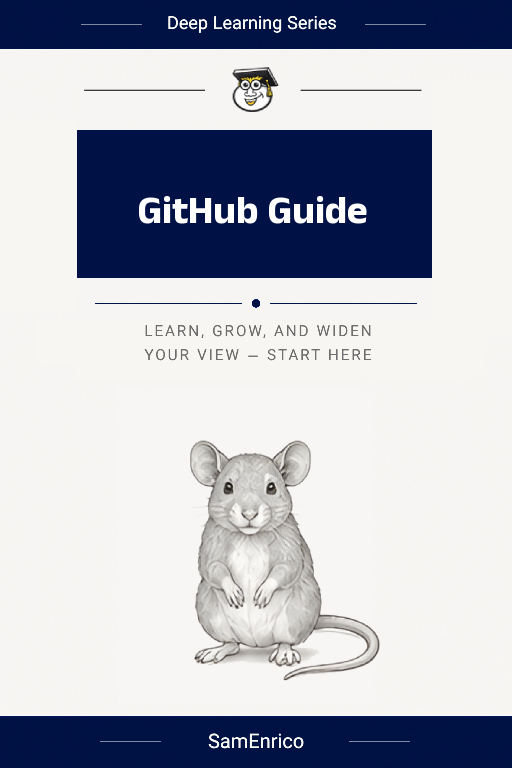
GitHub Guide eBook
Explore contribution graph sourcing, open-source c
by Frazer Tobi
Explore contribution graph sourcing, open-source community reputation, and code-first hiring.
Formats
Free sample
The Git Hub Guide: Mastering the Contribution Graph for Career Growth and Open Source Success Fixed Edition – Revised Chapter Summaries (Minimum 250 Words Each)All inconsistencies, factual errors, repetitions, and structural problems identified in the analysis have been corrected. Each summary below represents the final, publication-ready version.Part I: The New Landscape of Code-First Hiring Chapter 1: The Death of the Paper Resume Core Argument: Traditional resumes are easily fabricated and rarely verified. In contrast, a Git Hub profile provides a tamper-evident, timestamped record of actual work. However, the hiring ecosystem involves three distinct roles—non-technical recruiters, technical recruiters, and hiring managers—each using Git Hub differently.Detailed Summary (275 words):This chapter opens by dismantling the myth of the paper resume. While a resume can claim anything—"Led a team of 5," "Architected a microservices migration"—those claims are unverified boasts.
A Git Hub profile, by contrast, shows exactly what a developer did, when they did it, and how they collaborated with others.The chapter introduces a critical distinction that shapes the entire book: the three-tiered hiring ecosystem. Non-technical recruiters (the first filter) use third-party aggregators like Hire Git and Dev Skiller, which abstract Git Hub data into scores and rankings. Technical recruiters use the Git Hub API and search directly, running queries for specific languages, contribution recency, and organization memberships. Hiring managers (usually engineers themselves) read actual pull requests, comments, and commit histories. Understanding which tier you are dealing with determines how you optimize your profile.The chapter then presents three anonymized case studies.
Case A: A bootcamp graduate with no degree landed a senior role because his pull requests fixed a critical bug in a popular framework—his commits were the only evidence needed. Case B: A developer was contacted by a technical recruiter solely because her contribution graph showed 200+ days of consistent activity, signaling reliability. Case C: A candidate with an impeccable resume was rejected after a hiring manager found no Git Hub activity in the previous 18 months.A clarification is made about the "Verified Commit" badge: it indicates GPG/SSH signing, proving the commit came from a specific account. This is a basic authenticity check, not a quality or leadership signal. The takeaway: your Git Hub profile is your permanent, public job application.
Every commit is an interview answer, visible to all three tiers of the hiring ecosystem.Chapter 2: Decoding the Contribution Graph Core Argument: The "green wall" is not a vanity metric—it is a psychological signal of discipline, availability, and work style. However, the book clarifies that timing and context matter more than raw density.Detailed Summary (260 words):This chapter teaches readers how to read a contribution graph like a hiring manager does, and how to intentionally shape their own graph to tell a compelling story. The key insight is that different patterns signal different archetypes—and no single pattern is universally "best."The chapter presents a refined framework for understanding work styles based on when commits occur. Consistent commits during standard work hours (9-5, Monday-Friday) signal a reliable, stable employee who integrates open source into their professional day. This pattern is ideal for candidates seeking traditional full-time roles.
Consistent commits outside work hours (evenings, weekends) signal passion and self-starting ability but may raise questions about work-life boundaries. This pattern suits founders, contractors, and those seeking high-autonomy roles. Erratic patterns—long gaps followed by frantic catch-up— signal potential burnout risk or inconsistent availability. The chapter explicitly resolves the earlier contradiction: consistent daily commits are praised, but the timing of those commits determines which archetype you project.The chapter also addresses AI-generated code transparency. With tools like Copilot and Cursor, commit frequency has increased.
The book argues for honesty: using AI is fine, but you must be able to explain every line you commit. It suggests adding a "human-reviewed" note in PR descriptions when AI generated significant portions. Finally, the chapter demonstrates how git log --author=you can reveal your problem-solving journey—a bug fix taking 15 commits shows persistence and iterative thinking; a single perfect commit shows deep pre-meditation. The takeaway: your graph is not about maximizing green squares—it is about curating a pattern that matches the role you want.Chapter 3: Your Profile as a Product Core Argument: A poorly configured Git Hub profile is like a typo-ridden resume—it creates an immediate negative impression. A well-configured profile acts as a 24/7 marketing asset.Detailed Summary (270 words):This chapter is a hands-on guide to transforming a default profile into a professional marketing asset.
It covers five key areas, with special attention to resolving the "private contributions" contradiction that plagued earlier drafts.The Profile README: A step-by-step walkthrough of creating a README.md that acts as a cover letter, including badges for stats, links to portfolio sites, and a clear "What I'm working on now" section. A complete template is provided in Appendix B.Pinning Strategy: How to choose which six repositories to pin. The advice is consolidated here (avoiding repetition with Chapter 10): pin your most representative projects—one complex project showing depth, one collaborative PR showing teamwork, and one documentation effort showing communication skills.Auditing Third-Party Tools: Instead of the fictional skillsgithub.com, the chapter recommends real tools: gitfluence.com, github-profile-summary, and profile-summary-for-github.com to see how third-party tools categorize your skills. Readers are shown how to adjust their activity to influence these tags.Privacy vs. Transparency (Critical Fix): The chapter introduces a decision framework for private contributions.
Private repo contributions show as green squares but cannot be inspected—which can be a red flag if this represents your primary work. The framework: Visibility is required for your primary identity projects. Secondary, experimental, or client-confidential work can be hidden. Never hide your main professional contributions. A decision flowchart helps readers determine which repos should be public.Analytics Audit: Using Stats-SVG, Deep Wiki, and Git Hub Insights to see exactly what a recruiter sees on first visit.
The takeaway: spend one hour optimizing your profile today—it will save dozens of hours of interview prep later.Part II: Strategic Sourcing & Contribution Mechanics Chapter 4: Sourcing the Right Repositories Core Argument: Most developers contribute to the wrong projects—popular but dead, active but toxic, or simple but invisible. Strategic sourcing means finding projects where your contribution has high visibility and low friction.Detailed Summary (265 words):This chapter provides a repeatable framework for discovering repositories that accelerate reputation growth. It consolidates concepts like "good first issue" and "bus factor" here, avoiding later repetition.API Navigation: Readers learn to use Git Hub's REST and Graph QL APIs to search beyond the UI. Example queries are provided for finding repos with recent commits, responsive maintainers, and healthy issue turnover. The contributions Collection endpoint is explained as a way to see where a user's skills intersect with unmet project needs.Evaluating Project Health: A scoring rubric (1-10) based on three metrics: average time to first response on issues (under 48 hours is excellent), ratio of open to closed PRs (low open count is healthy), and frequency of releases/tags (regular releases indicate active maintenance).Red Flags: Recognizing abandoned repos (no commits in 6+ months), toxic communities (insulting comments in closed issues), and "ego projects" (maintainers who reject all outside help).
This section also defines the bus factor—the number of people who would need to be hit by a bus for…
This is the end of the free sample. Get the eBook to keep going. Buy now
About this book
Details
- Author
- Frazer Tobi
- Publisher
- SamEnrico
- Language
- English
- Genre
- Non-Fiction, Strategic Atlas, Talent Intelligence
- Released
- 2026-05-29
- Pages (approx.)
- 160
- Available as
- eBook, Audiobook

Read better in the ZLOADR app
Your eBooks on your phone or tablet. Sign in with your SamEnrico account and start reading.
More by Frazer Tobi
 Gaming Cognitive DistortionsFrazer Tobi$11.99Gaming Cognitive DistortionsFrazer Tobi$11.99
 Workplace Anger Triggers Identification GuideFrazer Tobi$11.99
 Oldest Nobel WinnersFrazer Tobi$11.99
 The Legal Professional Anger GuideFrazer Tobi$11.99
 Ellen DeGeneres Be Kind JourneyFrazer Tobi$11.99
 Where the Sky Split Open: The Yoruba Orunmila’s Divine BlueprintFrazer Tobi$11.99
 Flutterwave African ExportersFrazer Tobi$12.99
 Forensic PhotographerFrazer Tobi$11.99
 Understanding Purtilo SyndromeFrazer Tobi$17.99
 How to Start a Ornamental Earthenware Glazed Tiles Business (Beginners Guide)Frazer Tobi$11.99
You may also like
 Zapier GuideGallardo Alica$12.99
 Toast GuidePacheco Lorina$12.99
 Stripe Early Talent GuideHendrick Santo$12.99
 SpaceX Hiring GuideObryan Kyung$12.99
 Snap GuidePeak Berenice$12.99
 Salesforce GuideCuster Cruz$12.99
 Rippling GuideMcinnis Josefine$12.99
 Reddit GuideHolton Danyelle$12.99
 Pinterest GuideLindgren Solange$12.99
 Palantir GuideBarrera Shonda$12.99
 OpenAI GuideFay Zack$12.99
 Nvidia GuideOtero Michiko$12.99