
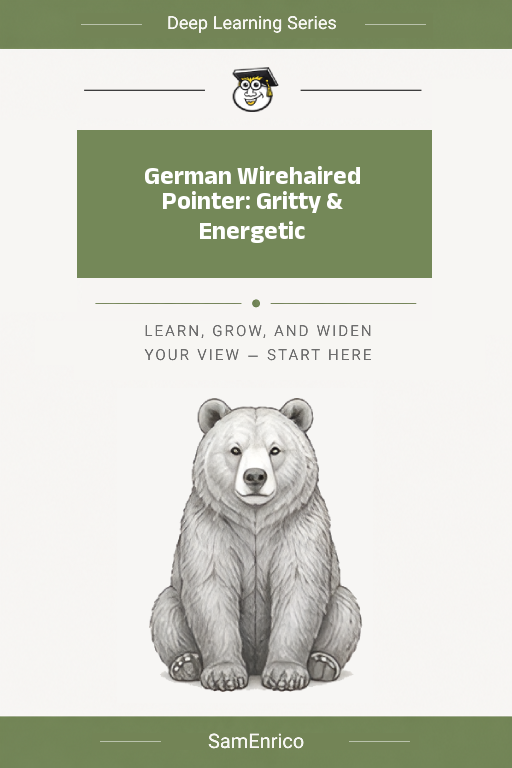
German Wirehaired Pointer: Gritty & Energetic eBook
This publication, published by SamEnrico, covers G
This publication, published by SamEnrico, covers German Wirehaired Pointer: Gritty & Energetic
Formats
Free sample
Chapter 1: The Drahthaar Blueprint...--–- The German Wirehaired Pointer did not emerge from a vanity project or a show ring whim. It was forged in the late nineteenth century on the hunting estates of unified Germany, where a growing class of professional foresters and serious sportsmen demanded a single dog that could point, track, retrieve from icy water, blood-trail wounded game, and still lie quietly by the hearth at night. To understand the GWP—its grit, its energy, its maddening independence and its heartbreaking loyalty—you must first understand the blueprint from which it was struck.The Hunting Crisis That Created a Breed In the mid-1800s, the German hunting landscape was fragmented and inefficient. A typical wealthy hunter maintained separate packs: pointers for upland birds, setters for woodland game, retrievers for waterfowl, and hounds for tracking deer and boar. This was expensive, required multiple kennels, and demanded several handlers.
The average forester or middle-class hunter could not afford such a menagerie. Moreover, German hunting culture emphasized the Jagdgebrauchshund—a working hunting dog tested on its ability, not its pedigree. Form followed function, and function demanded versatility.German hunters of the era faced punishing conditions: dense black forests, frozen lakes, brambles that shredded soft coats, and game that ranged from wary pheasants to wounded boar capable of injuring a dog. A hunting dog needed a coat that repelled water and thorns, a nose sensitive enough to scent roe deer at two hundred paces, a pointing instinct steady enough to hold birds until the hunter arrived, a tracking drive persistent enough to follow a two-hour-old blood trail, and a water drive enthusiastic enough to plunge into December rivers. No existing breed checked all these boxes.The German Shorthaired Pointer excelled at pointing and retrieving on land but lacked coat protection for cold water and thick cover.
The Pudel (the old German water dog, ancestor of today's Poodle) was a magnificent swimmer with a dense, water-repellent coat, but its pointing instinct was unreliable. The Wirehaired Pointing Griffon offered a harsh coat and good nose but often lacked the speed and drive German hunters wanted. The Stichelhaar—a coarse-coated pointing dog now rare—had the coat and grit but could be stubborn and difficult to train.What hunters needed was a synthesis. And synthesis requires vision.Hegewald's Philosophy: Performance First The visionary behind the German Wirehaired Pointer was Freiherr Sigismund von Zedlitz und Neukirch, known in hunting circles as "Hegewald." Born into Prussian nobility in 1838, von Zedlitz was a career forester and an obsessive hunter. He kept detailed records of his dogs' performance, tracking which individuals pointed most reliably, which swam with greatest enthusiasm, which tracked blood trails with most precision, and which produced offspring that inherited these traits.In the 1870s, von Zedlitz began publishing his philosophy in German hunting journals.
His slogan—"Durch Leistung zum Typ" (Through performance to type)—was revolutionary. The prevailing approach to dog breeding in Europe was typological: breed for a specific appearance, and working ability would follow. Von Zedlitz inverted this. Breed for working ability, he argued, and the correct appearance will emerge naturally. A dog that hunts well will look like a hunting dog.
Form follows function.This philosophy angered traditional breeders who had spent generations perfecting head shapes and tail carriages. But it resonated with practical hunters who judged dogs by results, not ribbons. Von Zedlitz began crossing German Shorthaired Pointers with the old German Pudel, producing puppies with harsher coats and stronger water drive. He then introduced Wirehaired Pointing Griffon blood to improve coat texture and tracking ability, and Stichelhaar blood to add grit, stamina, and weather resistance. The result was a prototype: a dog with the Shorthair's pointing instinct, the Pudel's water enthusiasm, the Griffon's nose, and the Stichelhaar's toughness.Von Zedlitz did not work alone.
He corresponded with breeders across Germany, exchanging stud dogs and performance data. His notebooks, preserved in German hunting archives, reveal a man obsessed with detail: "Schmidt's Rolf pointed eight of nine pheasants, retrieved all, refused water entry twice. Not acceptable. Breeds only if water entry improves." This was not sentimentality; it was selection. And selection built a breed.The Ancestral Quartet The German Wirehaired Pointer is not a random mixture.
Four foundation breeds contributed specific, essential traits. Understanding each reveals the genetic architecture beneath the wiry coat.The German Shorthaired Pointer (DK)The Shorthair provided the pointing instinct and the elegant, ground-covering gait that defines the GWP on the hunt. From the Shorthair came the intense bird drive—the focused, almost trance-like state when scenting game—and the trainable biddability that makes the GWP responsive despite its independent streak. The Shorthair also contributed the breed's moderate size and athletic build. However, the Shorthair's coat was inadequate for German winters and water work.
Breeders wanted the Shorthair's brain and drive wrapped in a tougher package.The Pudel (Old German Water Dog)Not to be confused with the modern French Poodle, the old German Pudel was a rugged, medium-sized water dog with a dense, corded or curly coat that shed water like a duck's back. From the Pudel came the GWP's love of water—not tolerance, but enthusiastic, joyful immersion regardless of temperature. The Pudel contributed the breed's coat density and weather resistance, as well as a degree of intelligence and problem-solving ability. Some breed historians argue the Pudel also gave the GWP its signature facial furnishings: the bushy eyebrows that deflect debris and the dense beard that protects the mouth from brambles and cold water.The Wirehaired Pointing Griffon (Korthals Griffon)Developed in the Netherlands and France by Eduard Korthals, the Griffon brought a harsh, wiry coat and exceptional tracking ability. Unlike many pointing breeds that focus primarily on birds, the Griffon tracked fur equally well—deer, boar, hare.
This fur-and-feather versatility was essential for the German concept of the all-purpose hunting dog. However, early Griffons were often slower and less energetic than German hunters wanted. Breeders selected Griffon crosses that maintained coat quality and nose sensitivity while improving ground speed and drive.The Stichelhaar (Rough-Coated Pointer)Now a rare breed found only in Germany, the Stichelhaar was a coarse-coated pointing dog from northern Germany. Its name roughly translates to "bristle hair," reflecting an almost bristly coat texture. From the Stichelhaar came extreme weather resistance, stubborn work ethic, and a certain rugged independence bordering on obstinacy.
The Stichelhaar also reinforced the breed's protective instincts—the tendency to be reserved with strangers and alert to threats. When blended with the other three ancestors, the Stichelhaar's harshness was moderated into the GWP's ideal wiry texture: dense enough to repel water and thorns, but not so stiff as to be uncomfortable or difficult to groom.This ancestral quartet produced a dog greater than the sum of its parts. The Shorthair contributed drive and trainability. The Pudel contributed water enthusiasm and coat density. The Griffon contributed nose sensitivity and tracking persistence.
The Stichelhaar contributed grit and weather resistance. Each flaw in one ancestor was compensated by a strength in another. This is the blueprint.The Verein Deutsch-Drahthaar (VDD): Institutionalizing Excellence By the 1890s, scattered breeders across Germany were producing wirehaired versatile hunting dogs, but without standardization. Some lines excelled at water…
This is the end of the free sample. Get the eBook to keep going. Buy now
About this book
Details
- Author
- Parent Delana
- Publisher
- SamEnrico
- Language
- English
- Genre
- Non-Fiction, Informative, Educational
- Released
- 2026-05-11
- Pages (approx.)
- 155
- Available as
- eBook, Audiobook

Read better in the ZLOADR app
Your eBooks on your phone or tablet. Sign in with your SamEnrico account and start reading.
More by Parent Delana
 Digital Minimalism ApproachParent Delana$11.99
 Natural Fiber Crime ForensicsParent Delana$11.99
 Karate Self Hypnosis GuideParent Delana$11.99
 The Chromium GuideParent Delana$11.99
 Workaholic Social Life GuideParent Delana$11.99
 Nigeria Independence 1960Parent Delana$11.99
 Loperamide GuideParent Delana$11.99
 Language Learning With SRSParent Delana$11.99
 The Quiet Architect: How Jack Dyer Built a Rugby Dynasty in Melbourne's ShadowParent Delana$11.99
 The Vanishing Express: Africa's Greatest Train Heist and the Men Who DisappearedParent Delana$11.99
 How to Produce Saxophone SwabsParent Delana$11.99
 A Collector's Handbook to the Austin A110 WestminsterParent Delana$11.99